
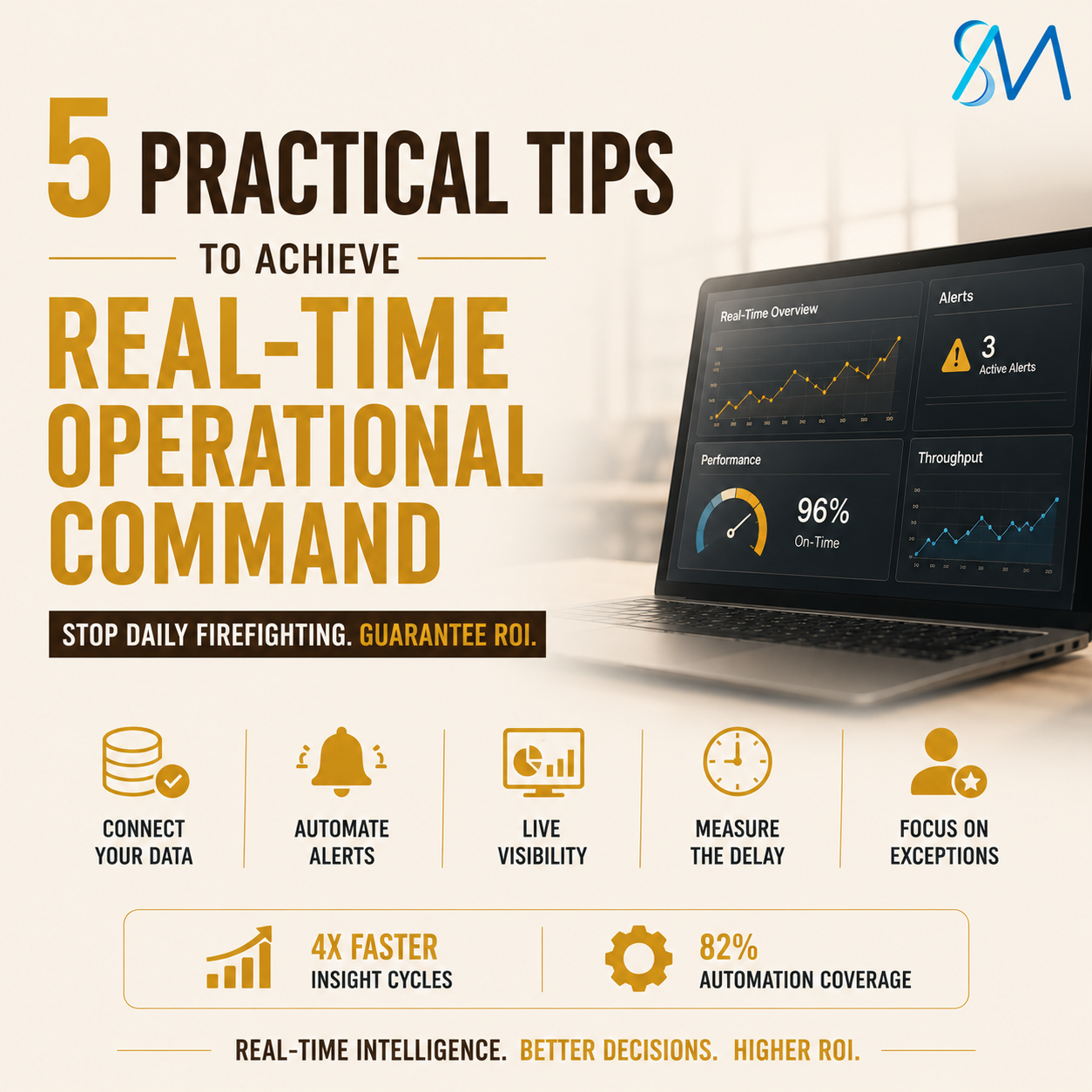
5 Practical Tips to Achieve Real-Time Operational Command: Stop Daily Firefighting and Guarantee ROI

abitha
May 22, 2026 · 19 min read
The Enterprise That Runs Faster Than Its Operations Infrastructure Leaves ROI on the Table Every Single Day
There is a specific pattern that appears consistently across enterprise organisations that have reached a meaningful scale. The leadership team is experienced. The strategy is sound. The talent is strong. And yet, somewhere between the plan made at the start of each week and the reality lived by the end of it, a significant portion of senior attention gets consumed by issues that were never supposed to reach the executive level at all. Escalations arrive after the window for a clean decision has already passed. Data requests that should take minutes take hours because the information lives across three platforms that do not speak to each other. The agenda built on Monday morning carries a shelf life measured not in days but in hours, and every unplanned intervention that rewrites it carries a cost that almost never appears on any dashboard anywhere in the organisation.
What makes this pattern significant is not that it exists — every organisation of scale faces operational complexity. What makes it significant is that the organisations navigating it most successfully are not doing so by adding headcount, running more reviews, or asking their senior leaders to work harder. They are solving it structurally, at the level of how operations are observed, signalled, decided upon, and executed. The gap between an organisation that firefights its way through each week and an organisation that commands its operations in real time is not a gap in management quality. It is a gap in operational architecture, and it has a direct, measurable impact on ROI. SuperBotics has seen this across 500 projects and 150 enterprise launches spanning the US, UK, France, Europe, Brazil, and Asia. The shift from reactive to real-time is available to any enterprise that is prepared to invest in the right structural foundation. This blog explains exactly what that foundation looks like, why it delivers the returns it does, and what building it requires in practice.
Why Operational Firefighting Persists Inside Well-Managed Organisations and What It Is Actually Costing
The first thing worth understanding about operational firefighting is that it does not indicate poor management. It indicates that the reporting and alerting infrastructure supporting the business was built for a different pace than the one the business now operates at. Most enterprise reporting architecture was designed around review cycles: the weekly operational review, the monthly dashboard, the quarterly business review. These are all valid governance mechanisms, and they serve an important purpose. The problem they create at scale is that they are fundamentally retrospective. They document what happened. They confirm what the numbers were. They rarely, if ever, surface what is happening right now or what needs a decision in the next two hours. When the information infrastructure is built for historical documentation and the business needs live intelligence, the gap between the two gets filled by the human layer, which means senior people spend a disproportionate share of their most valuable hours chasing status updates, assembling consolidated pictures from fragmented sources, and responding to situations that have already compounded further than they needed to because no automated system was watching the right signal at the right moment.
The gap is rarely where it first appears. Most operations leaders who take the ERP Fit Quiz find the real friction point is one layer deeper than where they have been looking.
→ See Where Your Operations Actually Stand — 2 Minutes→ Speak with Our Team
The second structural driver of operational firefighting at enterprise scale is data fragmentation, and it is more widespread than most organisations recognise at first. Technology stacks in mature businesses have almost always grown organically, shaped by years of acquisitions, departmental tool decisions, platform migrations, and point solutions chosen to solve specific problems at specific moments. The result is that data which should inform a single coherent operational picture is distributed across CRM platforms, ERP modules, cloud monitoring systems, project management tools, and reporting spreadsheets that still live inside individual inboxes. When these systems do not share a unified data layer, the integration work falls to people. Teams spend time that should be directed toward decision-making instead assembling the information that decisions require. The insight, by the time it reaches the leader who needs it, is already partially stale, partially interpreted, and partially incomplete. Operating on that quality of intelligence is not a leadership problem. It is a data architecture problem, and it has a compounding cost that accumulates silently across every single week the structure remains in place.
The organisations that have addressed this problem at its root consistently report the same outcome: they did not just improve operational efficiency. They recovered senior leadership capacity that had been absorbed into a support function the infrastructure should have been performing. When the team that was chasing updates starts directing strategy instead, the return on that recovered capacity is substantial, and it shows up in ways that go far beyond the operational metrics. It shows up in the quality of the decisions being made, the speed at which the business can respond to genuine strategic opportunities, and the confidence with which leadership can commit to ambitious growth plans knowing that the operational foundation will support them rather than constrain them.
Tip One: Connect Your Data Before You Act on Anything Else
Every capability discussed in the rest of this blog depends on one foundational decision being made well: the decision to resolve data fragmentation at the infrastructure level before attempting to build anything on top of it. This is the structural shift that creates the greatest downstream return, and it is also the one most frequently deferred because it looks, from the outside, like a preparation step rather than a value-generating investment. The organisations that have achieved the strongest operational outcomes across SuperBotics engagements did not defer this decision. They treated it as the enabling condition for everything that followed, and the data from those engagements validates that sequencing conclusively.
A single source of operational truth is not a reporting project. It is a data architecture decision that determines how reliably every downstream system, dashboard, alert, and automation performs. When CRM data, ERP data, cloud operational data, delivery platform data, and financial data share a common integration layer, the result is not just faster reporting. The result is a live, reconciled picture of the business that machines can monitor in real time, that automated systems can act upon without human mediation, and that senior leaders can consult at any moment knowing that what they are seeing is current, complete, and accurate. SuperBotics designs this integration layer using a data readiness assessment at the outset of every enterprise AI and operational command engagement, mapping the existing data landscape before recommending architecture. The assessment identifies not just where data lives but how clean it is, how consistently it is structured, and where the reconciliation gaps are that would create noise in any downstream system built on top of it. That level of rigour at the foundation stage is what makes the 4x faster insight cycles SuperBotics clients have achieved not just possible but sustainable and scalable as the business grows.
The practical value of this foundation becomes clear when leadership teams start using it. The question shifts from “can someone pull together the numbers from the last two weeks so we can discuss them?” to “what is the operational state of the business right now, and what does it tell us about the next decision we need to make?” That is a fundamentally different operating mode, and it is available only when the data underneath the question is unified, current, and trusted. Organisations that invest in this foundation describe the shift in terms that go beyond efficiency. They describe it as a change in confidence, in the quality of the conversations at the leadership level, and in the speed with which they can commit to decisions that previously required days of data assembly before anyone felt comfortable enough to act.
Tip Two: Automate the Alert Before the Escalation Reaches the Inbox
The moment a problem arrives in a senior leader’s inbox as an escalation, two things are already true. The first is that the situation has already been assessed, interpreted, and acted upon by at least one layer of the organisation before it reached the executive level, which means the original signal has been filtered and the response window has already been partially consumed. The second is that the capacity cost of handling that escalation, for everyone involved in the chain from the point of origin to the inbox, has already been incurred. Automated alerting, designed correctly, eliminates both of those costs by catching the condition at the point it emerges, surfacing it to the right person with the full context needed to act, and doing so before the situation has had the opportunity to compound.
The design of an effective alerting system at enterprise scale is more precise than it might appear. The goal is not to generate more notifications. Poorly configured alerting systems increase noise rather than reducing it, which creates alert fatigue and ultimately makes the signal harder to hear, not easier. The goal is to identify the specific thresholds, patterns, and deviations that are genuinely decision-relevant and build monitoring logic that surfaces those conditions and only those conditions, with enough contextual information attached that the person receiving the alert can act without needing to spend time assembling additional data before deciding. SuperBotics builds AI monitoring systems that distinguish between operational noise and genuine signal using pattern recognition trained on the specific characteristics of each client’s business. The alerts that reach leadership carry not just the condition but the context: what it means relative to the operational baseline, what the likely downstream impact is, and what the decision window looks like. That design transforms alerting from a notification mechanism into a decision-support system, and the difference in how senior leaders engage with it is immediate and measurable.
The enterprise AI integration clients SuperBotics has deployed this alerting architecture for have reported a consistent and significant reduction in the volume of escalations that reach the senior leadership level, alongside a measurable improvement in the speed of response for the incidents that do require executive attention. When the signal is caught early and the context is clear, response times compress substantially. The finserv client engagement that resulted in 45% less manual review time was built on this alerting architecture at its core, because the reduction in manual review did not come from people working faster. It came from systems monitoring the right conditions and surfacing them at the right moment so that human attention could be directed toward the decisions that genuinely required it rather than the monitoring tasks that did not.
Tip Three: Replace Historical Reports With Live Operational Intelligence
A weekly dashboard is a valuable historical record, and it belongs in a governance framework. What it is not, and what it cannot be, is an operational intelligence tool for a business that moves faster than a weekly cycle. The organisations that have built real-time operational command infrastructure have made a specific and deliberate architectural choice: they have separated the reporting function from the intelligence function and built each one for its intended purpose. Reporting tells the story of what happened. Intelligence tells leaders what is happening now and what is likely to happen next if no decision is made. Both have value. Only one of them makes real-time operational command possible.
The integrated live dashboard infrastructure SuperBotics builds for enterprise clients is designed around a specific and practical question: what does the operations leader need to see in order to make the best possible decision in the next four hours? That question determines every element of the dashboard design, from the metrics displayed and the granularity of the data to the refresh frequency, the alert integration, and the way exceptions are surfaced relative to the operational baseline. The answer to that question is different for every client and every operations context, which is why SuperBotics invests in a discovery and calibration phase before any dashboard infrastructure is built. The discovery phase maps the decision landscape: what decisions are made most frequently, what information those decisions depend on, where that information currently lives, and how long it currently takes to assemble it. That mapping drives the dashboard architecture, ensuring that what gets built is genuinely useful to the people who will use it rather than an aesthetically impressive visualisation of data that no one acts on.
The measurable result of moving from historical reporting to live intelligence is the compression of the insight cycle: the time between when a signal emerges in the operational data and when it informs a decision. For SuperBotics enterprise clients, this compression has averaged a factor of four. The 4x faster insight cycles reported across the enterprise AI and operational command portfolio are not primarily a product of faster computers or faster networks. They are the product of designing the information architecture specifically around the speed at which decisions need to be made, so that the data is already assembled and current at the moment the decision needs to happen rather than assembled in response to it.
Tip Four: Measure Event-to-Decision Latency, Not Just Operational Outcomes
Enterprise performance measurement frameworks are almost universally designed around outcomes: revenue achievement, conversion rates, delivery rates, customer satisfaction scores, quality metrics. These are essential, and no serious operational framework would exclude them. The measurement gap that creates persistent operational delay sits one level upstream from outcomes, and it is the gap that high-performing operations teams have learned to close. The metric that exposes where structural delays actually live is event-to-decision latency: the time between when a condition emerges in the operational data and when a decision is made in response to it.
Event-to-decision latency is an uncomfortable metric to start measuring for the first time because it reveals with precision where the delay actually sits, and the answer is almost always surprising. When SuperBotics instruments this measurement during the discovery phase of an operational command engagement, the data consistently shows the same pattern: the decision itself, once the right person has the right information, happens quickly. Senior leaders at enterprise scale are experienced, decisive, and capable of excellent judgement under pressure. The delay is almost never in the decision. The delay is in the information journey: how long it takes for a signal that emerged in the operational data to travel through the assembly, interpretation, and escalation layers until it reaches the person with the authority and context to act on it. That journey, in organisations without real-time operational infrastructure, routinely takes hours. In organisations with well-designed alerting, integrated data layers, and live intelligence dashboards, it takes minutes. The difference is not measured in efficiency percentage points. It is measured in the number of situations that resolve cleanly versus the number that compound before they are addressed, and in organisations of scale, that difference has a direct and significant impact on the cost structure of operations every single quarter.
Instrumenting event-to-decision latency for the first time gives operations leaders a precise map of where to invest in operational infrastructure improvement. It identifies the specific points in the information chain where delays accumulate and makes the case for structural investment in the precise terms that resonate at the board level: not efficiency for its own sake, but a specific, measurable reduction in the cost of operational delay across a defined set of high-frequency decision scenarios. SuperBotics uses this measurement as a governance mechanism throughout the programme delivery, tracking the latency compression achieved at each stage and making the ROI of the infrastructure investment visible in operational terms that connect directly to the financial case.
Tip Five: Build Your Operations Infrastructure for Exceptions, Not for Routine
The clearest indicator that operational infrastructure has reached its optimal state is what senior people are spending their time on. In organisations where the infrastructure is well-designed and well-automated, senior operations leaders are spending the majority of their time on the decisions and situations that genuinely require their experience and judgement: the strategic call, the unusual customer situation, the novel problem, the cross-functional coordination challenge that no automated system is equipped to navigate. In organisations where the infrastructure lags behind the business, senior people spend a significant and often majority share of their time on activities that the infrastructure should be handling: chasing status updates from systems that should surface them automatically, assembling consolidated views from data that should already be integrated, and responding to escalations that should have been caught and resolved at a lower level in the operational chain.
The principle of building for exception rather than routine is the architectural philosophy that drives the 82% automation coverage SuperBotics achieves for enterprise AI and operational command clients. That coverage figure is not an efficiency metric in the traditional sense. It is a measurement of what proportion of the routine operational workload has been moved from the human layer to the automated layer, freeing the human layer to focus on the work that genuinely requires human capability. Designing for that level of automation requires a thorough mapping of the operational workflow before any automation is deployed, identifying which processes are truly routine, which have sufficient variation to require human judgement, and which fall into the category of exception where senior expertise is genuinely necessary. Getting that categorisation right is the prerequisite for automation that adds value rather than creating brittleness, and it is where SuperBotics engineering teams invest the most intensive discovery effort at the outset of every operational command programme.
The 120 specialists available on demand across the SuperBotics delivery model bring this expertise across every automation platform and integration architecture relevant to enterprise operations, working within a governance model that assigns all IP to the client as standard and operates within GDPR, CCPA, HIPAA, and SOC 2 aligned frameworks depending on the regulatory environment. The 38% average cost optimisation achieved for Managed Teams clients reflects in part what becomes possible when the automation layer is handling the routine and the human layer is focused on the genuinely value-generating work. That is not a productivity improvement. It is a fundamental reallocation of organisational capability toward the work that creates competitive advantage.
What These Five Shifts Deliver When They Are Built Together
The five structural shifts described in this blog are each independently valuable. An organisation that resolves data fragmentation without yet building automated alerting will experience meaningful improvements in decision quality and information speed. An organisation that builds live intelligence dashboards without yet automating its exception handling will have better visibility than it had before. Each element of the operational command infrastructure creates return on its own. The compounding return, however, comes from building all five elements together in the right sequence, because the output of each one becomes the input that makes the next one more powerful.
When the data layer is unified and trusted, the alerting system has a reliable signal to monitor. When the alerting system is well-designed, the live dashboards surface the right conditions at the right moment rather than creating noise. When the dashboards reflect true operational state in real time, event-to-decision latency can be measured with precision and compressed with intention. And when all of those layers are operating together, the exception-oriented automation layer knows exactly where the boundary between routine and genuine exception sits, because that boundary is now visible in the data rather than experienced only anecdotally by the people living inside the process. The 4x faster insight cycles and 82% automation coverage that SuperBotics enterprise AI clients have achieved are outcomes of this complete system operating together, not individual tools performing in isolation.
The 6.8 year average client partnership tenure across the SuperBotics portfolio reflects what becomes possible when operational command infrastructure is built on a foundation that is designed to scale with the business rather than constrain it. The organisations that have been partnering with SuperBotics for an average of nearly seven years are not doing so because of contract structures or switching costs. They are doing so because the infrastructure they have built together continues to deliver expanding returns as the business grows, and because the partnership model, with its 98% on-time release rate, shared velocity dashboards, and outcome-linked governance, gives them confidence that the infrastructure will keep pace with wherever the business is going next.
The Leadership Advantage That Becomes Available on the Other Side of This Investment
There is a version of senior operational leadership that is almost entirely consumed by recovery. Leaders in that position are applying excellent judgement, significant experience, and genuine strategic capability to a set of problems that are urgent but not important at the level their expertise warrants. They are capable of extraordinary strategic contribution, and they are spending their most productive hours managing the gap between what their operations infrastructure should be telling them and what it is actually telling them. The cost of that configuration is rarely calculated explicitly, but it accumulates in every quarter where the strategic agenda gets compressed by the operational agenda, in every board conversation where the forward-looking discussion is shorter than it should be because the current-state discussion required more time than anticipated.
The organisations that invest in real-time operational command infrastructure are making a choice about what they want their senior leadership doing. They are choosing to redirect the most valuable and expensive capacity in the organisation from operational recovery toward strategic direction, from yesterday’s data toward tomorrow’s decisions. SuperBotics has delivered this outcome across 500 projects in more than 14 countries, and the consistent finding across every engagement is that the return on operational command infrastructure is not primarily measured in the metrics that appear on an operational dashboard. It is measured in the quality and ambition of the strategic conversations that become possible when leadership is no longer occupied by the operational layer. It is measured in the confidence with which growth commitments are made, in the speed with which new opportunities are pursued, and in the sustained competitive advantage that comes from an organisation that always knows sooner than its competitors and acts faster as a result.
Real-time operational command is not a technology project. It is a leadership investment, and when it is built on the right foundation, with the right sequence, and with the right partnership, it returns more value than almost any other infrastructure decision an enterprise organisation can make. The organisations that understand this are already building. The question for every senior leader reading this blog is a straightforward one: what would become possible for your business if your leadership team spent every working hour on the decisions that only they can make, supported by an infrastructure that handles everything else?
Ready to solve this for your organization? Visit SuperBotics MultiTech to see how our team can help.
The clearest starting point we have seen: know what your operations are actually ready for before deciding what to change.
The ERP Fit Quiz surfaces that picture honestly — no interpretation required.