7 Critical Questions to Ask Before Implementing Real-Time Visibility (and Eliminating Daily Operational Stress)

Abitha Jeyaraj, Marketing Executive
July 21, 2026 · 6 min read
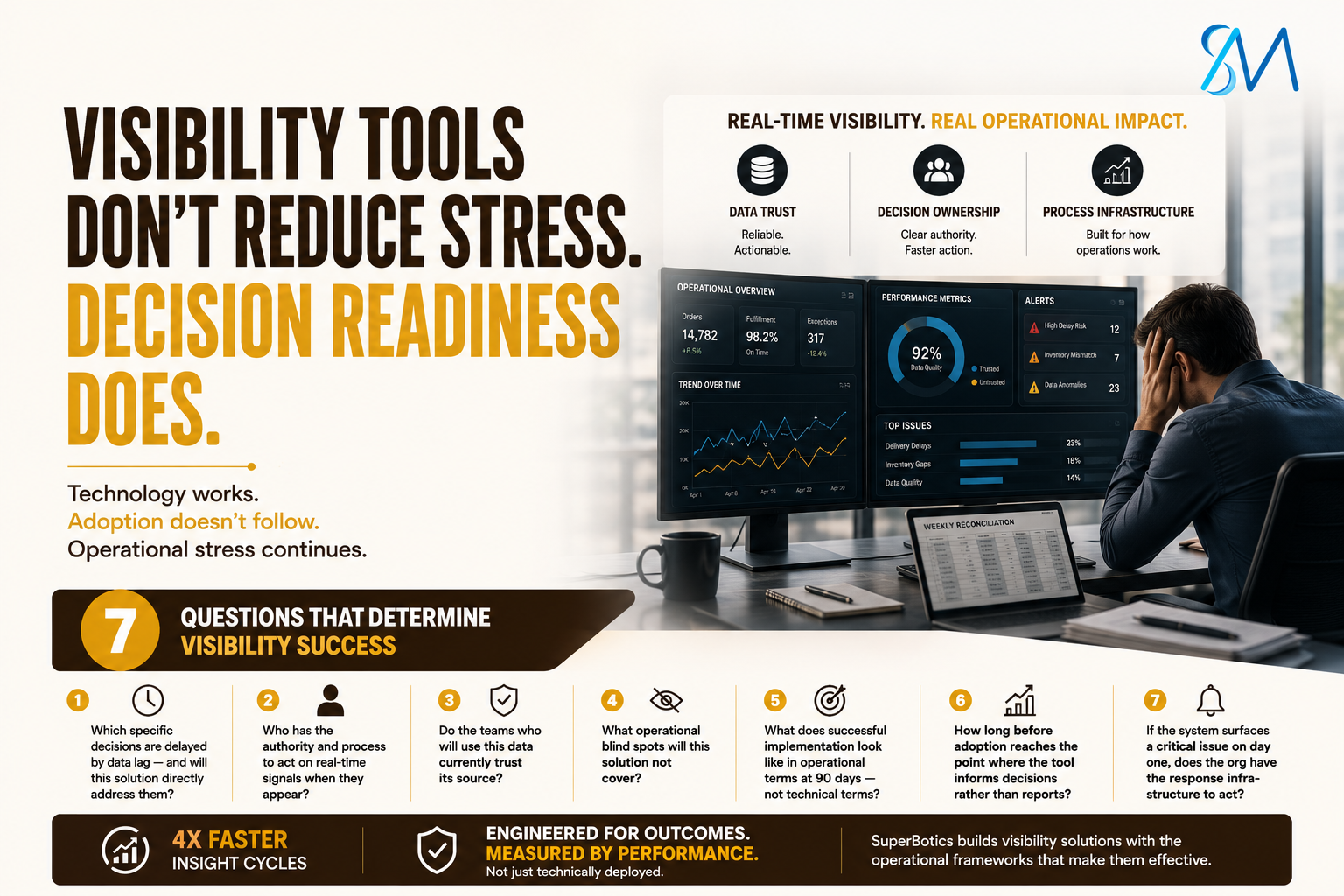
The visibility platform went live. Three months later, the ops team was still running the same weekly reconciliation meeting — because nobody fully trusted what the dashboard was showing.
This is the gap that most real-time visibility implementations fall into. The technology works. The adoption does not follow. And the operational stress the investment was meant to eliminate continues — alongside the cost of the platform that was supposed to address it.
Visibility tools do not reduce operational stress on their own. They reduce it when the organisation has the process infrastructure, data trust, and decision ownership to act on what the system surfaces. Without those conditions in place, real-time visibility creates real-time noise — and the operational teams who were supposed to benefit from it build informal processes around it instead.
The organisations getting sustained value from AI all start with the same question: what are we actually ready to automate, and what needs to be solved first?
We have mapped that starting point across 50+ enterprise deployments. If it is useful for where you are right now, we will share the framework directly.
Why Most Real-Time Visibility Implementations Underdeliver
In our AI and data engagements across enterprise manufacturing, retail, and financial services clients, we consistently observe one pattern in failed visibility investments: the evaluation focused on features. The operational outcomes were assumed to follow. They did not.
The dashboard looked impressive in the demo. The data feeds were configured correctly. The reporting layer was technically complete. And six months after implementation, the leadership team was making the same decisions at the same speed — because the conditions that would have allowed them to act on real-time signals had not been designed into the implementation.
Real-time visibility delivers ROI only when the organisation has the process infrastructure, data trust, and decision ownership to act on what the system surfaces.
The 7 questions below are the ones that separate visibility implementations that deliver measurable operational improvement from those that produce well-configured dashboards that nobody fully trusts.
The 7 Questions That Determine Whether Real-Time Visibility Will Eliminate Operational Stress
Question 1: Which specific decisions are currently delayed by data lag — and will this solution directly address them?
This is the most important question in any visibility evaluation, and the one most frequently skipped. Without a precise inventory of the decisions that are currently delayed by data availability, there is no basis for evaluating whether any solution will address the actual operational constraint. The solution that delivers ROI is the one designed around the specific decisions that need faster data — not around the data points that are easiest to surface.
Question 2: Who has the authority and process to act on real-time signals when they appear?
Visibility without decision ownership is reporting. It tells an organisation what is happening without creating a path to act on it. Before any visibility platform is implemented, the organisation needs named owners for each category of operational signal — with defined authority to act, defined response timelines, and defined escalation paths. Without this, real-time data surfaces issues that nobody has the mandate to resolve in real time.
Question 3: Do the teams who will use this data currently trust its source?
| Trust Level | Adoption Pattern | Operational Outcome |
|---|---|---|
| High trust in data source | Teams act directly on platform signals | Decision cycle time reduces measurably |
| Moderate trust | Teams verify signals before acting | Data lag reduced, but verification adds friction |
| Low trust | Teams build informal verification processes | Platform cost absorbed, operational stress unchanged |
Question 4: What operational blind spots will this solution not cover?
Every visibility solution has scope boundaries. The organisations that implement visibility platforms effectively define those boundaries before go-live — so operational teams know exactly which decisions the platform supports and which ones require additional data sources. Organisations that discover these boundaries after go-live build informal workarounds that persist as permanent informal infrastructure.
Question 5: What does successful implementation look like in operational terms at 90 days — not technical terms?
Technical success is when the platform is deployed and data is flowing. Operational success is when specific decisions are being made faster, escalation volume is measurably lower, or forecast accuracy has improved. These are different milestones. Defining operational success criteria before the implementation begins is what allows the investment to be evaluated against what it was supposed to deliver.
Question 6: How long before adoption reaches the point where the tool informs decisions rather than generates reports?
Adoption timelines for visibility platforms are rarely modelled explicitly. But the gap between technical deployment and operational adoption is where most visibility ROI is lost. Understanding this timeline before implementation — and building the change management and training infrastructure to accelerate it — is what separates implementations that deliver value within 90 days from those that are still being “embedded” two years later.
Question 7: If the system surfaces a critical issue on day one, does the organisation have the response infrastructure to act in time?
This is the question that tests whether the organisation is ready to benefit from real-time visibility or merely to receive it. A visibility platform that surfaces a critical operational signal without a response path in place has transferred awareness without enabling action. The response infrastructure — owned alerts, defined response windows, escalation paths — needs to be in place before the platform goes live, not built in response to the first critical signal.
How SuperBotics Engineers Visibility That Delivers Operational Outcomes
SuperBotics designs and delivers AI and data solutions that are evaluated against the decisions they improve — not the data they display. Across our enterprise AI integration engagements, 4x faster insight cycles are achievable when the implementation is built around operational outcomes from the design phase, with data trust, decision ownership, and response infrastructure addressed before go-live.
Our 14-week model-to-production programme for enterprise AI clients embeds operational design alongside technical delivery — so the visibility layer the organisation receives is one that teams trust, own, and act on from day one. Our 82% automation coverage and 4x faster insight cycle outcomes reflect what is possible when the seven questions above are answered before the first line of configuration is written.
The Visibility Investment That Eliminates Operational Stress Is the One Designed Around Operational Decisions
Real-time visibility is not a technology decision. It is an operational design decision that happens to involve technology. The organisations that achieve measurable reduction in operational stress within 90 days of implementation are the ones that answered the seven questions above before the procurement process began — and built their implementation around the answers.
The visibility platform that delivers its projected value is the one where every operational decision it was meant to accelerate has a named owner, a trusted data source, and a response path — before the dashboard goes live.
The organisations that eliminate daily operational stress through real-time visibility do not find a better platform. They build a better operating model — and then implement the platform inside it.
Want to implement real-time visibility that actually eliminates operational stress — not just adds a dashboard?
SuperBotics engineers AI and data solutions around the operational decisions they improve, with outcomes measured from day one.
Talk to SuperBotics about building operational visibility that delivers →
The right first question is not which AI tool — it is what does our data and team need to be ready for this to work.
That question, answered clearly, is worth more than any vendor comparison.