How SuperBotics Designed the Client Segmentation System That Gave Bora Lubrax Commercial Precision

abitha
June 16, 2026 · 5 min read
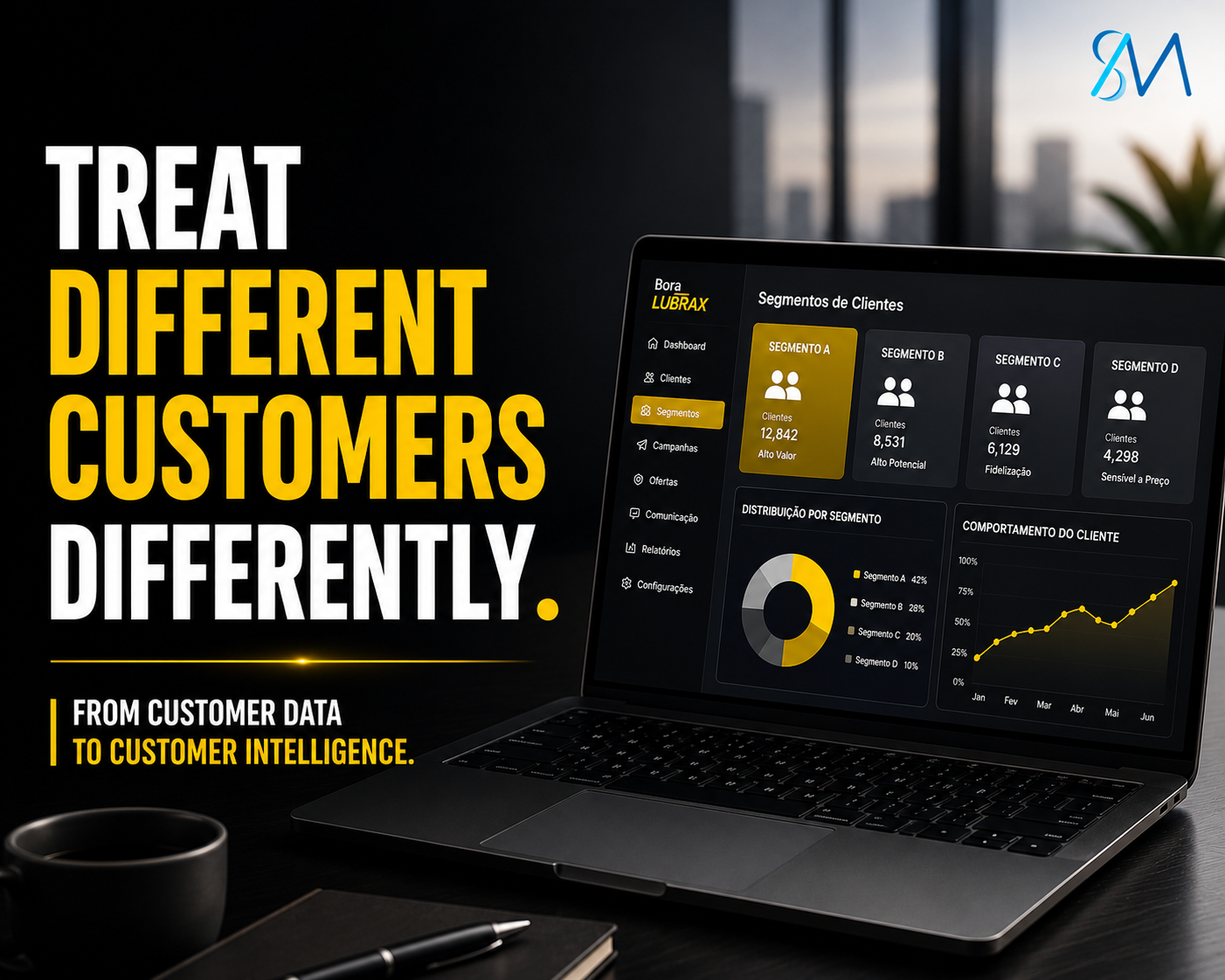
Treating every customer the same is the most expensive kind of equal treatment. One segment wants volume deals. One wants early access to new products. One wants to feel like a priority rather than an account number. If your system cannot tell them apart, your commercial team cannot act on the difference. And every interaction that should have been targeted becomes generic, taking a small piece of the relationship with it.
This was the precise challenge Bora Lubrax brought to SuperBotics. Their entire customer base existed as one undivided group inside their platform. No structure. No targeting logic. No way to tailor offers, communication, or service levels based on behaviour, value, or buying patterns. The commercial team knew their customers were different. The system had no mechanism to act on that knowledge.
The Cost of an Undivided Customer Base
The absence of segmentation is not a neutral state. It is an active cost that compounds across every commercial interaction the platform enables. When every customer receives the same communication, the relevance of that communication degrades for everyone. High-value accounts receive offers calibrated for entry-level buyers. Volume-driven clients receive messaging built for relationship-focused segments. Early adopters who want differentiated access receive the same cadence as the long tail.
Most teams are optimising against the wrong conversion baseline — the industry average does not account for platform, checkout flow, or traffic source mix.
Getting that baseline right is the step that made the biggest difference for the global retailer that saw 18% lift.
The solution was not better messaging. It was a system that could tell the difference between customers before any message was written.
Designing the Segmentation System from the Ground Up
SuperBotics designed the complete client segmentation experience for Bora Lubrax, from the clustering logic that groups customers into meaningful segments to the interface their commercial team uses every day. The entire build was executed in Figma and Adobe XD with AI-assisted design workflows to accelerate iteration cycles and validate interface decisions against real usage patterns before any production code was written.
The design process began with the segmentation logic itself. What dimensions of customer behaviour, purchasing pattern, and engagement history are most predictive of commercial intent? What groupings are meaningful enough to justify differentiated treatment across communication, offers, and service levels? These questions were answered before the interface was designed, because the interface needed to make those answers visible and actionable for people without data science backgrounds.
Data tells you who your customers are. Design tells you what to do about it. The gap between those two statements is where most segmentation initiatives lose their commercial value.
| Before Segmentation | After Segmentation |
|---|---|
| One undivided customer base | Structured segments by behaviour and value |
| Generic communication to all | Targeted messaging per segment profile |
| Manual account classification | Automated clustering logic in interface |
| No targeting logic for offers | Segment-appropriate offers at account level |
| Commercial team operating on instinct | Commercial team operating on structured data |
What the Interface Delivers
The segmentation interface gives the Bora Lubrax commercial team a structured, navigable view of their customer base that did not exist before. Segment membership is visible at the account level. Targeting logic is embedded into the workflow rather than requiring manual classification before each campaign. The interface scales with the customer base without requiring manual reclassification as buying patterns evolve.
The AI-assisted design workflow used throughout the project accelerated iteration significantly. Design decisions that would typically require multiple validation rounds were tested against usage patterns earlier in the process. The result was a system that felt familiar to the commercial team from day one, because the interface was built around how they actually work rather than how a generic CRM assumes they should.
Customer Data vs Customer Intelligence
Customer data tells you what happened. A purchase was made. An account was created. A communication was opened or ignored. Customer intelligence tells you what to do next, and why, and for whom. The gap between those two states is exactly what the Bora Lubrax segmentation system closes.
When a commercial team member opens an account today, they see a customer who belongs to a defined segment with a known profile, known commercial patterns, and a known set of offers and communication approaches appropriate for that profile. The decision about how to engage is made from structure, not instinct. That structure is what turns a customer database into a commercial asset.
What SuperBotics Delivers
SuperBotics delivers product engineering and UX design for enterprise platforms across e-commerce, loyalty, CRM, and customer intelligence systems. Our design and engineering pods work in Figma, Adobe XD, and production-grade front-end frameworks, with AI-assisted design workflows that accelerate iteration without reducing precision. Across 500+ successful projects and 150+ enterprise launches, we have built the commercial interfaces that turn data into decisions for clients in Brazil, Europe, the US, and the UK. Explore what SuperBotics delivers at superbotics.com.
Precision Begins with Structure
The commercial teams that act with the most precision are not the ones with the best instincts. They are the ones whose systems give them the right information about the right customer at the right moment in the relationship. That precision is not a function of data volume. It is a function of how that data is structured, surfaced, and made actionable through interface design that reflects how the team actually works.
Bora Lubrax now has every customer in a defined segment, every commercial team member with a structured view of who they are engaging and why, and every offer decision grounded in a profile rather than a guess. That is the difference between having customer data and having customer intelligence.
Conversion is a structural problem before it is a content problem. The improvements that hold tend to start with understanding the structure, not testing the copy.