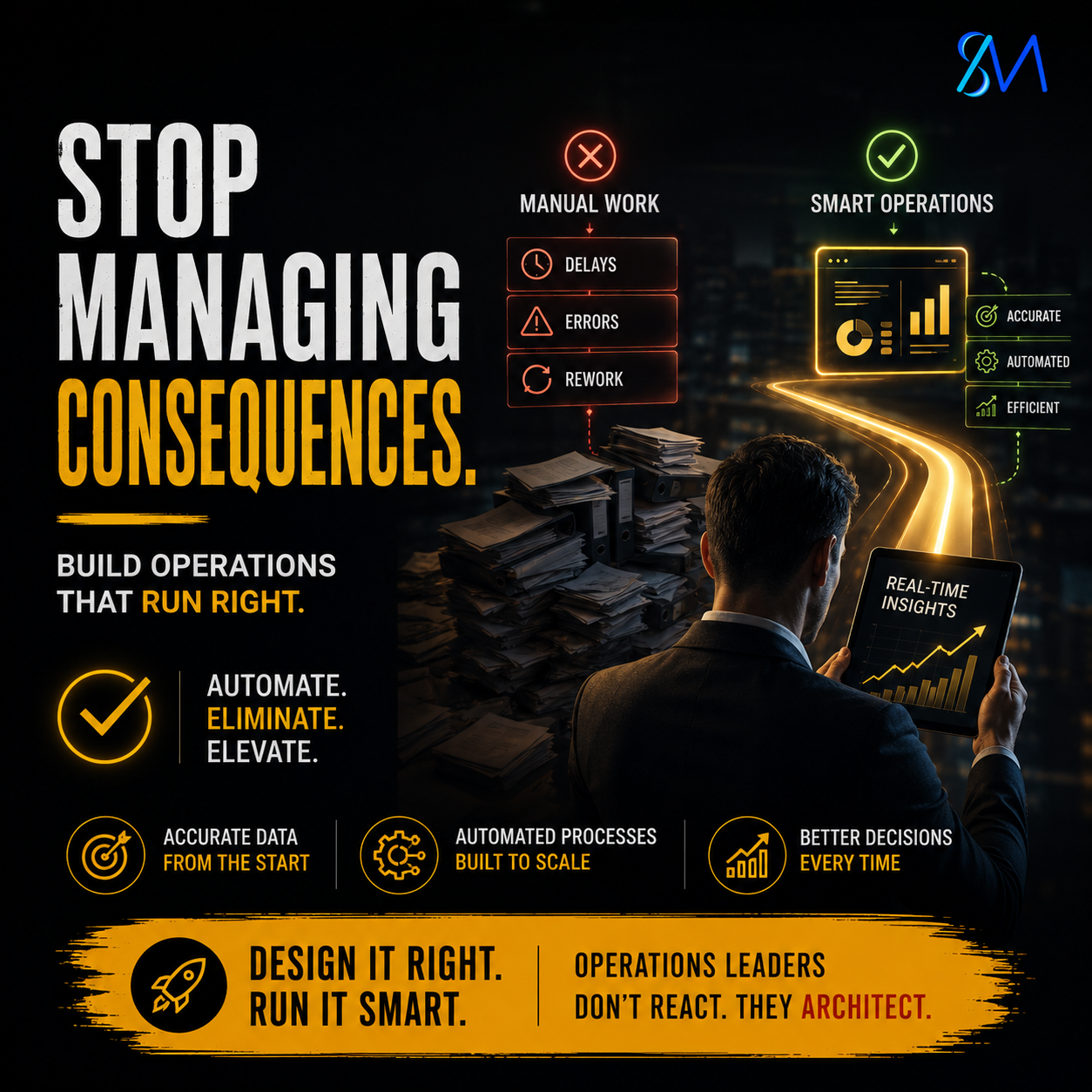
How Organisations Moved from Constant Exception Management to Predictable Operations

Abitha Jeyaraj, Marketing Executive
July 11, 2026 · 5 min read
The Exception Management Pattern That Keeps Operations Reactive
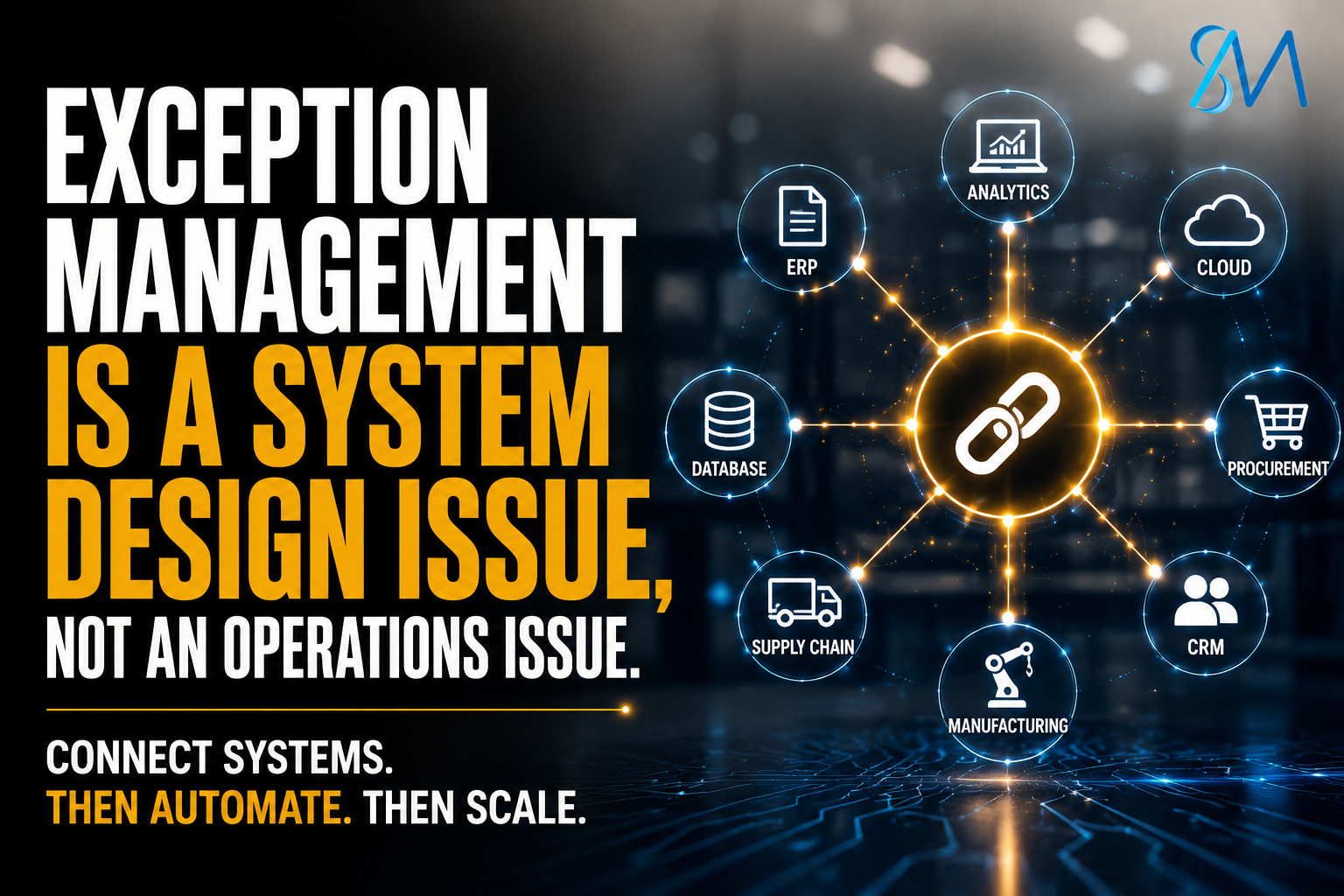
Exception management is not a sign of poor operations. It is a sign of systems that were not designed to communicate with each other, and a team skilled enough to bridge the gap manually. That distinction matters because it changes the remediation entirely. The organisations that consistently reduce exception management do not address it as a performance problem. They address it as a structural design problem.
The manual bridge becomes permanent through a process that happens gradually and without a deliberate decision. What began as a workaround for a system gap becomes the established procedure because it works reliably enough, and because redesigning it would require a project that never gets prioritised against more urgent operational demands. Over time, the workaround becomes invisible to leadership, embedded in daily operations in a way that looks like normal process rather than technical debt. Until it fails under load. Or until a key person leaves and the institutional knowledge that made the manual process function disappears with them.
Automation does not eliminate complexity. It exposes the complexity that already existed. Every organisation that has automated a manual exception-management process has discovered this. The automation accelerates the workflow. The exceptions it was managing do not disappear. They appear faster, at higher volume, and across more systems simultaneously. The underlying condition that created them, the disconnected system, the process gap, the data quality issue, was never addressed. It was automated.
The gap is rarely where it first appears. Most operations leaders who take the ERP Fit Quiz find the real friction point is one layer deeper than where they have been looking.
→ See Where Your Operations Actually Stand — 2 Minutes→ Speak with Our Team
The Sequence That Separates Organisations That Moved Past Firefighting From Those That Did Not
Across enterprise operations programmes, the organisations that successfully moved from constant exception management to predictable operational efficiency shared one characteristic: the sequence in which they approached the problem. Not the technology they chose. Not the scale of the investment. The order of decisions that preceded implementation.
The first decision was definitional. Every recurring exception was documented before any solution was proposed. Its origin, its frequency, its cost to the business in team hours and delayed decisions. This documentation exercise consistently produces a finding that surprises most operations leadership: the exception landscape is narrower than it appears. Most organisations managing twenty different exception types discover that fifteen of them trace back to three or four root causes. The remediation effort, scoped correctly, is significantly smaller than the firefighting workload suggests.
The second decision was architectural. Clean, validated data between systems before any automation layer was added. This sequencing principle, connect before you automate, is the single most consistently violated rule in operational improvement programmes. Automation built on disconnected or inaccurate data does not reduce exceptions. It produces them faster, at scale, with an automated consistency that makes diagnosis harder rather than easier.
Operational continuity is designed before implementation begins. Or it is improvised after the first incident that reveals it was never designed at all.
Measuring Operational Progress in Business Terms, Not Project Terms
The third decision that distinguished organisations that achieved lasting operational improvement was how they defined and measured success. Not go-live date. Not system uptime. The number of executive hours recaptured per week. The reduction in manual reconciliation cycles per month. The time between a business event and an informed decision, measured in minutes rather than hours. The volume of exceptions that required escalation, tracked weekly against a baseline established before the programme began.
These measures are operational. They appear on leadership dashboards rather than project reports. And that distinction matters, because operational improvement that is measured in project terms exists only until the project closes. Operational improvement measured in business terms becomes part of how the organisation understands and manages its own performance, creating the accountability structure that prevents regression.
Go-live is not the outcome. Stable, predictable operations at 90 days post-launch is the outcome. Organisations that measure success at go-live consistently find that their operational improvement erodes in the quarter that follows, as exceptions that were suppressed during the project stabilisation phase reassert themselves without a governance structure to address them.
| Success Measure | Project Terms (Wrong) | Business Terms (Right) |
|---|---|---|
| Integration | Systems connected, uptime achieved | Manual reconciliation cycles eliminated |
| Automation | Workflows automated, go-live complete | Exception volume reduced by X% in 90 days |
| Visibility tool | Dashboard deployed, users trained | Decision cycle speed improved, leadership hours recaptured |
| Process redesign | New process documented and rolled out | Escalation volume reduced, workarounds eliminated |
What SuperBotics Operational Efficiency Programmes Deliver
SuperBotics designs operational efficiency programmes around this sequence: diagnose the exception landscape, connect systems with precision, and define success in leadership terms before any implementation begins. Every engagement starts with an exception mapping exercise that traces recurring operational problems to their root causes before a solution is proposed. The architecture that follows addresses those root causes, not the symptoms they produce.
Our delivery covers enterprise integration, process automation, operational visibility infrastructure, and the adoption design that ensures new operational patterns become durable rather than temporary. Across 500+ projects, the organisations that achieved lasting operational improvement were the ones where the success definition was agreed before the first design session, and where that definition appeared on a leadership dashboard rather than only in a project status report.
Operations rarely becomes predictable by accident. It becomes predictable by design, when the exception landscape is understood before solutions are proposed, when systems are connected before they are automated, and when success is defined in terms that the business can see and sustain long after the project has closed.
The organisations that run predictably do not talk about their operations. They simply use the capacity that predictability creates to grow faster.
Ready to solve this for your organization? Visit SuperBotics MultiTech to see how our team can help.
The clearest starting point we have seen: know what your operations are actually ready for before deciding what to change.
The ERP Fit Quiz surfaces that picture honestly — no interpretation required.