Stop Wasting Time on Spreadsheets: How to Unify Disconnected Ops Systems and Drive Immediate ROI

abitha
May 27, 2026 · 8 min read

The Three Different Answers Problem
There is a scene that plays out in enterprise operations across manufacturing, retail, distribution, and services with remarkable consistency. A senior leader needs one number — total units processed, revenue recognized, open orders by region, whichever single metric that week’s most important decision depends on. She asks the system. The system gives her three different answers depending on which system she asks. The CRM shows the commercial view. The ERP shows the operational view. The spreadsheet the operations lead built in 2019 shows the reconciled view that everyone actually trusts, because it was built by someone who understood where the gaps were and manually bridges them every week. The decision gets delayed. The leader gets the number at end of day. The call she needed to make that morning gets made the following morning. The window where that decision had maximum impact has already closed. This is not a technology failure. The technology is working exactly as it was configured. It is an architecture failure — the result of systems that were implemented independently, optimized for their own functions, and never designed to produce a unified operational picture at the leadership level. And it compounds silently, every reporting cycle, every planning meeting, every quarter where senior leadership is navigating live business decisions on information that is consistently 24 to 48 hours behind the current state of the operation.
The hidden cost of disconnected operations data is one of the most consistently underestimated financial exposures in scaling enterprises. SuperBotics has mapped this cost across 500 plus projects in 14 countries, and the pattern is always the same: the visible cost is the hours spent on reconciliation. The invisible cost is the quality of every decision made before the reconciliation was complete. When a VP of Operations is managing an 18-month growth plan with pricing assumptions built on last week’s margin data, or when a COO is evaluating a distribution expansion on inventory data that has not yet reflected this morning’s inbound shipments, the gap between what the system shows and what is actually true carries commercial consequences that never appear on a report but consistently appear in the quarterly results. The organizations that close this gap achieve something measurable: they make the same decisions faster, with greater accuracy, and with the confidence that comes from knowing the data supporting those decisions reflects reality at the moment the decision is being made.
Why Disconnected Operations Data Persists in Growing Enterprises
The architecture that produces disconnected operations data was almost never a deliberate choice. It was the accumulated outcome of pragmatic decisions made at different stages of organizational growth. The CRM was implemented when the commercial team reached the size where opportunity tracking needed structure. The ERP was implemented when inventory and financial complexity required a proper system of record. The warehouse management system came when distribution scale demanded it. Each implementation was scoped to solve the problem it was brought in to solve, configured by specialists who understood that specific platform deeply, and handed over to operational teams who learned to work within its boundaries. The integrations between these systems — where they existed at all — were built as point-to-point connections that served the specific data flows understood at the time of implementation and became increasingly fragile as the business evolved around them. Nobody planned for the state that now exists. Nobody made a decision to have three systems that cannot produce a single trusted view of the business. It happened through growth, and it persists because the cost of addressing it has always felt higher than the cost of continuing to manage it through manual reconciliation.
The gap is rarely where it first appears. Most operations leaders who take the ERP Fit Quiz find the real friction point is one layer deeper than where they have been looking.
→ See Where Your Operations Actually Stand — 2 Minutes→ Speak with Our Team
The moment that calculation changes — and for most scaling enterprises it changes somewhere between 50 and 200 million in revenue — is when the manual reconciliation process can no longer keep pace with the speed at which the business needs to move. The reporting cycle that took two days at 40 million still takes two days at 120 million, but the decisions that depend on it are now worth significantly more, the windows in which those decisions have maximum impact are significantly narrower, and the competitive consequences of being consistently late to your own operational data are significantly larger. SuperBotics approaches this inflection point not as a technology replacement project but as an operational architecture decision: what does the organization need to see, at what frequency, at what level of granularity, to make the decisions that are driving the business forward? That question, answered clearly and in business terms before any integration architecture is designed, is what produces an integrated data layer that actually changes how the organization operates rather than simply adding another system to an already complex environment.
The SuperBotics Approach to Unified Operations Architecture
Every SuperBotics engagement on disconnected operations data begins with operational discovery — a structured process of understanding how data actually flows through the organization, where trust breaks down between systems, and where the manual bridges exist that are currently compensating for missing integrations. This discovery process consistently reveals that the most expensive data gaps are not the ones that are most visible. The team is aware of the reconciliation that takes four hours on Monday morning because everyone participates in it. They are rarely aware of the secondary decisions — the forecasting calls, the inventory commitments, the capacity planning conversations — that are made on the basis of data that has not yet been reconciled, because those decisions happen in real time and nobody tracks the cost of the inaccuracy until a variance appears in the quarterly close. SuperBotics maps both the visible and invisible cost before designing the integration architecture, because the ROI case for the work depends on capturing both, and the sequence in which integrations are built should prioritize the highest-value data flows first rather than the easiest ones.
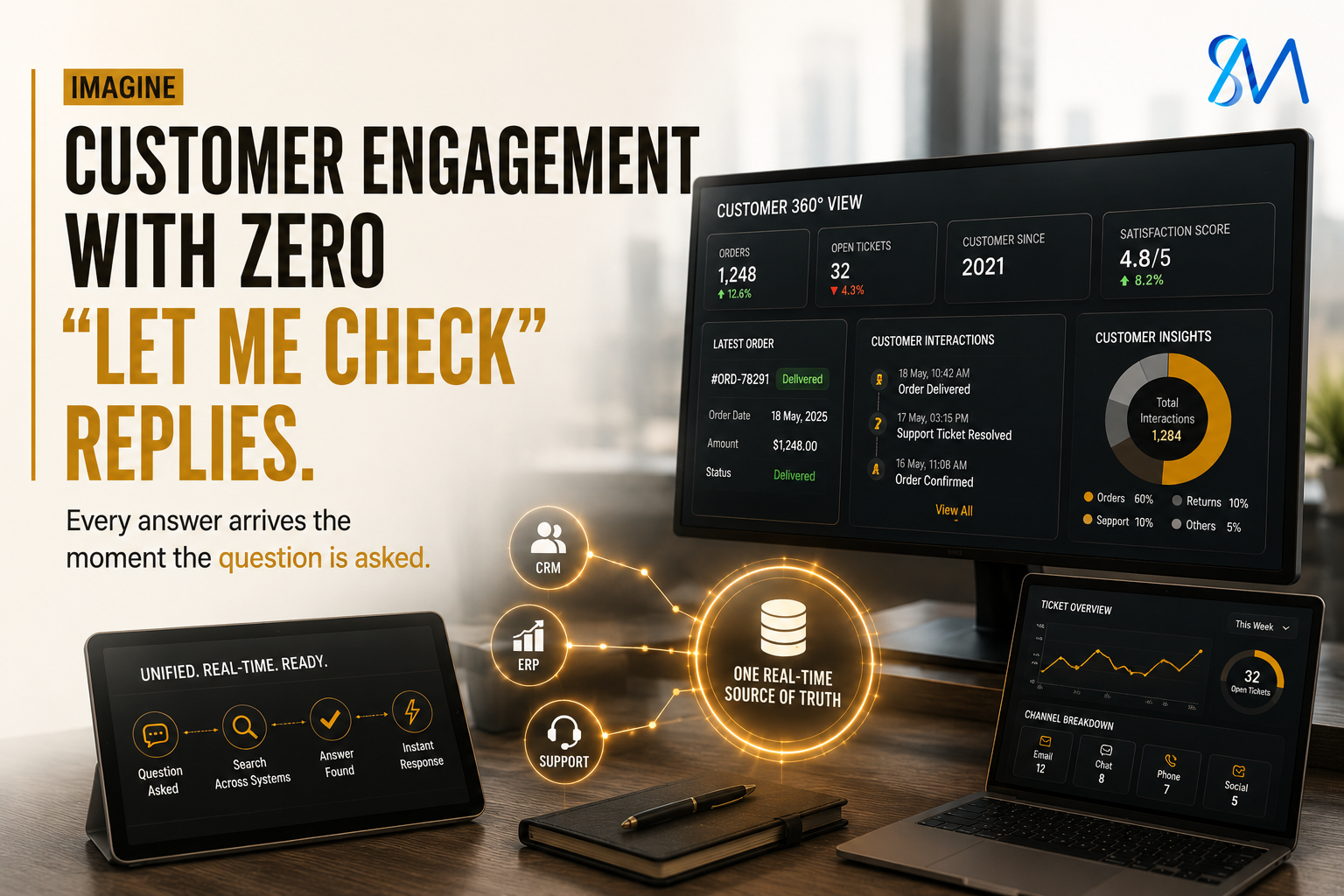
The integration architecture SuperBotics builds connects CRM, ERP, warehouse management, and operational platforms through a unified data layer designed around the decisions the organization needs to make rather than around the APIs the platforms expose. This distinction matters because platform APIs are designed for data exchange, not for decision support. Building an integration that faithfully synchronizes data between a Salesforce CRM and a SAP ERP does not automatically produce a reporting layer where a COO can see real-time commercial performance, inventory position, and margin by product line in a single view. Producing that view requires understanding what the COO needs to see, designing the data model that supports it, and then building the integrations that feed it — in that order. SuperBotics has delivered this sequence across Salesforce to SAP, Zoho to Odoo, Microsoft Dynamics to custom ERP environments, and combinations of all of these. The 38 percent average cost optimization achieved by SuperBotics Managed Teams clients reflects the cumulative impact of eliminating exactly this kind of structural inefficiency across the operational data layer.
The Proof: One Retail Client, Six Hours Recovered Every Week
SuperBotics worked with a retail client managing nine distribution points across Europe whose operations team opened every day with a morning reconciliation process that drew from four separate tools and two spreadsheets before leadership had a trusted picture of the previous day’s operational performance. The reconciliation was thorough. The team who ran it was experienced and meticulous. But it consumed six hours of operational capacity every week, it produced a view of yesterday’s performance when the team needed a view of today’s, and it created a structural dependency on three individuals whose institutional knowledge of the reconciliation process made them operationally indispensable in a way that introduced genuine organizational risk. SuperBotics mapped the data flows, identified the integration points where the four tools and two spreadsheets were manually bridging the gaps between systems, and built a unified operational dashboard that drew from the ERP, the WMS, and the sales platform simultaneously, producing a real-time operational view that replaced the reconciliation process entirely. The six hours were recovered. The dependency on the reconciliation specialists was replaced by a governed data architecture. Leadership moved from making decisions on yesterday’s data to making decisions on this morning’s data. The business impact of that shift is not measured in the hours recovered — it is measured in the quality of every commercial decision made from that point forward.
What SuperBotics Delivers
SuperBotics designs and implements unified operations data architectures for enterprises that are done managing the cost of disconnected systems. The engagement covers discovery of real data flows and decision dependencies, integration architecture design across CRM, ERP, WMS, and custom platforms, implementation with parallel validation to ensure operational continuity throughout the transition, and post-go-live governance to ensure the integrated layer remains accurate and trusted as the business continues to evolve. SuperBotics supports Salesforce, Zoho, SAP, Microsoft Dynamics, Odoo, and custom API ecosystems across AWS, Azure, and GCP environments. The 4x faster insight cycles SuperBotics achieves for enterprise clients are the result of this architecture — not more dashboards, but fewer steps between the data and the decision. Organizations ready to replace their reconciliation process with a unified operational layer can learn more at superbotics.com.
The clearest starting point we have seen: know what your operations are actually ready for before deciding what to change.
The ERP Fit Quiz surfaces that picture honestly — no interpretation required.