The 5 Critical Parameters for Maintaining Operational Control During Any Major System Migration: A CTO/VP Checklist

Abitha Jeyaraj, Marketing Executive
July 19, 2026 · 6 min read
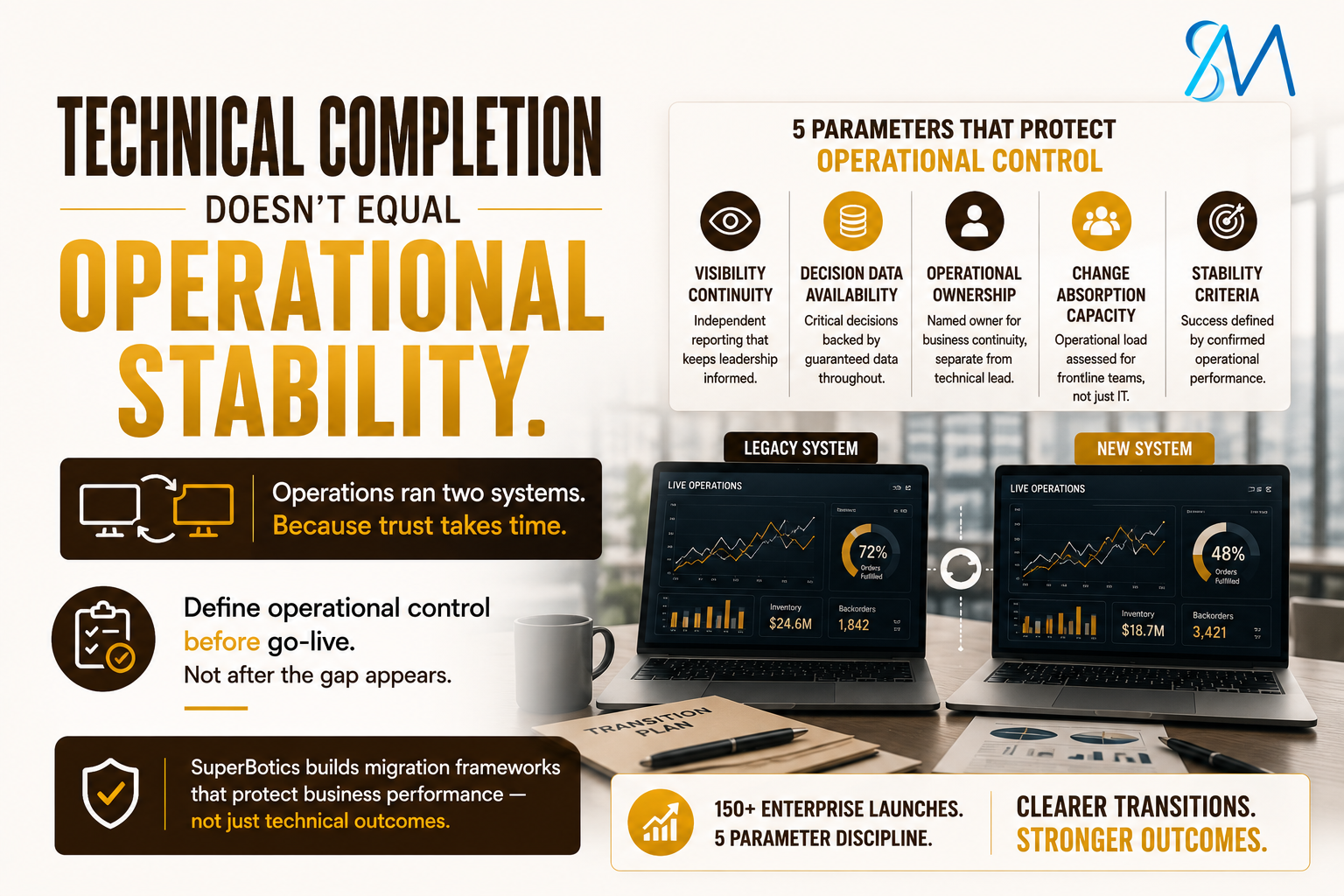
The technical delivery was on schedule. The system went live.
The operations team spent the first month after go-live running two systems simultaneously — because they could not yet trust the new one. By the time confidence in the new platform was established, the parallel operation had absorbed six weeks of team capacity, produced a reconciliation backlog that took another month to clear, and left a set of informal processes in place that nobody had designed and everyone was using.
This is a more common outcome than most post-migration reports acknowledge. Technical completion and operational stability are different milestones. And in organisations where this distinction is not defined before the transition begins, the gap between them is absorbed by the people closest to the work — not captured in the project dashboard.
Cloud cost and reliability problems share the same root cause in almost every organisation we work with: architecture decisions that made sense at launch and were never revisited at scale.
We have mapped the 5 patterns that cause it most often — useful to review regardless of where you are in your infrastructure journey.
The 5 Parameters That Determine Operational Control During Migration
In our work across 150+ enterprise launches, the transitions that scored clearly on all five of the following parameters navigated their cutover without significant business disruption. Each parameter addresses a specific failure mode that we observe in migrations that produce extended parallel operation, reconciliation backlogs, or post-go-live operational recovery periods.
Parameter 1 — Visibility Continuity. Does leadership have a reporting layer that functions independently of the new system’s go-live status? This is the foundation of operational control during transition. Organisations that build a guaranteed visibility layer before cutover never face the situation where a time-sensitive decision has to wait on a system that has not yet proven stable. Those that rely on the new system’s reporting from day one absorb the full cost of every data confidence gap that follows go-live.
Parameter 2 — Decision Data Availability. Are the most time-sensitive operational decisions protected by a guaranteed data source throughout the transition window? This requires mapping, before the cutover window opens, which specific decisions have the shortest data lag tolerance. Supply chain calls, daily financial reconciliation, customer escalation management — each has a different tolerance and a different protection requirement. Without this mapping, the continuity layer cannot be designed specifically enough to be effective.
The five parameters of operational control during migration are not project management tools. They are the architecture of business continuity during the period of highest operational risk.
Parameter 3 — Operational Ownership. Is there a named owner for business continuity, separate from the technical project owner? Across our 500+ successful project engagements, this separation is the single most consistent differentiator between migrations that absorb operational disruption and those that do not. When one person owns both technical delivery and business continuity, technical complexity predictably crowds out continuity oversight during the periods when both demand attention simultaneously.
| Parameter | Defined Before Cutover | Discovered After Go-Live |
|---|---|---|
| Visibility continuity | Leadership has guaranteed data throughout | Decisions delayed pending system stability |
| Decision data availability | High-risk decisions protected by design | Reconciliation gaps in first 4-8 weeks |
| Operational ownership | Continuity managed independently of project | Business risk absorbed by technical team |
| Change absorption capacity | Workload protected, workarounds prevented | Informal processes embedded for months |
| Stability criteria | Go-live confirmed in operational terms | Technical completion declared, ops recovering |
Parameter 4 — Change Absorption Capacity. Has the operational load on frontline teams been assessed — not just the technical workload? The teams who will run the new system are not a neutral delivery surface. They have existing workload, existing process habits, and a defined limit on what they can absorb while also learning a new platform. Organisations that assess this before the cutover window opens can sequence the transition to protect operational capacity. Those that do not discover the limit when it is reached — usually in the form of informal workarounds that persist long after the transition is declared complete.
Parameter 5 — Stability Criteria. Is success defined by technical completion or confirmed operational performance? These are different milestones with different measurement requirements. Technical completion is when the system passes its acceptance criteria. Operational stability is when the business makes decisions on new system data with the same confidence it had on the old system — and the outcomes reflect that confidence. Defining this distinction before go-live is what allows the transition to be declared complete on operational terms rather than technical ones.
What SuperBotics Builds for CTO and VP-Level Migration Governance
SuperBotics engineers the governance layer that addresses all five parameters before the first cutover window opens. Our cross-functional pods — engineering, QA, DevOps, and operational design — are onboarded within 10 business days and build the continuity framework alongside the technical delivery plan from the first engagement week.
For CTO and VP-level clients specifically, we provide the accountability framework that separates technical delivery ownership from operational continuity ownership — with defined reporting lines, defined review cadences, and defined stability criteria that both tracks measure against. This is the structure that allows technical complexity to be managed without displacing business continuity oversight.
Across our enterprise client base, the 6.8-year average partnership tenure reflects what this governance model produces in practice: organisations that trust their migration outcomes trust the partner who delivered them, and return for the next transition with the same governance framework already in place.
The Migration That Ends With Operational Confidence Begins With These Five Parameters
The checklist above is not a project management exercise. It is the architecture of operational control during the period when your business is most exposed. Each parameter addresses a specific failure mode that has produced real operational disruption in real enterprise transitions — not hypothetical risks.
The organisations that emerge from major system migrations with stronger operations than they had before define these five parameters before the board approves the budget — and build the governance infrastructure to deliver them before the cutover window opens.
Technical completion is a milestone. Operational confidence is the outcome. The distance between them is determined by what was designed before the transition began.
Preparing a major system migration and want a CTO-level governance framework that addresses all five parameters from day one?
SuperBotics partners with enterprise technology leadership to deliver migrations where operational stability is designed in — not recovered afterward.
Talk to SuperBotics about your next migration →
The infrastructure decisions made in the next quarter tend to hold for longer than expected — the cost and risk profile sets early.
If you want a clear picture of where your current architecture stands, a focused review is the most useful starting point.