
The 7 Critical Questions CEOs Must Ask Before Any System Migration to Guarantee Ironclad Operational Control

Abitha Jeyaraj, Marketing Executive
July 18, 2026 · 5 min read
The board approved the migration budget. The project plan was presented. The timeline looked reasonable. The risks were documented.
Nobody asked who was accountable for operational continuity if the transition ran long.
This is where migration risk quietly accumulates — not in the technical architecture, but in the business continuity assumptions that are never made explicit until they are violated. Across our 150+ enterprise launches, the migrations that produced unexpected operational disruption almost always had a well-designed technical plan. What they did not have was a CEO-level interrogation of the seven questions that determine whether the business emerges from the transition stronger or recovering.
The teams that scaled delivery without scaling chaos did not hire faster — they changed how work was structured. The difference is visible in how their first two weeks of onboarding looked.
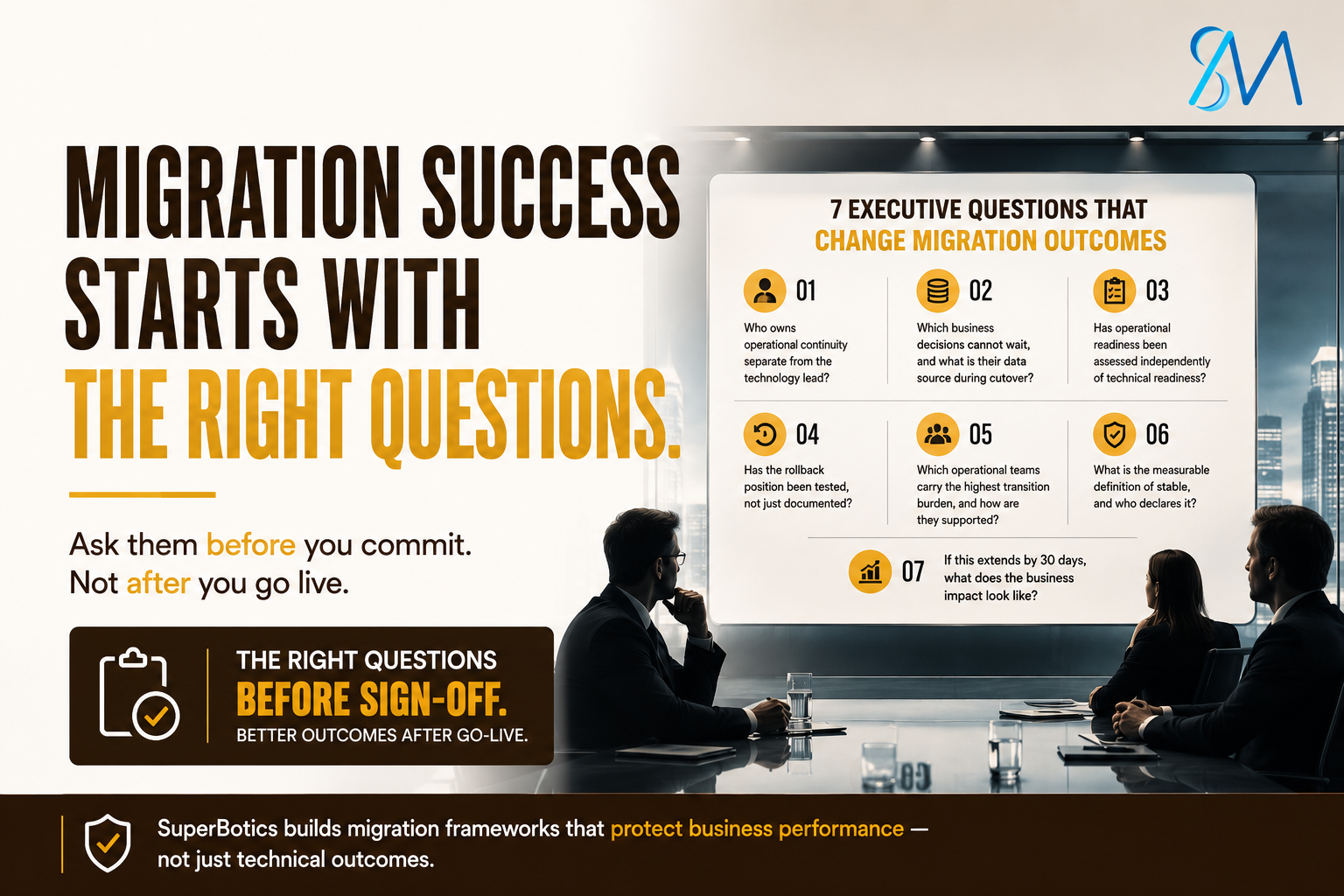
The 7 Questions CEOs Must Ask Before Any System Migration
Question 1: Who is accountable for operational continuity — and is that person separate from the technical project lead?
Technical delivery accountability and business continuity accountability are different roles. When one person carries both, technical complexity reliably displaces business continuity oversight when they compete for attention. The organisations that navigate migrations without operational disruption have a named owner for business stability who reports directly to operations leadership, independently of the project track.
Question 2: What does operational stability look like in measurable terms, and is that definition agreed before the project begins?
Stability is not a technical metric. It is an operational one — measured in decision cycle time, escalation volume, data reconciliation accuracy, and customer-facing performance thresholds. If this definition does not exist before the project kick-off, the organisation has no target to build toward and no basis for declaring success when go-live occurs.
A migration without a defined operational stability target is a project with a go-live date and no success criteria.
Question 3: Which business decisions depend on system data, and what is the maximum data lag those decisions can tolerate?
Supply chain calls, pricing reviews, financial reconciliation, customer escalation management — each has a data dependency and a decision window. Identifying these before the transition begins is what allows the continuity layer to be designed specifically enough to protect them. Identifying them after the first incident is what produces the margin variance that appears in the next quarterly review.
Question 4: Does the migration plan include a reporting layer that functions independently of the new system’s go-live status?
This is the single highest-impact governance question in any enterprise migration. Leadership needs a guaranteed data source for time-sensitive decisions throughout the transition window. If that data source depends on the new system having proven stable, leadership is operating without a safety net during the period of highest operational risk.
Question 5: Has the change absorption capacity of operational teams been assessed — not just the technical delivery workload?
| Assessment Dimension | What to Evaluate | Risk if Skipped |
|---|---|---|
| Operational workload | Existing load on teams running parallel systems | Workarounds that become invisible structural gaps |
| Cognitive load | Learning curve for new system during peak delivery periods | Informal processes that bypass governance |
| Decision confidence | Trust level in new system data among operational leaders | Parallel operation extending well beyond planned window |
Question 6: Is success defined by technical completion or confirmed operational performance?
These are different milestones. Technical completion is when the system goes live. Operational performance is when the business runs better than it did before the transition. The organisations that achieve confirmed operational performance define what that means before the project begins and build the governance infrastructure to measure it from go-live forward.
Question 7: What is the plan if the transition extends beyond the planned window — and who makes the call to extend?
Transition timelines slip. The organisations that manage this without operational disruption have a defined decision framework for extension scenarios: who holds the authority, what criteria trigger a review, and what operational protections activate automatically if the window extends. The organisations that do not have this framework manage extension scenarios under pressure, without agreed criteria, in the middle of the highest-risk period of the transition.
What SuperBotics Builds Into the CEO-Level Governance Layer
SuperBotics partners with enterprise leadership to build the governance infrastructure that makes these seven questions answerable before the transition begins — not discovered as gaps during it. Our cross-functional pods embed operational governance alongside technical delivery from the first week of engagement, and our continuity framework is designed, tested, and owned before the cutover window opens.
Across 500+ successful projects and a 6.8-year average client partnership tenure, the consistent finding is that migrations produce the best operational outcomes when CEO-level accountability is established for business continuity — separate from project delivery — from the start.
The Migration That Delivers Strategic Value Starts With Strategic Questions
A system migration is a technology project with a business outcome attached. The technology project has a project manager. The business outcome needs a CEO asking the right questions before the first line of configuration is changed.
The organisations that emerge from major system transitions with better operations — not recovered operations — are the ones where the seven questions above were asked and answered before the board approved the budget.
The migration that delivers its projected value is the one where the CEO was the first person to ask: who is accountable if the business is disrupted — and what have we built to prevent that from happening?
Planning a major system migration and want to build the CEO-level governance layer from the start?
SuperBotics partners with enterprise leadership to deliver migrations where operational continuity is designed in — not assumed.
Start the conversation with SuperBotics →
Before the sprint plan and the contract, there is a simpler question: does this model actually fit how your team works today?
The answer is usually clear within one honest conversation about your current workflow.