The Gap Between Deployed and Used: Why Frontline Tech Rollout Adoption Determines Your Real ROI

abitha
May 8, 2026 · 19 min read
Most technology deployments are evaluated at go-live. Budget consumed, timeline met, system available to users. The implementation partner completes the handover, the project steering committee signs off, and leadership redirects its attention toward the next initiative on the roadmap. The organisation has invested significantly. The platform is running. The project is closed.
But value is not created at deployment. Value is created through consistent, embedded, daily use at the frontline level. And in the majority of enterprise technology rollouts, that level of usage never materialises at the scale needed to justify what was spent. The gap between a system being live and a system being genuinely used is one of the most expensive gaps in enterprise technology today. It does not announce itself. It does not appear on the go-live dashboard. It surfaces quietly, weeks or months later, in the form of team frustration, inconsistent process adherence, and a return on investment conversation that no one in the organisation feels fully equipped to have.
The organisations that close this gap do not do so after go-live. They design adoption as a measurable outcome before the first configuration decision is made. The difference in results is not marginal. It is the difference between a technology investment that transforms how a business operates and one that becomes a cautionary story at the next technology planning cycle. This blog examines what drives that gap, why it persists even in well-resourced organisations, and what a properly engineered adoption framework looks like in practice, from initial workflow analysis through the critical first thirty days post launch.
The gap is rarely where it first appears. Most operations leaders who take the ERP Fit Quiz find the real friction point is one layer deeper than where they have been looking.
→ See Where Your Operations Actually Stand — 2 Minutes→ Speak with Our Team
The True Cost of the Deployment-to-Adoption Gap in Enterprise Technology Rollouts
The financial cost of low adoption is consistently underestimated because it is indirect. The licence fees are visible. The implementation cost is on the budget sheet. But the cost of a platform that is available and underused is calculated in slower operations, inconsistent data quality, duplicated manual processes running in parallel with the new system, and a team that has reverted to the behaviours that existed before deployment. These costs accumulate silently and are rarely attributed to the rollout that created them.
At the leadership level, the experience of this problem is characterised by a particular kind of uncertainty. Reports show that the system is live. Attendance records confirm that training was delivered. Access has been provisioned across the relevant teams. And yet the outcomes that were projected at business case stage are not materialising on the schedule that was presented to the board. Usage data, when it is eventually examined, reveals that only a fraction of the intended user base is engaging with the platform in the way it was designed to function. The rest have found workarounds, reverted to spreadsheets, or are using only the most basic features of a system that was configured to do considerably more.
The cost of this extends beyond the financial. When a technology rollout underperforms, it erodes the confidence of the teams who were asked to change how they work. It creates scepticism toward the next transformation initiative before it begins. It occupies leadership bandwidth in a correction cycle that could have been avoided with a different implementation approach. And in organisations where multiple rollouts have followed this same pattern, it produces a cultural resistance to change that is significantly harder to address than any technical challenge the platform itself presented.
What makes this pattern especially significant is that it is not a reflection of platform quality, team capability, or budget adequacy. Organisations that invest heavily in technology, select enterprise-grade platforms, and work with experienced implementation partners still encounter adoption gaps because the root cause lies not in what was built, but in how adoption was designed, or more accurately, in how it was not designed.
Why Smart, Well-Resourced Organisations Still Face This Pattern
The persistence of adoption challenges across well-funded enterprise technology programmes has a structural explanation that goes beyond individual project decisions. In most implementation frameworks, adoption is positioned as a downstream activity. It is something that happens after the platform is configured, after the data is migrated, after testing is complete. Change management is engaged late. Training is developed in the final sprint. Communication plans are issued in the weeks before go-live. The system is built first, and then the effort to bring people along begins.
This sequencing creates a predictable set of outcomes. By the time training is delivered, the configuration decisions that will shape daily user experience have already been made. If those decisions introduced friction for specific roles, that friction is now embedded in the platform. Users encounter it on day one. They raise it through support channels, or they find ways to work around it, and that workaround becomes the new process. The correction cycle that follows is expensive because it requires reopening configuration decisions, retraining teams, and rebuilding confidence in a system they have already formed an opinion about.
The measurement challenge compounds the problem. Most technology rollouts track adoption through proxy metrics that do not reflect actual behaviour change. Training session attendance is logged as a completion milestone. System access provisioned is counted as user readiness. Login frequency is reported as engagement. None of these metrics answer the question that matters: are the teams using the system in the way it was designed to be used, and are they extracting the business value it was deployed to deliver? When the wrong things are measured, the right interventions are never triggered, and the gap between deployment and genuine adoption widens without generating a visible signal that would prompt corrective action.
There is a third factor that is less frequently discussed but consistently present across enterprise rollouts. The teams responsible for configuration and the teams responsible for frontline operations have different reference points for what success looks like. Implementation teams optimise for functionality, system stability, and go-live readiness. Frontline teams evaluate the system on whether it makes their work easier or harder on a Tuesday afternoon when they are managing a full workload. Bridging that gap requires a structured process of workflow analysis and user validation that is built into the programme design, not left to ad hoc feedback sessions after launch.
SuperBotics has delivered over 500 enterprise technology programmes across 14 countries and 150 enterprise launches. The adoption patterns that underperform are consistent, and so are the design principles that prevent them.
How SuperBotics Builds Adoption Into the Programme Before Rollout Begins
The SuperBotics approach to enterprise technology adoption starts with a principle that shapes every implementation decision: adoption is not a post-deployment activity, it is a design input. This means that the process of understanding how teams will use the system is conducted before configuration begins, and the outputs of that process directly inform what gets built, how it gets configured, and how training is structured.
The workflow-level friction assessment is the structured process through which this understanding is developed. Before any configuration work begins, the SuperBotics team maps the current state of operations for each role group that will interact with the new platform. This is not a requirements gathering exercise in the traditional sense. It is a specific analysis of where the new system will intersect with existing work habits, where the configuration choices being considered will create cognitive load or procedural disruption, and where the gap between how the system is designed to operate and how the team currently operates is large enough to require targeted intervention. This assessment produces a friction profile for each role, and that profile becomes an input to configuration decisions, training design, and post-launch support planning.
The practical effect of this approach is that configuration decisions are made with full awareness of their adoption consequences. When a field team uses a mobile device to log activity, the configuration is tested against that workflow rather than optimised for desktop functionality. When a sales team has a specific sequence of steps they follow to advance an opportunity, that sequence is reflected in how the CRM is built rather than requiring the team to adapt their process to the platform’s default behaviour. These are not small adjustments. Across 150 enterprise launches, the difference between a configuration built around how a business operates and one built around how a platform defaults to operating is consistently one of the strongest predictors of adoption velocity.
Role-Based Engagement as a System Design Principle
One of the most consistent sources of adoption friction in enterprise technology rollouts is the treatment of users as a single homogeneous group. A technology platform is deployed across an organisation. Training is standardised across all users. Communication about the rollout is issued to the entire team simultaneously. And the expectation is that every role will arrive at adoption at roughly the same time and in roughly the same way. This expectation does not reflect how organisations actually work.
A finance director and a field operations lead interact with an enterprise platform in fundamentally different ways. They have different data requirements, different workflow rhythms, different tolerance for system complexity, and different definitions of what makes the platform useful to them. A rollout programme that does not account for these differences at the design stage will produce uneven adoption, because the system will feel intuitive to some users and cumbersome to others, based entirely on whether the configuration happened to align with their particular workflow.
SuperBotics addresses this through role-based engagement design, which is built into the system configuration itself rather than layered on top of it as a training adjustment. Each role group receives a configuration that reflects their specific workflow requirements, a training programme developed around their actual day-to-day use cases, and adoption checkpoints calibrated to the outcomes that matter for their function. For a customer-facing team, the checkpoint might focus on opportunity record completeness and follow-up scheduling. For an operations team, it might focus on process adherence and exception handling. For a leadership team, it might focus on reporting accuracy and decision-ready data availability. These checkpoints are defined before go-live and tracked from day one.
This approach has a measurable effect on adoption velocity. When the system is configured to reflect how a team actually works, the learning curve is shorter because the platform reinforces existing good practice rather than requiring the team to unlearn it. When training is built around real use cases rather than feature demonstrations, competence develops faster and confidence follows. And when adoption checkpoints are role-specific, deviations are identified and addressed at the team level rather than surfacing as aggregate underperformance six months after launch.
Usage-Based Checkpoints: Measuring What Actually Drives ROI
The shift from attendance-based adoption metrics to usage-based adoption metrics is one of the most consequential design decisions in a technology rollout programme. It changes what gets measured, what gets acted upon, and ultimately what gets achieved.
Attendance metrics are administratively convenient. They are easy to collect, easy to report, and easy to present as evidence of progress. But they answer a question that does not correlate with business outcomes: how many people were exposed to the system. Usage-based checkpoints answer a different set of questions. Are teams completing the workflows the system was designed to support? Is data being entered with the completeness and accuracy required for downstream processes? Are the automation and integration features being activated in the way that produces the efficiency gains projected in the business case? These questions are harder to answer but they are the only questions whose answers are directly connected to the ROI the investment was intended to deliver.
SuperBotics structures usage-based checkpoints at defined intervals across the adoption period, typically at two weeks, four weeks, and eight weeks post go-live. Each checkpoint includes a review of system usage data disaggregated by role group, a structured assessment of where usage patterns align with the target state and where they diverge, and a specific set of interventions triggered by any divergence identified. These interventions are not generic retraining sessions. They are targeted engagements with the specific teams or individuals whose usage patterns indicate a friction point, a misunderstanding, or a configuration gap that needs to be addressed.
The governance structure around these checkpoints is equally important. The adoption review is not a project management meeting. It is a business performance meeting, attended by the operational leaders responsible for the teams being measured, not just the technology team managing the deployment. This distinction matters because it changes the accountability structure around adoption. When operational leaders are present at adoption reviews and are looking at usage data for their teams, the conversation about what needs to change happens at the right level and produces action at the right speed.
The First Thirty Days: Where Enterprise Technology Rollout Adoption Is Won or Sustained
The period immediately following go-live is the most consequential window in the entire adoption lifecycle. It is the period during which teams form their first durable impressions of the system, establish the habits that will define their long-term usage patterns, and encounter the edge cases that no testing environment fully anticipates. It is also the period most commonly left unsupported in standard enterprise technology implementation programmes.
The standard model is that implementation support transitions to a help desk or managed service model at go-live. The implementation team that built the system, understands its configuration, and knows why every decision was made moves off the account. The team that takes over has documentation and a support ticketing system. What they do not have is the contextual knowledge to distinguish between a support request that reflects a genuine system issue and one that reflects an adoption gap that, if left unaddressed, will become a permanent workaround.
SuperBotics embeds a dedicated adoption support team for the first thirty days post go-live as a standard component of every enterprise rollout programme. This team is not a help desk. It is an active, embedded resource that monitors live usage data across all role groups, identifies adoption patterns that are diverging from the target state, and intervenes in context with the specific teams affected. When a field team develops a workaround in week two because a configuration decision created a step that does not reflect their workflow, the embedded adoption team identifies that pattern in the usage data, validates it with the team, and initiates the configuration adjustment that resolves it before the workaround becomes established practice.
The impact of this model on adoption velocity is substantial. Organisations that receive this level of embedded support in the first thirty days consistently show higher long-term system utilisation than those that transition to standard support at go-live. The reason is straightforward. The first thirty days are when the habits that define long-term usage are formed. If those habits are formed around a system that has been actively tuned to the team’s workflow, and supported by people who understand the configuration deeply, the habits that form are productive ones. If they are formed around friction that was not addressed quickly enough, the habits that form are workarounds, and workarounds are significantly harder to unwind than they are to prevent.
SuperBotics has refined this thirty-day model across 150 enterprise launches. The structure includes daily usage monitoring in week one, structured role-group reviews at day seven and day fourteen, a mid-point adoption assessment at day fifteen that identifies the highest-priority configuration and training adjustments, and a formal adoption health review at day thirty that establishes the trajectory for the next phase of the programme. This is not a reactive model. Every step is defined, scheduled, and staffed before go-live begins.
What the Evidence Shows: Adoption Designed In Versus Adoption Added On
The difference in outcomes between rollouts that design adoption in from the start and those that address it post-deployment is visible in three areas: the speed of ROI realisation, the consistency of team performance, and the volume of post-launch correction work required.
On ROI realisation, the pattern across SuperBotics engagements is consistent. When adoption is designed into the programme, with workflow assessment preceding configuration, role-based engagement built into the system, and usage-based checkpoints tracking actual behaviour, value begins to surface in the first quarter post go-live. When adoption is treated as a post-deployment activity, the ROI realisation timeline extends to two or three quarters, with a correction cycle in between that consumes budget that was not planned for and management attention that was needed elsewhere.
The finserv client engagement that SuperBotics delivered reflects this pattern directly. The programme involved AI-assisted operations with a 45% reduction in manual review time achieved for the client. That outcome was not delivered simply by deploying the right technology. It was delivered because the adoption programme was designed to ensure that the teams performing the review work were using the AI-assisted tools in the way they were configured to function, that the edge cases and exceptions were addressed in the first weeks of operation, and that usage was tracked at the level of individual workflow steps rather than aggregate login activity. The 45% reduction was a designed outcome, not a deployment outcome.
On team performance consistency, the same pattern holds. Organisations that emerge from a well-designed adoption programme operate with a level of process consistency that compounds over time. Teams develop shared practices, data quality improves because everyone is entering information in the same way, and the reporting and insight capabilities of the platform become reliable inputs to decision-making rather than aspirational features that no one fully trusts. This consistency is what produces the long-term value of an enterprise technology investment. And it is only achievable when the adoption programme is strong enough to get every team to a genuine baseline of capability, not just the teams who found the system intuitive from the start.
SuperBotics clients maintain an average partnership tenure of 6.8 years. That longevity is a direct consequence of the quality of outcomes delivered at the rollout and adoption stage. An organisation that reaches its ROI projections in the first quarter, operates with consistent team performance, and has a technology partner who is still embedded and accountable beyond go-live has a very different relationship with that partner than one that experienced a troubled adoption and spent two years correcting it.
What SuperBotics Delivers for Enterprise Technology Rollout and Adoption Programmes
SuperBotics delivers end-to-end enterprise technology implementation with adoption built in as a measurable outcome across CRM, ERP, enterprise AI integration, and cloud-based platform programmes. Every engagement begins with the workflow-level friction assessment that informs configuration design, includes role-based system configuration and training built around actual day-to-day use cases, tracks adoption through usage-based checkpoints rather than proxy metrics, and embeds a dedicated adoption support team for the first thirty days post go-live.
The platforms supported span the full range of enterprise technology. For CRM and ERP, SuperBotics delivers implementation and integration across Salesforce, Zoho, SAP, Microsoft Dynamics, Odoo, and OpenText, with every configuration built around how the business actually operates rather than around default platform behaviour. For enterprise AI integration, the programme runs on a structured 14-week model from strategy to production, covering AI strategy workshops, data readiness assessment, responsible AI governance, model engineering, RAG, multi-agent workflows, and MLOps. Platforms include OpenAI, Google Gemini, Azure AI, Anthropic Claude, Amazon Bedrock, LangChain, and LlamaIndex. For cloud management, SuperBotics delivers migration, optimisation, and managed infrastructure across AWS, GCP, Azure, and DigitalOcean, with FinOps governance embedded from the first architecture decision.
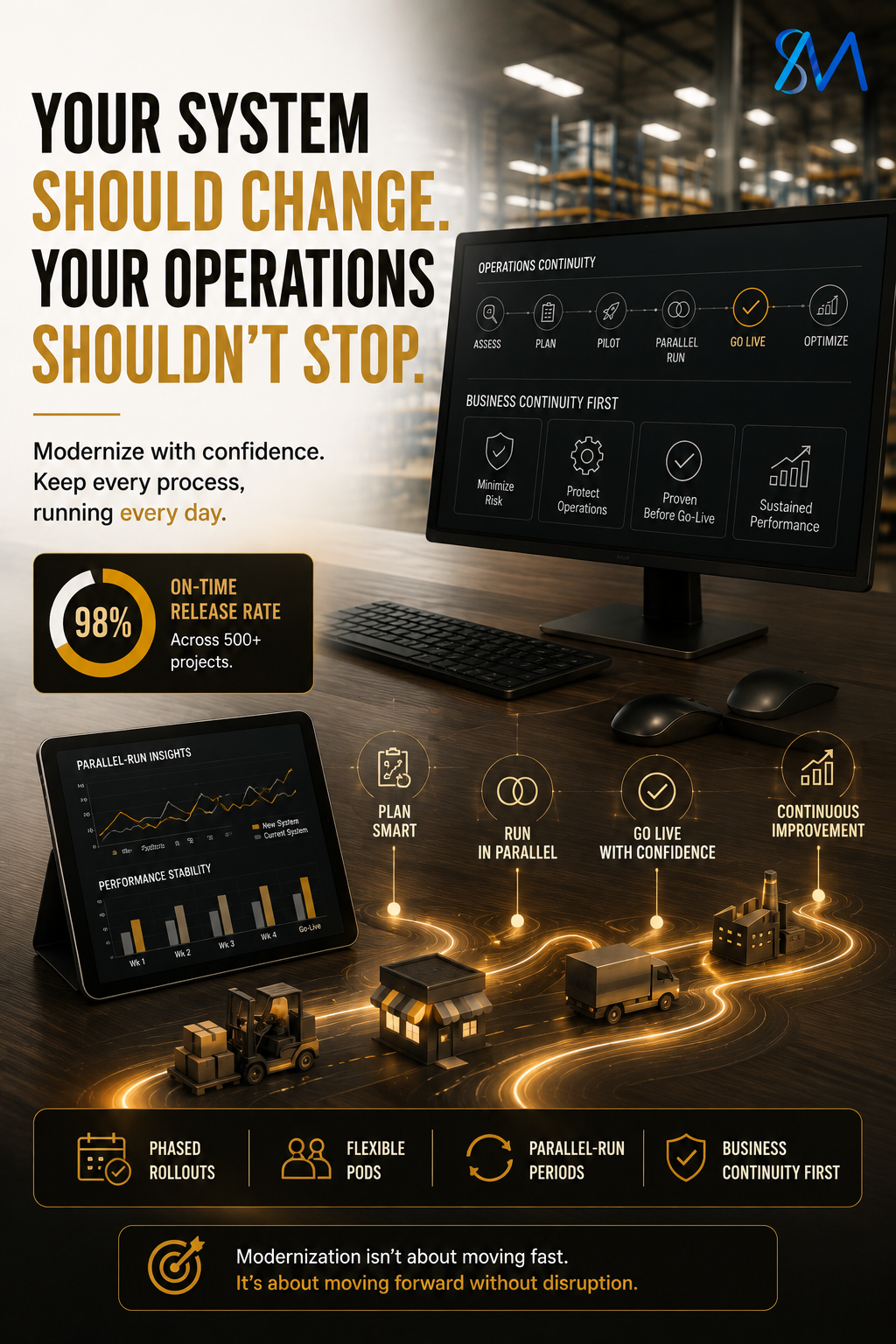
The delivery team that executes these programmes is structured for sustained performance. The core team of 20 engineers carries an average of 7 years of enterprise experience. The extended delivery network of 120 plus specialists covers every technical and functional discipline a complex rollout requires. Cross-functional pods are onboarded and delivering within 10 business days, structured around a three-phase model: discovery and calibration in week zero, integration and launch in weeks one and two, and delivery and optimisation from week three forward. The 98% on-time release rate across 500 plus projects reflects the governance rigour applied to every programme, including the adoption governance that ensures the system being delivered on time is also being used at the level the investment requires.
When Adoption Is Designed In, the Technology Investment Performs as It Was Intended
The technology investment an organisation makes in any given year should be returning visible value within the same financial year. That is not an aspirational standard. It is the outcome of a programme that was designed with adoption as a core objective from the start, not a follow-up task that gets resourced when underperformance becomes impossible to ignore.
The organisations achieving the strongest ROI from their enterprise technology investments share a consistent characteristic. They did not separate the question of what to build from the question of how to ensure it gets used. They designed adoption into the programme architecture. They measured the right things at every stage. They maintained active support through the window where habits are formed and usage patterns become durable. And they worked with an implementation partner who understood that the outcome they were accountable for was not a working system at go-live. It was a team that was operating at full capability on the platform sixty days later.
The gap between deployed and used is always closeable. The evidence across 500 plus projects in 14 countries is clear. When adoption is treated as a measurable outcome rather than an assumption, the value that was projected at business case stage surfaces on the timeline that was presented to the board. Teams operate with the consistency that makes enterprise technology worth investing in. And the ROI conversation that leadership needs to have becomes straightforward, because the numbers are already there.
The organisations that operate at that level did not get there by accident. They built adoption into the programme before the first configuration decision was made, and they chose a partner who understood that deploying the right system is only half of what delivery actually means.
Ready to solve this for your organization? Visit SuperBotics MultiTech to see how our team can help.
The clearest starting point we have seen: know what your operations are actually ready for before deciding what to change.
The ERP Fit Quiz surfaces that picture honestly — no interpretation required.