The Hidden Cost of Data Silos: How CRM and ERP Integration Defines SME Operational ROI

abitha
May 20, 2026 · 14 min read

INTRODUCTION
There is a particular kind of operational drag that does not appear on any dashboard. It does not generate a support ticket. It does not surface in a monthly board report. But across 500 enterprise engagements spanning the US, UK, France, Europe, and Brazil, SuperBotics sees it in nearly every SME that has scaled past a certain size: the architecture of how business data flows has never been properly built. Sales, Finance, and Operations are each running on their own version of the truth, each version slightly different from the others, and each version driving decisions that are subtly misaligned with the actual state of the business.
The spreadsheet is rarely the origin of this problem, and it is rarely the right place to solve it. Spreadsheets are a response to a need that a more structured system was not meeting. They appear when teams need visibility that their existing tools do not provide, when CRM data does not reflect operational reality, when ERP reporting requires a week of manual reconciliation before anyone can act on it. The spreadsheet fills the gap. The gap itself, however, stays exactly where it is. And every quarter that passes with data architecture unaddressed is a quarter in which growth decisions carry invisible risk.
The gap is rarely where it first appears. Most operations leaders who take the ERP Fit Quiz find the real friction point is one layer deeper than where they have been looking.
→ See Where Your Operations Actually Stand — 2 Minutes→ Speak with Our Team
This blog is written for the executive who already senses the problem and wants to understand both its depth and its resolution. It is also written for the leader who is still measuring the cost of fixing their data architecture against the cost of leaving it in place. By the time you finish reading, those two figures will look very different.
WHY DISCONNECTED DATA ARCHITECTURE PERSISTS IN WELL-RUN ORGANISATIONS
The organisations that arrive at SuperBotics with significant data silo challenges are not poorly managed. They are, in most cases, well-led businesses that grew faster than their original systems were designed to support. The CRM was selected when the sales team was twelve people. The ERP was implemented to handle procurement and finance at a scale that has long since been exceeded. The operations team built their own workflows because neither system reflected how work actually moved through the business. These are rational decisions made at rational moments. The compounding effect of those decisions, however, creates an architecture that the business eventually outgrows in ways that are difficult to see from the inside.
The challenge is that disconnected systems do not announce themselves as a strategic liability. They announce themselves as minor operational friction. A report takes longer than it should. A customer record is out of date. A purchase order does not reflect the current price the sales team agreed. These are small enough problems that the business adapts around them rather than addressing them at the structural level. Teams build reconciliation processes. Finance schedules a weekly meeting to align the numbers. Sales updates the CRM manually after deals close. Over time, these workarounds become invisible infrastructure, embedded in how the organisation operates, and the actual architecture of the business’s data continues to drift further from where it needs to be.
The reason this pattern persists in well-resourced organisations is that the cost of maintaining it stays below the threshold of urgency while the cost of fixing it seems large and disruptive. This is the calculus that keeps most SMEs in a suboptimal data architecture for longer than is commercially sound. The organisations that break out of it do not typically do so because a crisis forces their hand. They do so because a leader looks at what their data architecture is costing them in decision quality, reporting speed, and growth capacity and decides that the return on integration is too large to continue deferring.
THE REAL OPERATIONAL COST: DECISIONS MADE WITHOUT COMPLETE INFORMATION
The most precise way to understand what data silos cost a business is to trace what happens to a single operational decision when the data behind it is fragmented. A sales leader wants to understand which accounts are at risk. The answer lives across the CRM, the finance system, and the operations platform. None of them talk to each other. The analysis requires pulling reports from three different systems, reconciling fields that do not match, filling gaps with manual judgment, and arriving at a picture that is already several days old by the time it reaches the decision-maker. That process, repeated across every material business decision the organisation makes, represents an extraordinary quantity of lost time and degraded decision quality.
The reporting cycle is a direct expression of this cost. When CRM, ERP, and operations data live in separate systems, producing a consolidated view of business performance requires a reconciliation effort that is both time-intensive and error-prone. Many SMEs that SuperBotics works with arrive at a monthly or quarterly reporting cycle not because that frequency serves their business well, but because that is the minimum interval at which the reconciliation work is feasible. In a market environment where the organisations with faster feedback loops compound their advantage every quarter, a reporting cycle measured in weeks rather than hours is a structural competitive disadvantage.
There is also a subtler cost that rarely gets quantified: the cost of the decisions that do not get made. When data is difficult to access and reconcile, organisations naturally gravitate toward decisions that require less data. Strategic questions that demand a clear integrated view of the business either get deferred or get answered with the incomplete picture that is available. Over time, this shapes the organisation’s strategic posture in ways that are difficult to attribute to data architecture but are entirely a product of it. The organisations that move fastest on market opportunities are almost universally the ones that have already built the data infrastructure to see those opportunities clearly and quickly.
THE SUPERBOTICS APPROACH TO CRM AND ERP INTEGRATION
The most important principle in SuperBotics’ CRM and ERP integration practice is that the technology configuration follows the business architecture, not the other way around. This distinction matters more than almost any other in determining whether an integration project delivers lasting value. The common failure mode in enterprise integration work is to configure a platform to its generic best-practice defaults and then expect the business to adapt its operations to suit the system. The result is a technically functional implementation that the team underutilises, works around, or eventually abandons in favour of the same spreadsheets the project was meant to replace.
SuperBotics begins every CRM and ERP engagement with a structured discovery process that maps how data actually moves through the client’s business. Not how it is supposed to move according to the process documentation. Not how it moved five years ago when the current systems were selected. How it moves today, including all the manual steps, the informal workarounds, and the judgment calls that experienced team members make without thinking. This discovery phase produces a data flow architecture that reflects the genuine operational reality of the business. The integration is then built on top of that architecture, meaning the final system fits the organisation precisely and team adoption is natural rather than enforced.
The technical work covers the full integration stack. SuperBotics’ engineers design and build the API orchestration layer that connects CRM and ERP data in real time, eliminating the synchronisation lag that causes the mismatches most reconciliation cycles are trying to correct. Custom automation handles the data transformations specific to the client’s business rules. Omnichannel customer experience is connected to the operational back end so that sales, service, and operations teams are all working from the same current picture. Training and adoption support is embedded in the delivery programme so that the transition from siloed systems to integrated infrastructure is smooth and the team is confident in the new environment from day one.
SuperBotics delivers CRM and ERP integration across Salesforce, Zoho, SAP, Microsoft Dynamics, Odoo, and OpenText. Every engagement is scoped around the platforms the client has already invested in. There is no requirement to change technology stacks and no generic template applied. The integration is specified from the ground up, built around the client’s actual workflows, business rules, and reporting requirements.
ONE SOURCE OF TRUTH: WHAT REAL-TIME INTEGRATION DELIVERS FOR GROWTH-STAGE SMEs
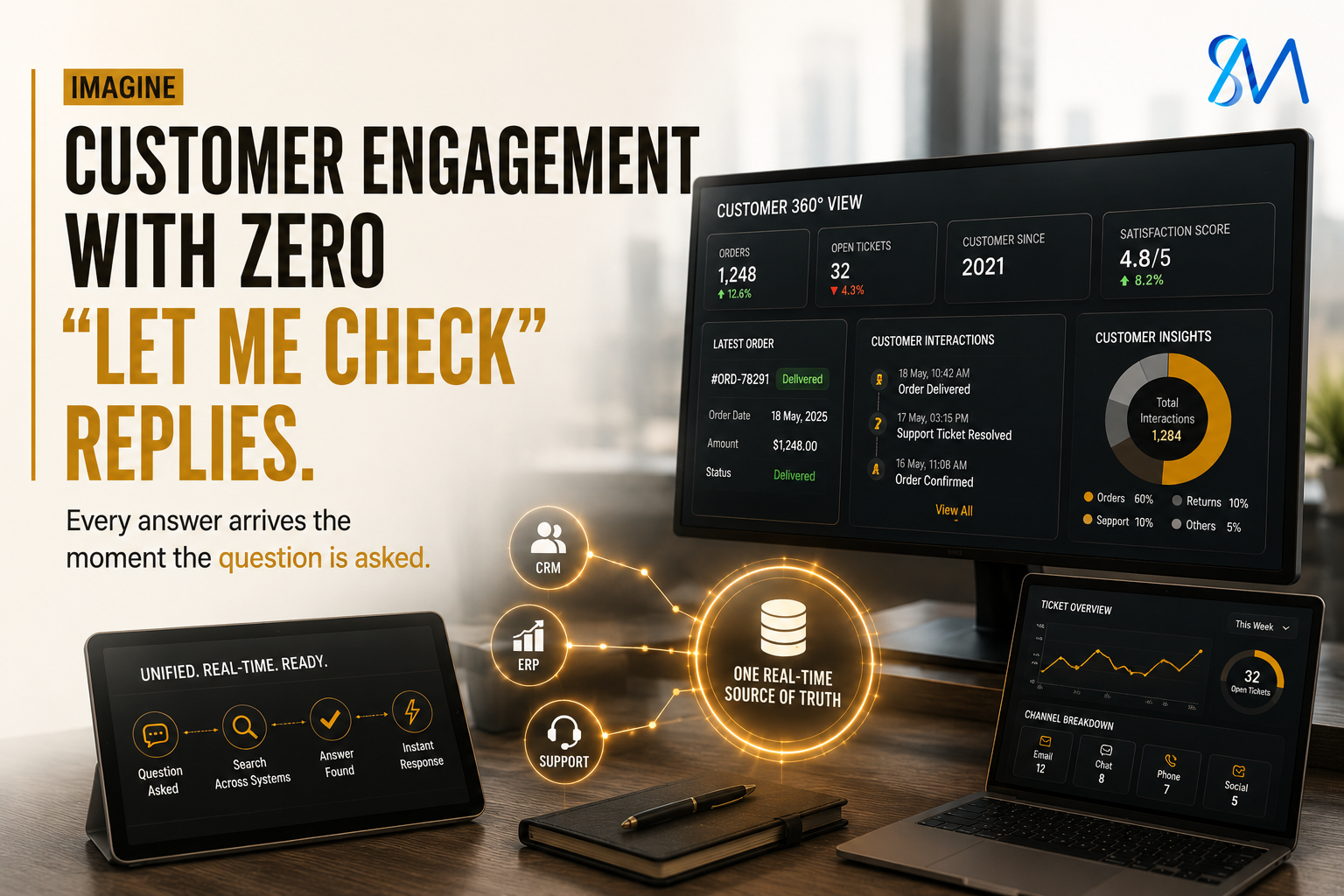
The phrase “single source of truth” has been used so widely in enterprise technology marketing that it has lost some of its operational meaning. For the purposes of this blog, it is worth being precise about what a genuinely integrated CRM and ERP environment delivers and why it represents a qualitative shift in how a business can operate. When CRM and ERP data are synchronised in real time and accessible through a unified reporting layer, every material business decision draws from the same current data. Sales knows the operational status of every account. Finance has immediate visibility into revenue pipeline and commitment. Operations can see the demand signals that sales is generating before they become urgent requests. The conversations that currently happen in weekly alignment meetings happen instead at the level of the data, automatically and continuously.
The reporting cycle transformation is among the most immediately measurable outcomes of a well-executed integration. Organisations that arrive at SuperBotics with a weekly or monthly reporting cycle, driven by the time required to reconcile disparate systems, regularly find that their post-integration reporting frequency can compress to daily or even real-time. This is not a modest improvement in operational efficiency. It is a structural change in how quickly the business can see what is happening, identify where attention is needed, and direct resources accordingly. At the growth rates that characterise successful SMEs in the US, UK, and European markets, a reporting cycle compressed from one week to one day represents a compounding advantage that builds quarter over quarter.
There is also a qualitative impact on the organisation’s relationship with its own data that is difficult to quantify but consistently reported by SuperBotics clients. When data is fragmented and reconciliation is laborious, organisations develop a low-level institutional distrust of their own numbers. Teams check each other’s figures. Leaders ask where a number came from before they act on it. The integration project eliminates the source of that distrust. When all teams know they are working from the same live data, the quality of internal dialogue around business performance improves substantially. Decisions get made faster. Accountability is clearer. The energy that was previously consumed by reconciliation work moves into productive analysis and action.
SuperBotics’ 500-plus project delivery history shows a consistent pattern: the organisations that achieve the strongest integration outcomes treat the work as a strategic business initiative rather than a technology project. The business discovery phase is led by senior operational stakeholders. The success criteria are defined in business terms, including reporting cycle time, decision frequency, reconciliation hours eliminated, and data confidence levels. The technical team builds to those criteria. This alignment between business outcome and technical delivery is one of the primary reasons SuperBotics maintains a 6.8-year average client partnership tenure. The relationship endures because the integrated architecture continues to compound in value as the business grows.
DELIVERED OUTCOMES: WHAT SUPERBOTICS CLIENTS ACHIEVE THROUGH INTEGRATION
The outcomes that SuperBotics integration clients achieve are a direct product of the methodology described above. Starting from genuine business discovery rather than generic platform configuration means that every integration delivers against the specific decision-making and reporting needs of that organisation. The platforms change by client. The outcomes share consistent patterns across industries and geographies.
SuperBotics’ finserv clients have seen particularly significant results from integration work that connects customer relationship data to operational workflows. One engagement delivered a 45% reduction in manual review time through AI-assisted operations built on top of a fully integrated data architecture. The integration itself was the prerequisite for that outcome. Without a single source of truth connecting CRM and operations data, the AI layer would have had nothing coherent to work with. The sequencing matters: data architecture first, advanced capability on top. This is the pattern that produces durable outcomes rather than pilot-stage results that never reach production.
SuperBotics pods onboard and begin delivering within 10 business days. The 98% on-time release rate across SuperBotics’ project history is a product of the front-loaded discovery and specification process: when the business requirements are precise and the technical approach is validated, delivery is predictable. Across 150-plus enterprise launches, the consistent differentiator between integrations that delivered sustained value and those that plateaued was the quality of the business discovery work at the outset. SuperBotics invests in that phase specifically because the return it generates across the delivery programme and the post-launch lifecycle is disproportionately large.
WHAT SUPERBOTICS SPECIFICALLY DELIVERS
SuperBotics delivers end-to-end CRM and ERP integration across the full enterprise platform landscape. The scope covers implementation, configuration, API orchestration, custom automation, training, and ongoing support. Every engagement begins with business discovery and ends with a live integrated environment that the client’s team can operate and extend independently. Compliance is embedded as standard across GDPR, CCPA, HIPAA, PCI DSS, ISO 27001, and SOC 2 aligned architecture for clients in regulated industries. All intellectual property is assigned to the client in every agreement.
The platforms SuperBotics delivers integration across include Salesforce, Zoho, SAP, Microsoft Dynamics, Odoo, and OpenText. Clients are not asked to change their technology investments. The integration is built to serve the business the client has, with the systems they have already invested in, connected in a way that reflects how those systems are actually used and how the business actually operates.
The SuperBotics team structure for integration engagements combines CRM and ERP platform specialists, API and integration engineers, business analysts, QA engineers, and adoption and training support. The core team of 20 engineers carries an average of seven years of enterprise delivery experience. 120-plus specialists are available on demand for engagements that require specific platform depth or volume. The D-U-N-S registration number 874095414 confirms SuperBotics as globally procurement ready for enterprise clients with formal vendor qualification requirements.
CONCLUSION
The businesses that are scaling most effectively in the current market are not the ones with the most technology. They are the ones whose technology fits the way the business actually works, whose data flows cleanly from every part of the organisation into a single coherent picture, and whose leaders make decisions with the confidence that comes from knowing the numbers are current, complete, and reconciled. That state of operational clarity is entirely achievable. It is not a function of company size or technology budget. It is a function of whether the integration work has been done, and done properly.
The cost of the current architecture is real, even when it is invisible on the dashboard. Every week of reporting lag, every hour of manual reconciliation, every decision made without a complete view of the business represents a cost that accumulates silently and compounds over time. The organisations that address their data architecture now are not just eliminating a current inefficiency. They are building the operational infrastructure on which the next phase of their growth will run. The competitive gap between businesses that have done this and businesses that have not will be one of the defining features of SME markets over the next several years.
SuperBotics has delivered this outcome across 500 engagements in 14-plus countries, in industries ranging from financial services to manufacturing to retail, for organisations at every stage of the journey from early integration to full enterprise data architecture. The approach is proven. The outcomes are documented. The only variable is timing. The SMEs that will lead their markets in the next decade are the ones building their data architecture today. The difference between where you are and where you need to be is a single integration away.
Ready to solve this for your organization? Visit SuperBotics MultiTech to see how our team can help.
The clearest starting point we have seen: know what your operations are actually ready for before deciding what to change.
The ERP Fit Quiz surfaces that picture honestly — no interpretation required.