The Real Reason New Hires Leave in the First Ninety Days

Abitha Jeyaraj, Marketing Executive
August 19, 2026 · 8 min read
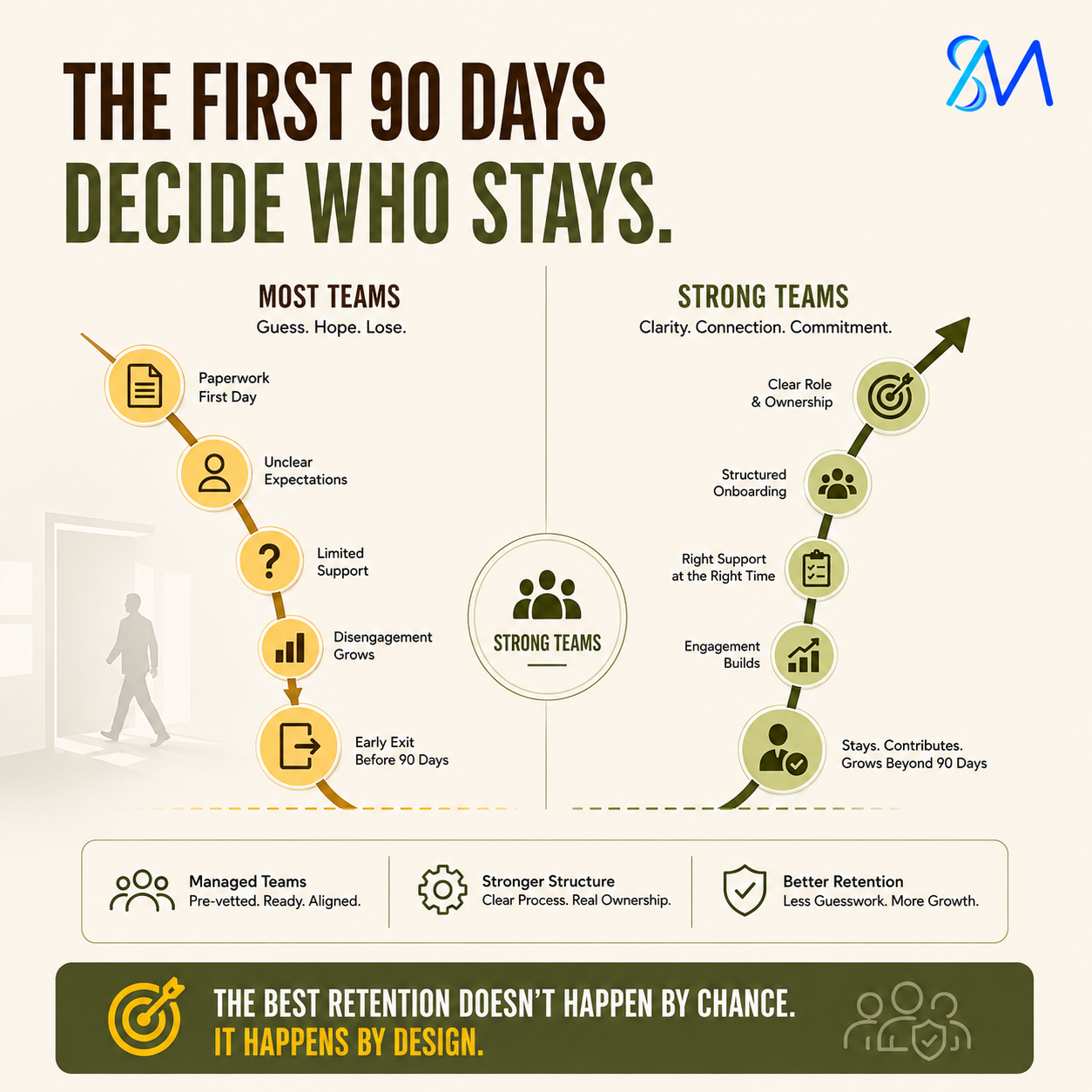
A new hire resigns at the end of month three, and the exit interview cites something vague about fit. Leadership treats it as an isolated case, a mismatch between the candidate and the role. Then it happens again the following quarter, with a different hire, a different manager, and the same vague explanation. By the third occurrence, the pattern is undeniable, but by then, the organisation has absorbed the cost of three failed ramp-ups without ever identifying the actual cause, and the hiring manager involved each time is left wondering if the issue is simply bad luck repeating itself.
This is one of the most expensive blind spots in enterprise operations, precisely because it never shows up as a single dramatic failure. It shows up as a slow, quiet drain on delivery capacity, hidden inside a turnover statistic that HR reports quarterly but rarely investigates structurally. In our engineering reviews across 500 plus engagements, we consistently observe that every early exit had a reason, and in almost every case, that reason was visible weeks before the resignation actually happened, to anyone who was watching for it.
The businesses most affected by this are not the ones who hire carelessly. Often, the hiring process itself is rigorous, with strong technical screening and thoughtful culture interviews. The gap sits somewhere else entirely: in the first ninety days after the offer is accepted, when onboarding is built around completing paperwork rather than around the specific moment a new hire quietly decides whether the job matches what they were told it would be.
Why Talented New Hires Leave in the First Ninety Days
It is worth being specific about why this persists even in organisations with genuinely thoughtful HR functions and well-designed onboarding checklists. The administrative onboarding process, provisioning, training, documentation, is relatively easy to standardise and audit for completeness. Building a structured mechanism for surfacing whether a new hire’s lived experience matches what they were promised is a fundamentally different exercise, closer to relationship management than process design, and most HR teams are stretched too thin across the full employee lifecycle to build that mechanism specifically for the ninety-day window where it matters most.
Most onboarding programmes are designed around administrative completeness: forms signed, systems provisioned, initial training modules finished. These are necessary steps, but they answer a different question than the one that actually determines retention. The question a new hire is quietly asking during their first ninety days is whether the role, the team, and the expectations match what they understood during the hiring process, and whether anyone would notice if the answer started to be no.
When that question goes unanswered, or worse, unasked, a new hire’s early doubts do not surface as a formal complaint. They surface as gradually decreasing engagement, quieter participation in team discussions, and a slow drift toward disengagement that a manager focused on delivery deadlines can easily miss, especially if that manager is also new to overseeing onboarding at scale. By the time the resignation letter arrives, the decision was usually made weeks earlier, and the exit interview simply confirms what nobody structurally checked for in time to act.
This pattern intensifies specifically in fast-scaling operations, where hiring velocity outpaces the organisation’s capacity to give every new hire structured attention during their critical early weeks. The team is growing precisely because delivery demand is high, which means the managers best positioned to notice early disengagement are also the ones with the least available time to notice it.
This dynamic is particularly costly because the financial impact of an early exit is almost always underestimated. The visible cost, recruiting fees and a vacant seat, is only a fraction of the actual loss. The larger cost is the ramp-up investment already made: the hours a manager and peer team spent training someone who leaves before that investment produces a return, and the delivery disruption that follows when a project loses a team member three months in, right as they were beginning to contribute independently. Most finance teams have never actually quantified this figure, because it does not appear as a discrete line item anywhere in a standard budget review.
How SuperBotics Builds Retention Into Delivery Capacity
Our Managed Teams model addresses the immediate capacity gap by bringing pre-vetted specialists across engineering, QA, DevOps, design, and product management directly into your operation, onboarded and delivering within 10 business days. But closing a capacity gap quickly is only half of what actually protects retention. The deeper fix is structural: clear ownership of the onboarding experience, documented process for the first ninety days specifically, and a defined mechanism for surfacing whether a new hire’s early experience is matching expectations, before it reaches the point of a quiet resignation.
We build this structure directly into how our elastic delivery pods integrate with your existing team, because a pod that is technically productive from day one but poorly connected to your organisation’s actual working rhythm creates the same early disengagement risk as a traditional hire brought in without structured onboarding. Our approach includes shared velocity dashboards, outcome-linked governance, and quarterly value reviews, all of which create natural checkpoints where a mismatch between expectation and reality becomes visible early, rather than surfacing for the first time in a resignation letter.
The businesses with the best retention are not the ones who hire the most carefully. They are the ones who removed the guesswork from someone’s first ninety days.
This structural approach applies whether the person joining your team is one of our Managed Teams specialists or a direct hire onto your own headcount, because the underlying discipline, clear ownership, documented process, and a genuine checkpoint during the critical early period, is what actually protects retention, regardless of who signs the employment contract.
A key part of this structure is separating the administrative onboarding checklist from the relational onboarding experience, because the two require entirely different ownership. Provisioning systems and completing compliance training can be tracked on a simple checklist with clear completion dates. Whether a new hire feels genuinely oriented, understands how decisions actually get made on their team, and has a trusted person to ask an honest question without it feeling like a performance risk, requires a different kind of ownership entirely, one that a generic HR onboarding workflow rarely accounts for.
The Proof: What Structured Onboarding Actually Changes
Our clients maintain a 6.8-year average partnership tenure, a figure built on exactly this discipline applied consistently across engineering, QA, DevOps, design, and product management roles. Combined with a 98% on-time release rate across 150+ enterprise launches, this reflects a broader pattern: teams that are onboarded with genuine clarity about ownership and expectations from day one deliver more consistently, and stay longer, than teams onboarded primarily around administrative completeness.
| Paperwork-Centered Onboarding | Structured Ninety-Day Onboarding |
|---|---|
| Early disengagement goes unnoticed until resignation | Quarterly value reviews surface mismatches early |
| Ownership of onboarding outcome is unclear | Clear ownership tied to outcome-linked governance |
| Turnover treated as an isolated HR statistic | Turnover pattern reviewed structurally across cohorts |
The organisations that eventually solve this problem rarely do so by hiring more cautiously. They solve it by treating the first ninety days as a designed experience with clear checkpoints, rather than a probationary period defined mainly by paperwork and initial training completion.
Over time, this discipline also changes how leadership talks about growth internally. Instead of treating headcount expansion and retention as two separate conversations, one about hiring velocity and one about HR satisfaction scores, a structured ninety-day framework connects them directly. Every new cohort becomes a data point that either confirms the onboarding structure is working or reveals a specific gap worth investigating immediately, rather than waiting for the next annual engagement survey to surface a pattern that was already visible months earlier to anyone looking closely.
What SuperBotics Specifically Delivers
For organisations facing capacity gaps alongside early turnover, our Managed Teams engagement delivers pre-vetted, cross-functional pods onboarded within 10 business days, integrated through shared velocity dashboards and outcome-linked governance that create structural checkpoints during the critical early period. This closes the immediate delivery gap while addressing the deeper retention pattern that quietly costs far more than any single unfilled role.
The teams that scaled delivery without scaling chaos did not hire faster. They changed how work was structured, visible from their first two weeks of onboarding.
The strongest teams do not measure their onboarding programme by how quickly paperwork gets completed. They measure it by whether a new hire, ninety days in, still believes the job matches what they were told it would be, and whether anyone in the organisation would actually notice if that belief started to change.
Every organisation we have worked with initially believed their turnover pattern was specific to their industry or their hiring process. It almost never is. The fix is almost always the same: build the checkpoint into the first ninety days deliberately, rather than discovering the mismatch for the first time in an exit interview.