What Will Your Team Stop Doing? The Integration ROI Question That Changes Everything

Abitha Jeyaraj, Marketing Executive
July 9, 2026 · 6 min read
The Question That Integration Business Cases Rarely Answer
Most integration projects are approved against the wrong measure. The question that opens the architecture conversation is almost always: what will this system do? The features. The data it will move. The systems it will connect. These are the inputs to a technical brief, and they are necessary. They are not sufficient. The question that determines integration ROI is a different one entirely: what will our team stop doing?
Manual data entry is not a line item in most integration business cases. It is described in general terms, as an inefficiency to be reduced, rather than quantified in hours, frequency, and downstream cost. That quantification gap is precisely where integration investments lose their ROI story, because without it, there is no success measure. The integration goes live, the team migrates to the new workflow, and six months later the question of whether the investment delivered value has no precise answer. It delivered the integration. Whether it delivered the business outcome it was approved to deliver is a question nobody built the mechanism to answer.
Integration that works becomes invisible. Only the efficiency remains. But that invisibility requires a deliberate design decision at the business case stage: define what success looks like in operational terms before the first architecture session, and build the measurement capability to confirm it has been achieved.
The gap is rarely where it first appears. Most operations leaders who take the ERP Fit Quiz find the real friction point is one layer deeper than where they have been looking.
→ See Where Your Operations Actually Stand — 2 Minutes→ Speak with Our Team
Why Manual Data Entry Is an Operational Tax, Not an Operational Cost
The distinction matters. An operational cost is managed and reported. An operational tax is paid continuously, usually without precise accounting, and compounds in ways that do not surface clearly in standard reporting. Manual data entry is a tax because its true cost is not the hours of entry alone. It is the decision cycle it delays, the error propagation it enables, and the leadership bandwidth it consumes in reconciliation and verification work that should not exist.
When a sales close requires manual entry into three systems before it appears in the pipeline, the pipeline visibility that leadership depends on is always running behind the actual business by the interval of that manual process. When a customer service resolution requires manual logging before it reaches the account record, the customer view that informs the next interaction is always incomplete by that same interval. These are not small inefficiencies. At enterprise scale, the cumulative effect on forecast accuracy, customer experience, and operational decision quality is measurable in ways that standard integration business cases rarely capture.
The organisations that build the most compelling integration business cases quantify this tax precisely before the investment is approved. They map the specific manual process, count its frequency, measure its duration, identify the downstream decisions it delays, and calculate the cost of that delay in operational terms. That quantification becomes the ROI baseline against which the integration is measured. It also becomes the commitment the integration must deliver.
The integration that reclaims executive bandwidth is the one scoped around what the business will stop doing. Not around what the systems will start doing.
Five Parameters That Separate Integration Investments That Reclaim Bandwidth From Those That Add Complexity
Before committing to any integration investment, five parameters need clear, specific answers. Together, they determine whether the project is scoped to deliver business outcomes or scoped to deliver technical capability, and that distinction predicts the ROI result with a high degree of reliability.
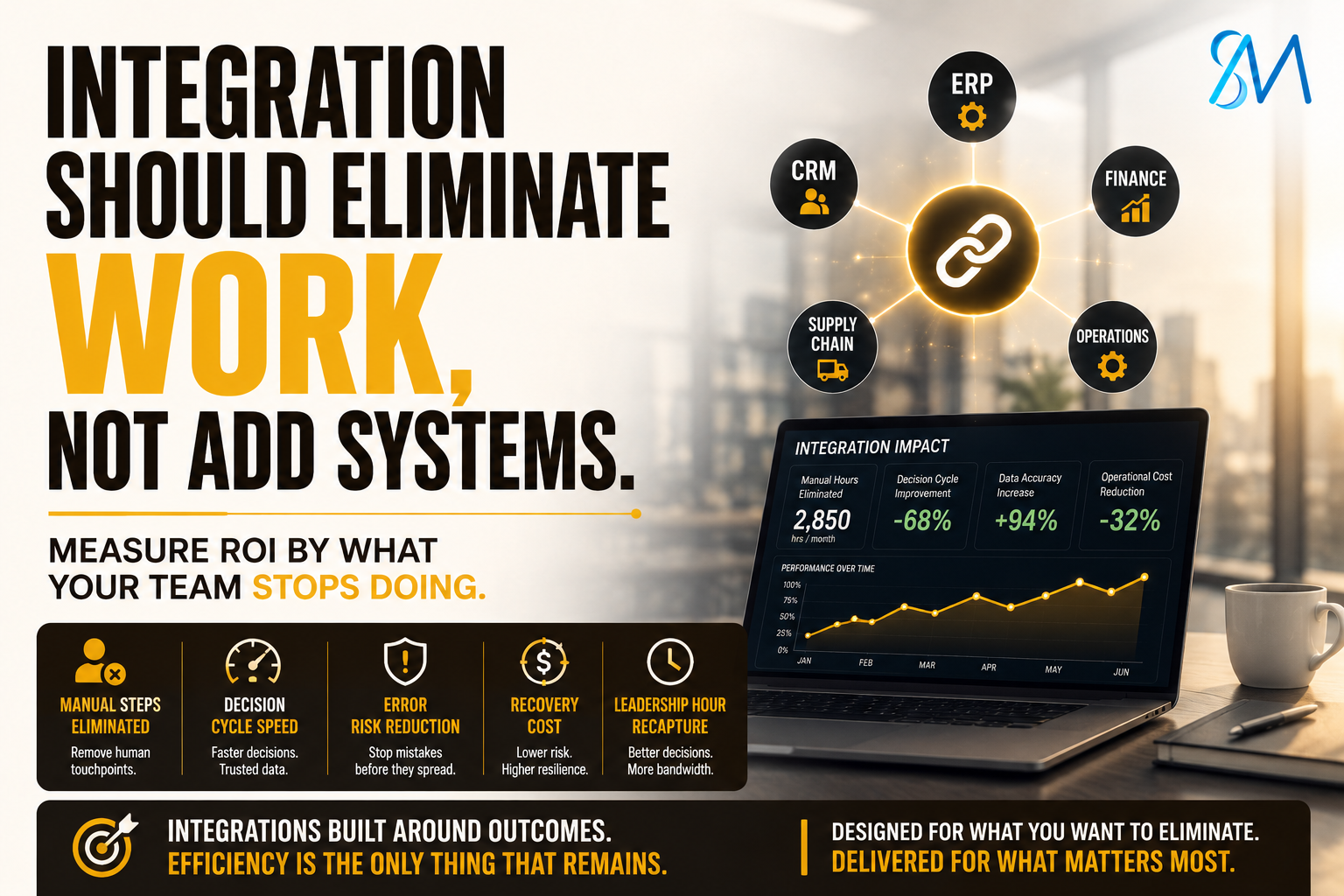
The volume of manual steps eliminated is the primary value driver. Not features added, but human touchpoints removed from recurring processes. This number, measured in touchpoints per week multiplied by the time cost of each touchpoint, is the baseline ROI figure. Decision cycle speed, measured as the time between a business event and a leader having accurate, trusted data available to act on, is the executive-level outcome. Every hour that interval shrinks is an hour of decision quality improvement. Error propagation risk addresses the downstream systems that inherit a mistake made at the point of manual entry. Recovery cost quantifies what one week of integration failure costs in operational terms. And leadership hour recapture identifies which decisions become faster and more accurate when the data infrastructure is clean.
| Parameter | What to Measure | Why It Matters to Leadership |
|---|---|---|
| Manual steps eliminated | Touchpoints removed per week × time cost | Capacity recaptured for growth work |
| Decision cycle speed | Time from event to informed decision | Faster forecasting and response |
| Error propagation risk | Downstream systems affected by one entry error | Data governance and audit confidence |
| Recovery cost | Cost of one week integration failure | Risk quantification for board reporting |
| Leadership hour recapture | Hours freed from reconciliation per week | Executive bandwidth redirected to strategy |
The Governance Layer That Ensures Integration ROI Is Sustainable
Integration ROI is not a launch event. It is a sustained operational outcome that requires a governance layer to maintain. The integrations that deliver consistent value over time are the ones that were built with monitoring, alerting, and quality assurance infrastructure from the beginning, not the ones that were built to deliver at go-live and maintained reactively thereafter.
Data accuracy monitoring, configured to alert before error rates reach operational impact thresholds, is the mechanism through which data trust is preserved. Without it, accuracy issues accumulate silently until a business decision is made on incorrect data and the source of the error requires investigation. Performance monitoring at the synchronisation layer ensures that latency does not creep beyond the decision cycle speed parameters the integration was designed to deliver. And audit logging that satisfies compliance requirements for every system the integration touches removes the manual compliance burden that often reasserts itself when integration monitoring is inadequate.
Across our integration engagements, clients who invest in this governance layer at the design stage consistently report higher adoption rates, lower maintenance overhead in the first year, and clearer ROI measurement than those who treat governance as a post-launch priority. The governance investment at the design stage is a fraction of the cost of rebuilding trust in data that was allowed to degrade.
What SuperBotics Enterprise Integration Delivers
SuperBotics designs integration programmes that begin with business outcome definition and end with governance infrastructure that sustains those outcomes over time. Every engagement answers the five ROI parameters before architecture begins, ensuring that the technical design is built to deliver what the business case promised rather than what a feature specification described.
Our API orchestration, data synchronisation, and integration governance delivery spans Salesforce, SAP, Microsoft Dynamics, Odoo, OpenText, and custom platform integrations. The monitoring, alerting, and accuracy assurance frameworks we deploy are operational infrastructure, not afterthoughts, because integration ROI that cannot be measured and maintained is integration ROI that will eventually be questioned.
The integration that reclaims executive hours does not do so once and stop. It does so consistently, quarter after quarter, because it was designed and governed to maintain data trust across every operational scenario the business encounters. That is the integration worth building. And it always begins with the right question: not what will the systems do, but what will the team stop doing.
Integration that is designed around what disappears is the only kind worth approving.
Ready to solve this for your organization? Visit SuperBotics MultiTech to see how our team can help.
The clearest starting point we have seen: know what your operations are actually ready for before deciding what to change.
The ERP Fit Quiz surfaces that picture honestly — no interpretation required.