When Operations Leads Before Deployment, Enterprise Workflow Integrations Deliver on Their Full Promise

abitha
April 30, 2026 · 17 min read
The Integration Programme That Delivered and the One That Almost Did Not
There is a version of every enterprise workflow integration where go-live day is calm. The operations team is not discovering surprises. Customer-facing processes are running within tolerance. Engineering and operations are looking at the same dashboards, reading the same signals, and making decisions together because they planned for this moment weeks before deployment opened. Revenue is protected. The business moves forward. The programme becomes a reference point for how technology change should be managed at scale.
There is also a version where go-live day is a recovery exercise. The engineering team shipped a technically correct system. The operations team inherited it without the context needed to run it. The gap between what was built and what the business was prepared to absorb surfaced in production, at full scale, with real customer transactions in motion. The remediation that follows is not just expensive in direct cost. It is expensive in leadership time, team confidence, partner trust, and the compounding distraction that pulls senior attention away from forward programmes for weeks or months after the incident has passed.
The difference between those two versions is almost never technical. Across 500-plus projects delivered by SuperBotics across CRM, ERP, cloud, and AI workflow integrations, the variable that most consistently determines go-live quality is not the sophistication of the architecture, the maturity of the platform, or the size of the engineering team. It is whether operations leadership was a design partner from the beginning of the programme or an inheritor of the outcome at the end of it. That sequencing decision is made before the first configuration is written, and its effects are felt long after the deployment window closes.
The gap is rarely where it first appears. Most operations leaders who take the ERP Fit Quiz find the real friction point is one layer deeper than where they have been looking.
→ See Where Your Operations Actually Stand — 2 Minutes→ Speak with Our Team
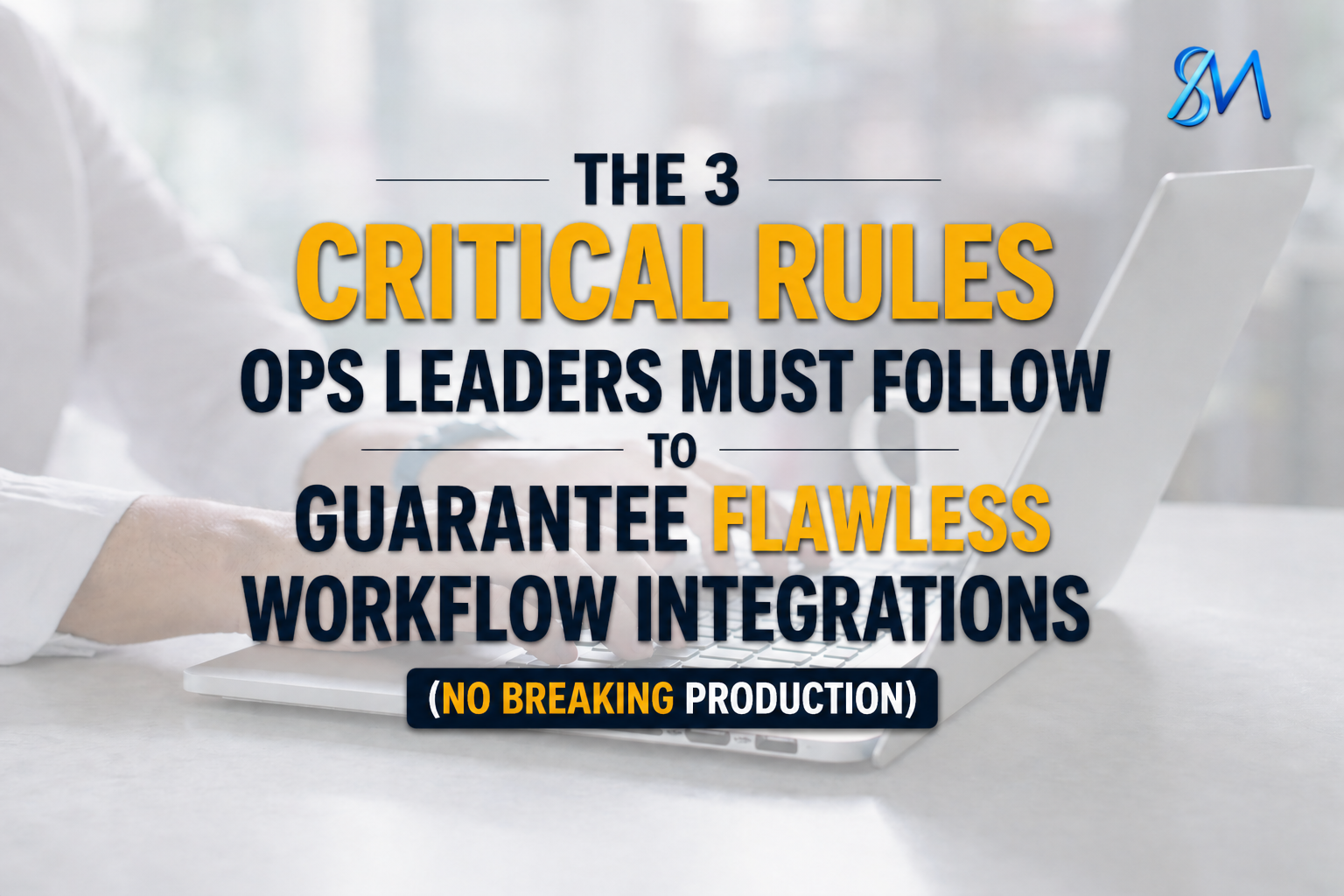
This blog is written for the executives and senior technology leaders who are accountable for integration programmes at the business level, and who understand that the value of a well-governed go-live extends far beyond the technical milestone. What follows is the three-rule model that defines how SuperBotics approaches enterprise workflow integration go-lives, why each rule exists, and what the delivery record shows when they are applied consistently.
The Structural Condition That Produces Integration Risk at the Moment of Go-Live
Enterprise integration programmes are large, sequential, and structured around clear phase boundaries. Discovery leads into design. Design leads into build. Build leads into testing. Testing leads into deployment. Each phase has owners, and in most organisations, the operational leadership team is not among the primary owners of the phases that precede deployment. This is not a governance failure or a resourcing decision. It reflects how integration programmes have historically been categorised: as technology programmes, managed by technology teams, with operational stakeholders brought in to validate outputs rather than shape inputs.
The challenge with that model is not that it produces technically inadequate systems. In most cases, it does not. The challenge is that it systematically excludes from the design conversation the people who hold the most detailed understanding of how the business actually operates at ground level. Operations leaders know where the manual workarounds are. They know which exception-handling processes exist outside the documented workflow. They know which teams have built institutional knowledge around the existing system that does not appear anywhere in the configuration documentation. They know what a bad Monday morning looks like when a critical business process behaves unexpectedly, and they know which downstream dependencies will surface the problem before the technology team does.
When that knowledge enters the programme at the deployment phase rather than the design phase, the programme has already made decisions that it cannot reverse at the pace that go-live requires. The architecture is set. The configuration is locked. The deployment schedule is committed. Operational input at that stage becomes a list of concerns without a runway to address them, and the gap between what the system does and what the business was prepared to absorb becomes a live production risk. The organisations that have moved through multiple integration cycles at enterprise scale understand this pattern. They have experienced it at least once. The ones with 6.8-year partnerships with SuperBotics have stopped experiencing it, because the programme structure that eliminates it is applied from day one of every engagement.
The root cause is a sequencing assumption that is worth naming directly: that deployment readiness and operational readiness are two separate milestones, owned by two separate teams, completed in sequence. The enterprise integration programmes that deliver without recovery are the ones that treat those two milestones as a single, jointly owned definition of done. Every structural decision that SuperBotics makes in programme design is oriented toward creating the conditions for that joint ownership to function in practice, not just in the programme charter.
Rule One: Run a Parallel Window Before Full Cutover, and Treat It as an Operational Event, Not a Technical Checkpoint
The parallel window is the practice of running the old and new workflow environments simultaneously for a defined period before the cutover date, with both processing real transactions and the outputs being actively compared and reviewed by the operations team. It is the most reliable mechanism available for exposing integration behaviour under live business conditions before the legacy environment is decommissioned and the new system carries the full operational load. Every major integration programme SuperBotics delivers is structured with a parallel window as a non-negotiable phase, and the governance of that window is owned jointly by engineering and operations from the moment it opens.
What the parallel window surfaces that testing does not is the behaviour of the new integration under the full complexity of live operations. Automated test suites are excellent at validating defined scenarios. They are not designed to capture the edge cases that emerge from real transaction volumes, from the specific data quality characteristics of a live production environment, or from the interaction between the new integration and the adjacent systems that were not part of the test scope. These are not engineering oversights. They are structural limitations of controlled testing environments, and the parallel window is the tool that compensates for them in a way that protects revenue rather than learning from its absence.
The governance model for the parallel window is as important as the window itself. SuperBotics structures parallel window reviews as formal operational events with defined attendees, documented comparison criteria, and a clear decision framework for what level of discrepancy triggers a remediation cycle versus what is within acceptable tolerance for full cutover. Operations leaders own the sign-off on cutover readiness, not engineering. This is not a procedural detail. It reflects a fundamental principle of the programme design: the decision to transition the business from one operational state to another is a business decision, and the people accountable for business operations are the ones who make it, with full visibility into what the comparison data is showing.
Across the AWS, Azure, Salesforce, SAP, Zoho, and custom API integrations that SuperBotics has delivered, the parallel window has consistently been the phase where the programme produces its highest value per investment. Not because it catches critical failures, though it does that as well, but because the joint operational review it requires creates the shared understanding between engineering and operations that makes the final cutover a confident, coordinated business decision rather than a technical event that operations learns about after the fact.
Rule Two: Define Impact Scope Before Deployment Opens, With Operations Holding the Pen
Impact scope documentation is the structured answer to three questions that every enterprise integration programme must resolve before deployment begins: which systems and processes will be affected by this integration going live, which teams and stakeholders need to be informed and prepared before the cutover window opens, and what does a structured, time-bound recovery look like if a critical component behaves unexpectedly in production. These questions have specific, documented answers in every integration programme that proceeds without major incident. In programmes that encounter significant post-launch remediation, they tend to be answered reactively, during the incident itself, by people who are simultaneously trying to resolve it under time and reputational pressure.
The quality of impact scope documentation determines the quality of the organisation’s response to any production event, and production events occur even in well-governed integration programmes. The question is not whether an unexpected behaviour will surface during or after go-live. The question is whether the organisation has a clear, pre-agreed protocol for identifying it, escalating it to the right decision-makers, and executing a recovery path that is already defined and practiced. An organisation that answers those questions in the impact scope document before deployment begins responds to a production event in minutes with a coordinated team. An organisation that answers them during the event responds in hours with a fragmented one.
SuperBotics requires impact scope documentation to be completed and formally signed off by operations leadership before any deployment activity begins in a programme. The sign-off is not a formality. It is the operational leadership team confirming that they understand the full scope of what is changing, that the right people are prepared and informed, and that the recovery path is defined and resourced. Engineering cannot sign off on this document, because engineering does not own the operational consequences of what it is deploying. Operations holds the pen on this document because operations holds the accountability for what happens in production after the cutover.
The discipline of defining impact scope before deployment also produces a secondary benefit that compounds across the life of the integration. It forces a structured conversation between engineering and operations about every system dependency, every process that touches the integration, and every team that will be affected by the change. That conversation surfaces assumptions that were previously implicit, resolves ambiguities that were previously deferred, and creates a shared operational model of the integration that both teams can reason from consistently. The organisations that work with SuperBotics across multi-year partnerships consistently identify the impact scope discipline as one of the highest-value governance practices in the engagement, because its benefits extend well beyond the individual go-live into the programme of continuous integration evolution that follows.
Rule Three: Separate Deployment from Activation and Give Operations the Control Instrument
Deployment and activation are two distinct operational events that carry fundamentally different implications for the business, and they should be governed by two different decision processes with two different sets of owners. Deploying code makes a capability available in the environment. It changes the technical state of the system. Activating a workflow changes the operational state of the business. It determines what customers experience, what processes run, and what teams are required to support. Conflating these two events by designing programmes where deployment and activation occur simultaneously removes the ability for operations leaders to control the timing of business impact, and it creates conditions where a technical decision made by an engineering team can have immediate customer-facing consequences before the operational team is positioned to support them.
Feature flag architecture is the technical mechanism that creates this separation in practice. A feature flag is a configuration control that allows a deployed capability to remain inactive in the environment until an authorised decision-maker enables it. In the context of enterprise workflow integration, feature flags give operations leaders the ability to activate new workflows on their own schedule, after deployment has been completed and validated, without requiring a separate engineering deployment to trigger the activation. This means that engineering can complete its work, close its deployment window, and hand over a technically ready environment to operations, which can then activate workflows team by team, process by process, market by market, at a pace and sequence that reflects operational readiness rather than technical readiness.
The separation that feature flag architecture creates is not just operationally valuable. It is strategically significant for the relationship between engineering velocity and operational confidence in a scaling organisation. Fast engineering teams in organisations without activation governance create a structural tension: the faster engineering ships, the more frequently operations is required to absorb change without adequate preparation time. That tension produces one of two outcomes over time. Either engineering slows down to accommodate operations, which reduces the organisation’s ability to move at the pace the business requires, or operations develops a persistent backlog of absorbed risk that eventually surfaces as a significant production incident. Feature flag architecture resolves this tension at its structural root by decoupling the two decisions that were creating it.
SuperBotics architects feature flag controls into every CRM, ERP, cloud, and AI workflow integration programme as a standard delivery component, not an optional technical enhancement. The 20-engineer core team, averaging seven years of enterprise integration experience, builds activation governance into the programme architecture at the design stage, so that the control instruments are available and tested before the go-live window opens. Operations leaders enter the cutover period with a clear activation sequencing plan, a tested rollback path at the workflow level, and the technical tooling to execute both without requiring engineering involvement in the activation decision. That combination is what makes go-live day a calm, controlled operational event rather than a high-stakes technical performance.
What 6.8 Years of Partnership Tenure Shows About Stable Integration Delivery
The 6.8-year average client tenure that SuperBotics sustains across its enterprise client base is the outcome of a compounding effect that begins at the first go-live. An organisation that experiences a high-confidence integration launch, where production is protected, the operations team is prepared, and the cutover is a business decision rather than a technical event, has a qualitatively different perception of what a technology partnership can deliver. That perception shapes the next programme, and the programme after that, and the way the organisation thinks about the strategic value of technology investment at the leadership level.
The finserv client that achieved 45% less manual review time through AI-assisted workflow integration reached that outcome through a programme structured exactly on the three-rule model described in this blog. Operations leadership was a design partner from the discovery phase. The impact scope was documented and signed off before the first deployment window opened. Workflow activation was sequenced using feature flag controls that the operations team governed independently. The go-live was a coordinated operational transition, not an engineering handover. The 45% improvement was measurable from the first full operational cycle, because the programme was designed to produce a stable, supported workflow from day one rather than a technically functional system that the operations team then spent months learning to run effectively.
The 98% on-time release rate that SuperBotics sustains across 150-plus enterprise launches is not a reflection of simple programmes. It is a reflection of a delivery model where operational readiness is treated as a first-class engineering requirement, not a post-deployment concern. Programmes that include cloud migrations for healthcare clients aligned with HIPAA and zero-trust architecture standards, multi-locale e-commerce deployments across distributed customer bases, and AI workflow integrations across platforms including AWS, Azure, Salesforce, and SAP maintain this rate because the programme structure is designed to surface and resolve operational risks during the programme, not after it. The operations team at the end of a SuperBotics-delivered integration is not discovering the system for the first time at go-live. They have been co-designers of the transition from the beginning, and the go-live is the culmination of a joint programme, not the start of a new operational challenge.
The 82% automation coverage achieved for enterprise AI clients, and the 4x faster insight cycles delivered through AI and data integration programmes, are outcomes that require operational adoption to realise. They are not produced by technical deployment alone. They require operations teams who understand what has been built, who were involved in shaping how it fits into their workflows, and who have the governance tools to activate and adapt it as the business evolves. The three-rule model is what creates the conditions for those outcomes to be achieved and sustained across the life of the partnership.
What SuperBotics Delivers for Enterprise Workflow Integration Go-Lives
SuperBotics brings a cross-functional integration programme to every enterprise go-live that treats operational readiness as an engineering responsibility from programme day one. The delivery team includes engineering, DevOps, QA, and integration specialists, with operations readiness governance embedded across every phase of the programme under a shared delivery model. The pod is onboarded and delivering within ten business days, with the programme architecture, including parallel window design, impact scope documentation, and feature flag activation governance, established in the first two weeks of the engagement.
Platform coverage across AWS, Azure, Salesforce, SAP, Zoho, Microsoft Dynamics, Odoo, and custom API ecosystems means that the programme can be applied to integrations of genuine enterprise complexity, including multi-system architectures where the operational interdependencies are extensive and the activation sequencing requires careful coordination across business units, geographies, and partner systems. Compliance alignment across GDPR, CCPA, HIPAA, PCI DSS, ISO 27001, and SOC 2 is built into the programme architecture, not applied as a validation layer at the end of the build phase. Intellectual property is assigned to the client as standard in every agreement, without exception.
The 120-plus specialist network available on demand means that programme scale is not a constraint on the quality of the delivery model. Large, complex integrations receive the same governance structure, the same operational readiness rigour, and the same activation control framework as focused, single-system programmes. The 38% average cost optimisation achieved for Managed Teams clients reflects a delivery model where programme efficiency and delivery quality are complementary rather than competing objectives. The programme is designed to protect production first, and to deliver that protection without the overhead that typically accompanies enterprise-grade governance in integration delivery.
The Principle That Outlasts Every Individual Go-Live
The most durable insight from delivering over 500 enterprise integration programmes across more than a decade of technology partnerships is that stable go-lives are not produced by superior technology choices alone. They are produced by programme structures that respect the full complexity of what it means to change how a business operates at scale, and that treat the people accountable for running the business as essential contributors to the design of that change, not recipients of its output.
The three rules described in this blog are not advanced practices or differentiating innovations. They are disciplines that the most consistently successful enterprise integration programmes apply without exception, because the value of applying them compounds across every go-live that follows the first one. An organisation that runs a parallel window learns something about its integration behaviour that it could not have learned any other way. An organisation that completes an impact scope document before every deployment develops an institutional practice of thinking clearly about operational consequences before technical actions are taken. An organisation that separates deployment from activation builds a governance culture where engineering velocity and operational confidence are not in tension because the programme architecture does not require them to be.
SuperBotics has built its 6.8-year average partnership tenure on one conviction: that the organisations achieving the most durable outcomes from technology investment are the ones where stability is designed into the programme from the beginning, not recovered after the go-live. The technology will continue to evolve. The platforms will change. The integrations will grow more complex. The principle that governs how those changes are delivered to the business does not change. Production must be protected first, and that protection must be a joint ownership between engineering and operations from the first design conversation. Every organisation that has held that principle consistently has found that it does not slow technology delivery. It is the condition that makes technology delivery worth trusting at scale.
Ready to solve this for your organization? Visit SuperBotics MultiTech to see how our team can help.
The clearest starting point we have seen: know what your operations are actually ready for before deciding what to change.
The ERP Fit Quiz surfaces that picture honestly — no interpretation required.