Why ERP, POS, and Shop-Floor Upgrades Fail at the Cutover, Not the Build

Abitha Jeyaraj, Marketing Executive
August 27, 2026 · 7 min read

The Fear Every Operations Leader Carries Into a System Change
System downtime during a shop-floor upgrade is the fear no one says out loud in a steering committee meeting. Everyone talks about scope, budget, and timeline. Almost no one names the actual risk sitting underneath all three: the hour when the old system goes dark and the new one is not yet proven under real production load. That hour is where every modernization programme actually lives or dies.
The fear is not irrational. A line stoppage during a system cutover routinely costs more in lost throughput and missed shipment windows than the software itself. A retailer running a point of sale migration mid season can watch checkout queues back up within minutes of a failed sync. A manufacturer moving ERP modules mid shift can lose an entire production run to a data mapping error nobody caught in testing. These are not hypothetical risks. They are the specific reason operations leaders delay upgrades they already know they need.
The gap is rarely where it first appears. Most operations leaders who take the ERP Fit Quiz find the real friction point is one layer deeper than where they have been looking.
See Where Your Operations Actually Stand — 2 Minutes
→ Speak with Our Team
Most operations leaders carry a memory of exactly this kind of failure, even if it happened somewhere else, to someone else, in a system they never touched. That memory shapes every technology decision that comes after it. A vendor promises a smooth migration, and the operations leader nods, then privately adds another six months to the internal timeline, because the promise does not match what they have actually seen happen when a cutover goes wrong.
Why the Fear of Downtime Persists Even With Better Technology
The technology available for ERP, POS, and shop-floor integration has improved substantially over the last decade. Cloud infrastructure is more resilient. Migration tooling is more mature. Yet the fear of downtime during a system change has not decreased at the same pace, because the fear was never really about the technology. It was about the sequencing.
Most failed cutovers do not fail because the new system is broken. They fail because the transition plan assumed a level of readiness that was never actually tested end to end, under production conditions, with the exact data volume and exact edge cases the business runs every day. A demo environment with clean sample data behaves nothing like a live shop floor at the end of a shift, three data corrections behind, running a barcode format the vendor never saw in testing.
Across 500+ projects and 150+ enterprise launches, downtime during a system change has almost always come down to one thing: a planning failure, not a technology inevitability. The organisations that avoid it are not the ones with the newest software. They are the ones who refused to treat go live as the first real test of the system.
How SuperBotics Protects Production Continuity Through the Transition
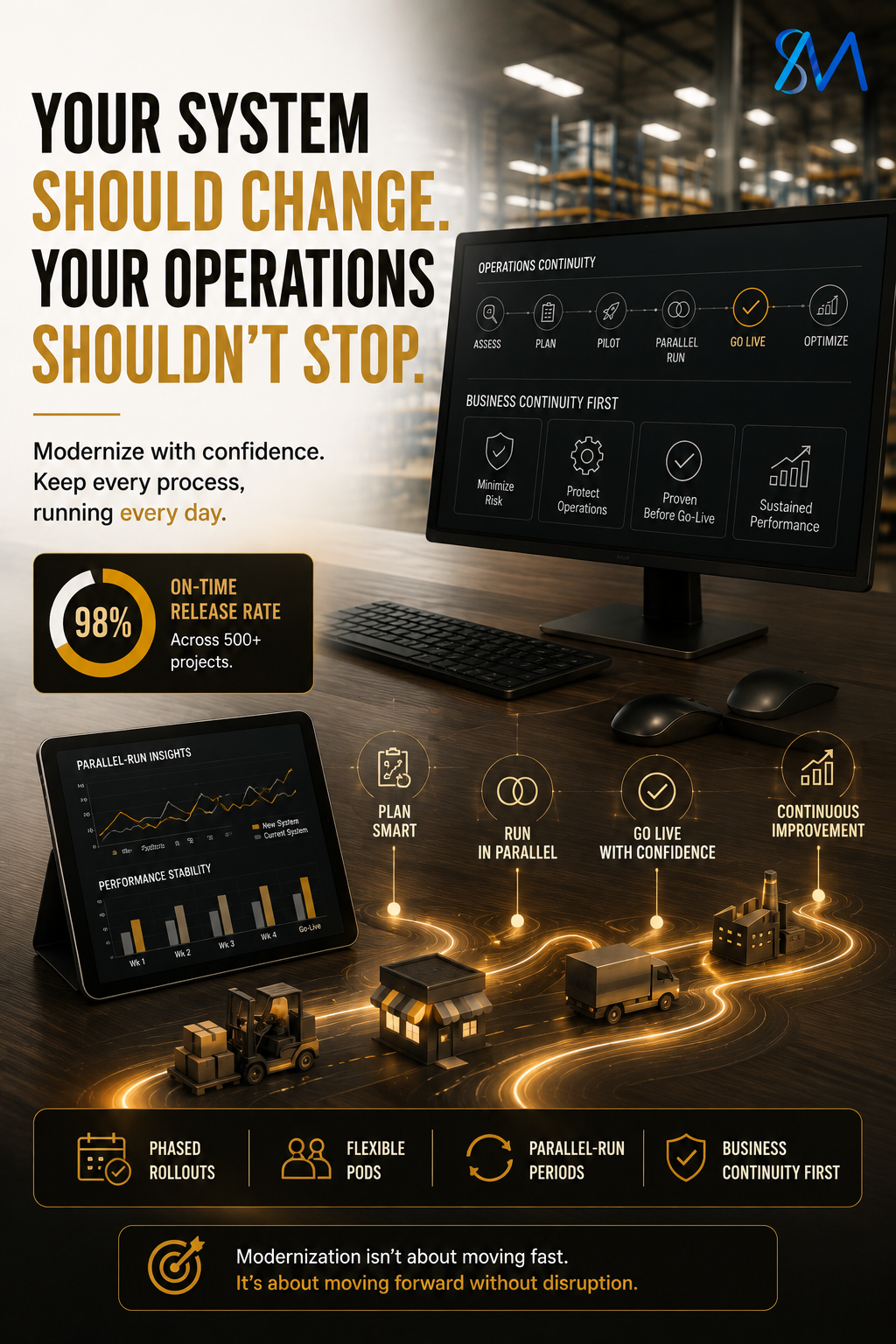
Our approach to ERP, POS, and shop-floor modernization is built around a single non negotiable principle: nothing goes live until it has proven itself alongside the system it is replacing. That principle shapes every phase of the engagement, from discovery through cutover.
We begin by mapping the operational reality of the current system, not its documentation. That means walking the shop floor, watching how POS terminals are actually used during a rush, and identifying the workarounds staff have quietly built to compensate for gaps the original system never addressed. Those workarounds are usually the first thing a new system breaks, because nobody remembered to design for them.
From there, we run dual environments in parallel for a defined validation period. Every workflow that matters to daily operations gets tested against both systems simultaneously, not just the workflows that were easy to document. Discrepancies get resolved before cutover, not discovered during it. Pods scale up or down within two weeks depending on what the validation phase surfaces, so the team investigating an edge case is never blocked waiting for headcount.
Cutover itself happens in phases tied to business rhythm, not to an arbitrary project milestone. A retailer does not migrate POS mid season. A manufacturer does not switch ERP modules mid production run. The cutover window is chosen around when the business can absorb the lowest possible risk, and the rollback plan is defined and rehearsed before the first terminal goes live on the new system.
The Four Checkpoints Every Cutover Must Clear Before Go Live
- Parallel run validation across every high frequency workflow, not just the documented ones
- A rehearsed rollback plan with a defined trigger point, agreed before cutover begins
- Data reconciliation between old and new systems confirmed at the record level, not sampled
- A cutover window chosen around business rhythm, never around the project calendar
What This Discipline Has Delivered Across 500+ Projects
This discipline is part of why SuperBotics holds a 98% on-time release rate across 150+ enterprise launches. It is not a claim about the software we implement. It is a claim about the sequencing we insist on before a single terminal, warehouse scanner, or finance module goes live on a new system.
The pattern holds across industries. A retailer moving POS across multiple store locations avoided a single day of checkout downtime by running the legacy and new systems in parallel through an entire peak trading week before the final cutover. A manufacturer replacing shop-floor scheduling software identified three data mapping errors during the validation phase that would have halted a production line had they surfaced during a live cutover instead. Neither outcome came from luck. Both came from refusing to let the parallel run phase get compressed to meet a deadline.
What SuperBotics Delivers for ERP, POS, and Shop-Floor Modernization
We implement and integrate ERP, POS, and shop-floor systems across SAP, Microsoft Dynamics, Odoo, Salesforce, Zoho, and OpenText, with phased cutovers built specifically to protect production continuity. That means dual environment validation as standard, not as an optional add-on. It means a rollback plan that exists in writing before go live, not one improvised if something breaks. And it means a cutover team available during the actual transition window, not just during business hours convenient to a project schedule.
Every engagement is built around the same underlying question: what does this business need to keep running while the system underneath it changes? Answering that question honestly, before implementation begins, is what separates a modernization programme that protects the business from one that gambles with it.
Why Compliance and Audit Trails Depend on the Same Discipline
Cutover discipline is not only about avoiding lost throughput. For manufacturers running quality management systems tied to ISO frameworks, or retailers with PCI obligations tied directly to POS infrastructure, a rushed migration can quietly break the audit trail an auditor expects to see intact. A shop-floor system tracking batch genealogy needs every record to reconcile across the cutover date, not just the transaction totals. A POS environment handling card data needs its PCI scope mapped before a single terminal moves to a new payment gateway, not discovered after an assessor asks for evidence.
This is one of the reasons dual environment validation matters beyond operational risk. It gives compliance and finance teams a window to confirm that reporting, reconciliation, and audit trails survive the transition intact, rather than finding out during the next audit cycle that a gap opened during migration week and nobody caught it in time.
The clearest starting point we have seen: know what your operations are actually ready for before deciding what to change.
The ERP Fit Quiz surfaces that picture honestly — no interpretation required.
Planning the Transition Before You Need It
The businesses that modernize without disruption are not lucky, and they are not necessarily better resourced than the ones who get burned by a cutover. They planned the transition before they needed it, and they refused to let go live be the first real test of whether the new system actually worked. Most operations leaders already carry the memory of what happens when that discipline is missing. The gap between that memory and a transition that protects the business is almost always a matter of sequencing, not budget. Where does your next system change actually stand right now?