Ending the “Let Me Check” Moment in Customer Engagement

Abitha Jeyaraj, Marketing Executive
August 31, 2026 · 6 min read
The Small Trust Withdrawal Hiding Inside Every “Let Me Check”
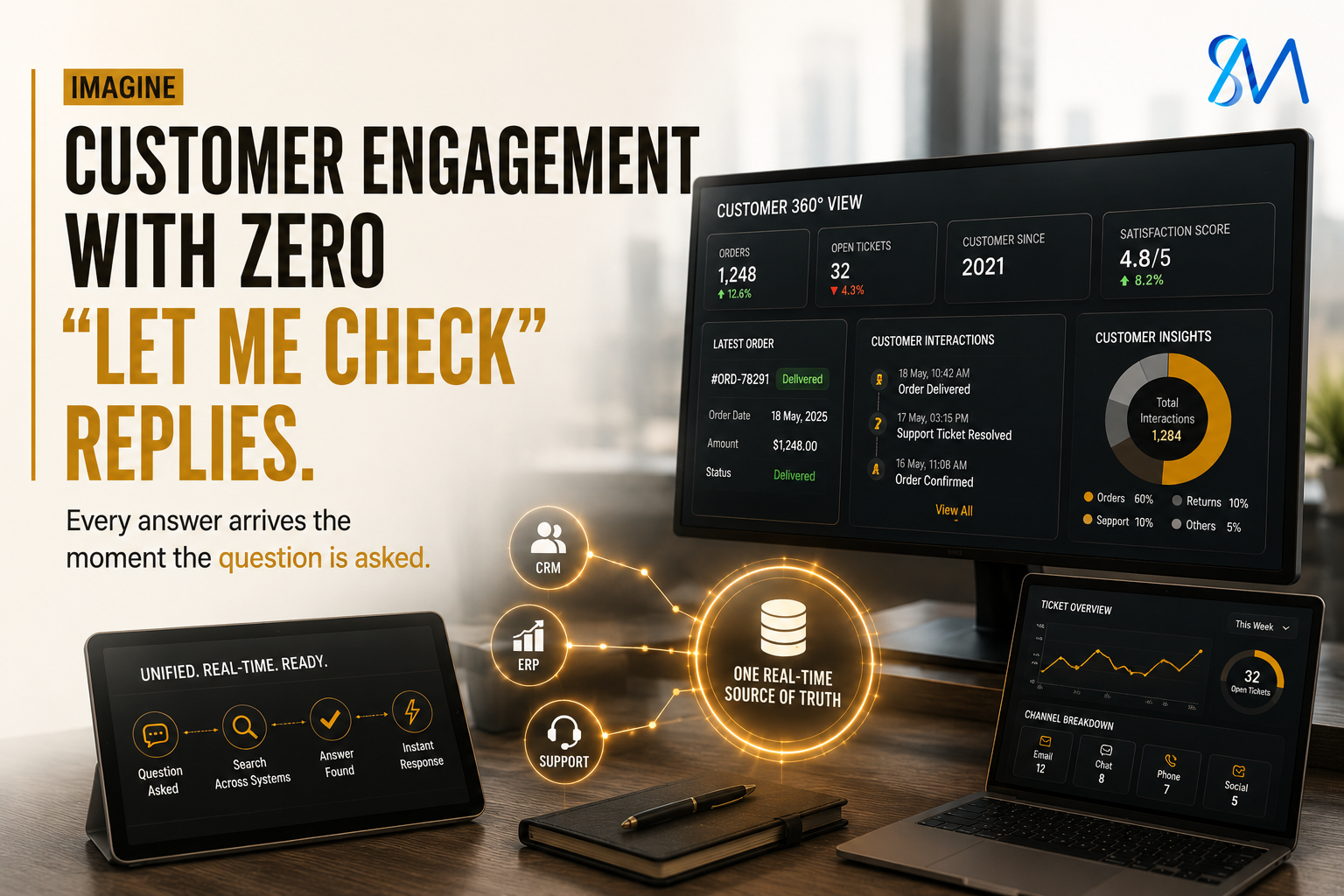
Imagine customer engagement with zero “let me check” replies. Every answer arrives the moment the question is asked, without a hold, a transfer, or a promise to call back later. For most organisations, that is not how a support or sales call actually goes, and the reason has very little to do with the person answering the phone.
Most of those pauses exist for one reason. The answer lives in a different system than the person answering the phone. The rep is not incompetent, and they are not being evasive. The data they need to answer honestly simply is not reachable in real time from where they are sitting. Every “let me check and get back to you” is a small trust withdrawal the customer remembers longer than the business does.
The gap is rarely where it first appears. Most operations leaders who take the ERP Fit Quiz find the real friction point is one layer deeper than where they have been looking.
See Where Your Operations Actually Stand — 2 Minutes
→ Speak with Our Team
This gap shows up constantly in organisations running CRM, ERP, and support systems as three separate sources of truth. A customer asks about an order status. The rep can see the CRM record, but the order status lives in the ERP, and the sync between them runs on a schedule measured in hours, not seconds. By the time the rep gets an answer, the customer has already hung up, called back, or escalated.
A CRM and an ERP can both be individually excellent and still disagree with each other about a basic fact like whether an order has shipped, simply because nobody built the pipeline connecting them in real time.
Why This Gap Persists Even in Organisations With Modern Systems
It would be easy to assume this is a legacy technology problem, solved once an organisation moves to modern cloud platforms. In practice, the gap persists even after modernization, because connecting systems and integrating them for real time decision making are two very different projects. A CRM and an ERP can both be modern, well maintained, and individually reliable, while still disagreeing about basic facts like current inventory or payment status, because nobody built the pipeline that keeps them synchronized in real time.
Across clients in 14 countries, we have seen this exact gap surface the same way regardless of industry. The systems work. The data exists somewhere in the business. It just is not reachable by the person who needs it, at the moment the customer is asking for it.
How SuperBotics Connects CRM, ERP, and Support Into One Real-Time View
We rebuild this exact moment by connecting CRM, ERP, and support systems into one real-time operational view, rather than three systems that periodically synchronize with each other. The data sits in one trusted place, and the answer sits one click away for whoever is speaking with the customer, whether that is a sales rep, a support agent, or an account manager.
This work spans Salesforce, Zoho, SAP, and Dynamics environments, using direct API orchestration rather than batch synchronization jobs that introduce exactly the delay this problem depends on. The goal is not simply moving data faster. It is designing the integration around the specific moments where a customer is waiting on an answer, and making sure those moments never require a transfer, a callback, or a gap.
What Changes Once CRM, ERP, and Support Share One Real-Time View
- No transfers between departments to answer a single customer question
- No callbacks promised because the data was not reachable in the moment
- No gaps between what the CRM shows and what the ERP actually reflects
- One source of truth every customer-facing team member can act on instantly
The Discipline Behind a 98% On-Time Release Rate
This is the same integration discipline behind our 98% on-time release rate across 500+ projects. It is not a claim about any single platform. It is a claim about the precision required to connect systems that were never designed to talk to each other in real time, without introducing new failure points in the process.
The businesses winning on customer experience are not answering faster because their staff work harder. They are simply not making customers wait for an answer that already exists somewhere in the business. The gap is rarely where it looks like it is from the inside, which is exactly why most organisations underestimate how much of their customer experience problem is actually a systems integration problem.
What SuperBotics Delivers for CRM and ERP Integration
We deliver CRM and ERP integration built for omnichannel customer experience, connecting Salesforce, Zoho, SAP, and Dynamics into a single source of truth your team can act on instantly. That includes the API orchestration work to keep systems synchronized in real time, not on a batch schedule, and the process design to make sure the right data reaches the right screen at the moment a customer is actually asking the question.
Where Omnichannel Experience Breaks Down First
The pattern is easiest to see across channel handoffs. A customer starts a conversation over chat, escalates to phone, and expects the agent picking up the call to already know what was discussed. When CRM, ERP, and support platforms sit in silos, that handoff resets to zero every time, and the customer has to repeat themselves to a new person who is starting from a blank screen. Multiply that across support, sales, and account management, and the cumulative effect on customer trust is far larger than any single interaction suggests.
This is why the integration work has to be designed around the customer’s actual journey across channels, not just around connecting two systems for the sake of a tidy architecture diagram. The technical connection matters only if it changes what the person on the phone can see in the moment the customer is asking.
The clearest starting point we have seen: know what your operations are actually ready for before deciding what to change.
The ERP Fit Quiz surfaces that picture honestly — no interpretation required.
The Gap Is Rarely Where It Looks
The gap between a customer waiting on hold and a customer getting an immediate answer is rarely a training problem or a staffing problem. It is almost always a systems integration problem hiding behind a customer service metric. The ERP Fit Quiz takes two minutes and shows you exactly where yours is, and for most operations leaders, the answer is one layer deeper than where they have been looking.


