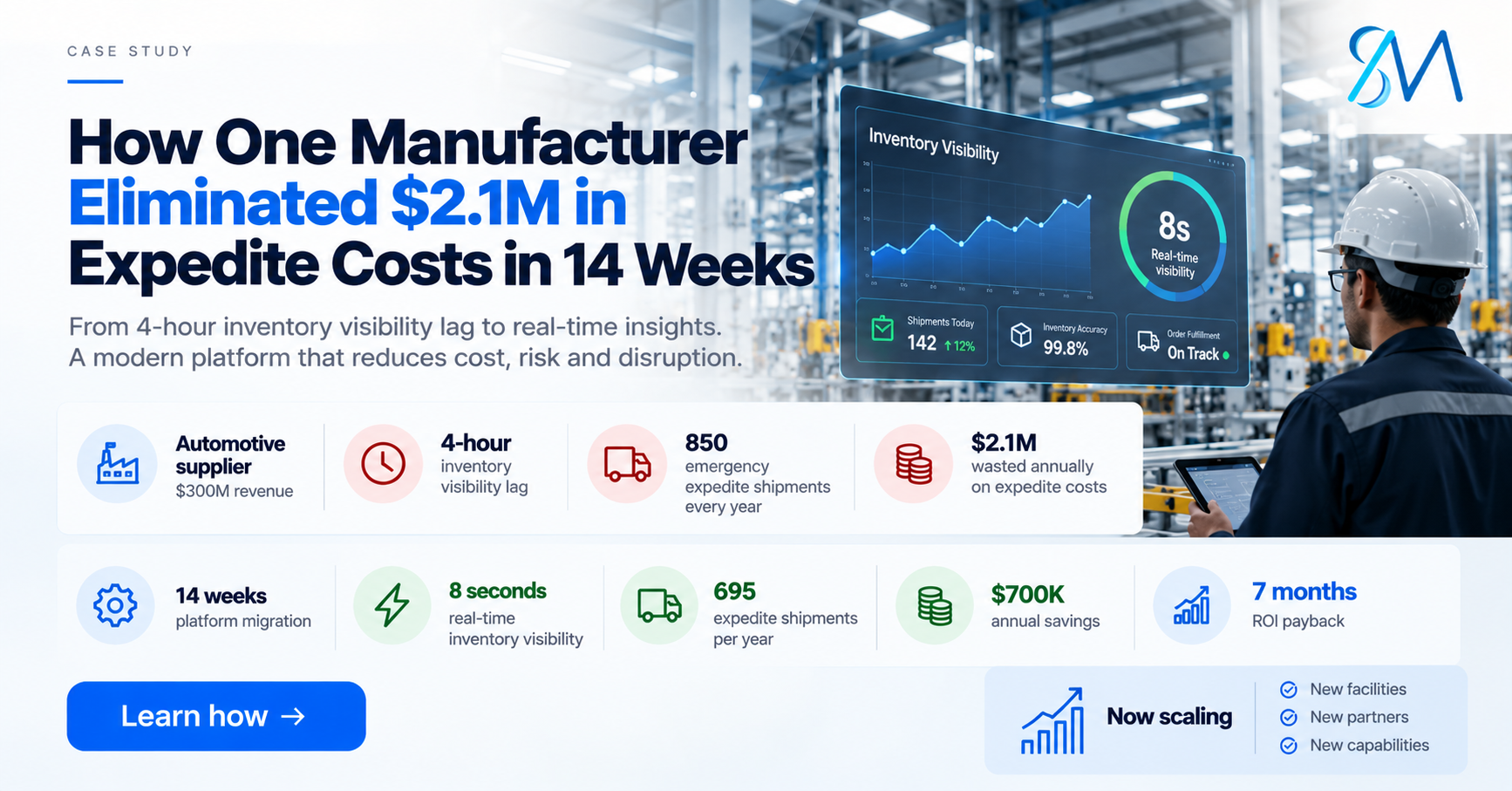
Is Outdated Technology Slowing Down Your Manufacturing Operations?

Abitha Jeyaraj, Marketing Executive
November 16, 2026 · 5 min read

Your manufacturing operations are moving forward. Productivity is climbing. Output targets are being met. But somewhere in the middle of all that momentum, a silent cost is growing.
Every delayed system upgrade. Every difficult integration. Every postponed improvement. They all add up to technical debt, and that debt is compounding.
What seems manageable today turns into weeks of extra work tomorrow. Your team stops preparing for growth and starts reacting to problems instead. The innovation pipeline slows. Margins tighten. And nobody can quite explain why.
The cost of technical debt in manufacturing is not just a technology problem. It is a business problem. And it compounds every quarter you leave it unaddressed.
At SuperBotics MultiTech, we have spent 500 plus projects solving exactly this problem. Here is what we learned about the real cost of waiting.
What Technical Debt Actually Costs
Let’s be specific. You have a legacy system running your manufacturing workflows. It works. It has been working for years. So you have chosen to leave it as is and invest in growth instead.
That choice makes sense. Until it doesn’t.
Here is what happens: A new customer asks for an integration that your current system cannot handle. Your team spends three weeks building a workaround. The workaround works, but now there are two ways the system can handle that type of integration, and neither is clean.
Six months later, another integration request comes in. This time it takes five weeks because your team has to navigate the previous workaround and avoid breaking it.
The pattern repeats. What should take days takes weeks. What should take weeks takes months. And somewhere in your operations team, someone is managing a spreadsheet alongside the actual system because that is the only way to keep track of what is actually happening.
That is technical debt at work. And in manufacturing, where change cycles are critical and integration points are everywhere, this debt becomes visible fast.
The Real Cost Breakdown
When we talk to operations leaders at SuperBotics, the cost of technical debt shows up in four places:
Delayed Changes
Integration takes weeks instead of days.
+$5K-15K per project
Team Capacity
Engineering firefighting instead of innovation.
+$30K-50K per year
Manual Processes
Spreadsheets, custom tooling, offline tracking.
+$20K-40K per year
Untracked Risk
Data silos, security gaps, compliance issues.
Variable (hidden)
Total Annual Cost: $55K to $145K+
Lost capacity, rework, and hidden risk. And this grows every year you defer modernization.
Why Modernization Keeps Getting Postponed
Here is the trap: technical debt does not feel urgent when it is small.
Your system is working. It is not broken. It is just slow. And in the moment, slowing down does not feel as expensive as stopping everything to rebuild it.
So you make the rational choice. You defer the upgrade. You live with the integration workaround. You keep the spreadsheet running alongside the system.
The problem is that technical debt is not linear. It compounds. And it reaches a tipping point where the cost of carrying it exceeds the cost of addressing it. By then, you have lost years of potential growth.
The Cost of Deferring vs. Modernizing
If you defer: Cost keeps rising every year. Year 1: $2K. Year 3: $15K. Year 5: $28K+.
If you modernize: Upfront investment (Year 1: $5-8K), then cost stabilizes and drops over time.
The real cost of deferral is catastrophic long-term. Modernization is expensive upfront, but flattens the curve.
“I wish we had started earlier.” That is what operations leaders tell us after modernization. Not because they regret the investment, but because they regret waiting.
How SuperBotics MultiTech Approaches Technical Modernization
We do not believe modernization should begin when something breaks. It should begin with a clear technology strategy.
That strategy answers three questions:
- Where are you actually spending capacity today due to technical debt?
- What is the cost of that debt in terms of speed, risk, and flexibility?
- What does a modernized state look like, and how do you get there without disrupting operations?
Here is how SuperBotics works through it:
What SuperBotics does in each phase:
- Assessment: System audit. Interview key teams. Find where you are losing capacity.
- Roadmap: Define your target state. Break modernization into phases. Set clear milestones.
- Migration: Build the new system in parallel. Test thoroughly. Plan your cutover strategy.
- Optimize: Performance tuning. Team adoption. New operating rhythm. Measure and learn.
What Sets SuperBotics Apart
We have guided 500 plus enterprises through technical modernization. Here is what makes our approach different:
First: We do not assume you will rebuild everything. SuperBotics audits your current systems, finds the leverage points, and identifies what can be improved without full replacement.
Second: We take the time to understand how your business actually operates. That means talking to manufacturing teams, operations leaders, and the people managing workarounds. The technical roadmap comes second. Understanding the business reality comes first.
Third: We migrate intelligently. Parallel systems. Phased transitions. Rollback plans. Your operations do not stop while SuperBotics rebuilds your foundation.
Fourth: We measure. We track capacity freed, cycle time reduced, and automation coverage achieved. You see the value of modernization in weeks, not quarters.
The proof: Over 500 plus projects, SuperBotics has delivered an average of 38 percent cost optimization for teams that modernized their platforms. Across our enterprise AI and automation clients, we achieve 82 percent automation coverage. That means 4 times faster insight cycles and the capacity to innovate again.
The right question is not whether you can afford to modernize. It is whether you can afford not to.
SuperBotics MultiTech has built a clear methodology around this exact problem. Let’s talk about what modernization could mean for your manufacturing operations.
Building a Stronger Technology Foundation
Modernization is not about the newest technology. It is about getting the fundamentals right so your team can move fast, scale with confidence, and spend time on innovation instead of firefighting.
The operations leaders we work with tell us the same thing afterwards: the investment was worth it. Not because they got new systems, but because their team got their time back.
If you are carrying technical debt that is slowing you down, it is worth having a conversation with SuperBotics about what modernization could look like for you. We have mapped this journey across every manufacturing vertical and system type.
Let’s build a stronger technology foundation together.