Seven Questions Every Executive Should Answer Before Approving an Integration Investment

Abitha Jeyaraj, Marketing Executive
July 10, 2026 · 6 min read
The Integration Budget That Gets Approved Too Early
Most integration projects are approved before the business case is finished. The architecture conversation begins before operational success has been defined. The brief describes what the systems will do. It rarely describes what the business will stop doing once those systems are connected, or how the change will be measured against the investment that created it.
This sequencing error is not a planning failure. It is a framing failure. Integration investments are most commonly evaluated as technology projects: systems to connect, data to move, platforms to unify. When the evaluation framework is technical, the business case that results is technical. And a technical business case cannot produce a business outcome measurement, because it was never designed to. The ROI gap that opens between approval and delivery is almost always traceable to the moment the business case was approved without a clear answer to the operational outcome question.
The investment is not the risk. The assumptions behind it are. And those assumptions, tested before architecture begins, cost a fraction of what they cost to discover after go-live.
The gap is rarely where it first appears. Most operations leaders who take the ERP Fit Quiz find the real friction point is one layer deeper than where they have been looking.
→ See Where Your Operations Actually Stand — 2 Minutes→ Speak with Our Team
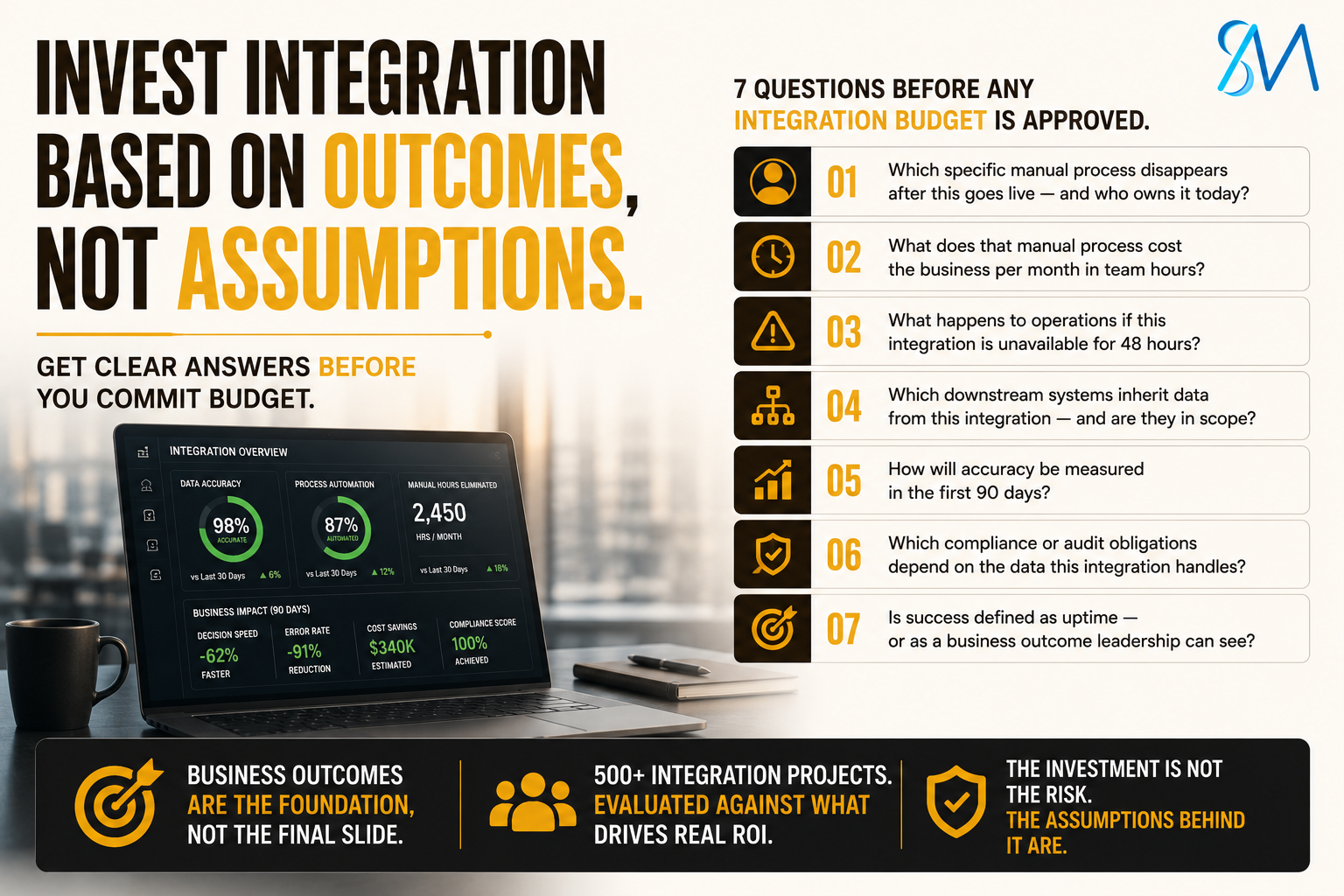
Seven Questions That Should Have Clear Answers Before Any Integration Budget Is Approved
Across enterprise integration engagements in the US, UK, and Europe, the projects that delivered their projected ROI consistently had something in common: every one of these questions had a specific, agreed answer before the architecture conversation began. The projects that did not deliver had skipped some or all of them in the interest of moving faster to implementation.
The first: which specific manual process disappears after this goes live, and who owns it today? The answer to this question is the integration’s primary value statement. If it cannot be named precisely, the integration has no business case. It has a technical case.
The second: what does that manual process cost the business per month in team hours? This is the ROI baseline. Without it, there is no measure of whether the investment delivered. The calculation is straightforward: frequency of the manual task multiplied by duration multiplied by the fully loaded cost of the team member performing it. It is almost always larger than the organisation expects.
The third: what happens to operations if this integration is unavailable for 48 hours? This question surfaces the operational dependency the integration will create and forces a decision about resilience architecture before it becomes an incident. The answer determines whether monitoring, alerting, and failover are included in the project scope or discovered as missing components after the first failure.
The difference between an integration that reclaims executive hours and one that creates a new maintenance dependency is almost always visible at the planning stage.
The Four Questions That Define Integration Scope and Governance
The fourth question: which downstream systems inherit data from this integration, and are they in scope? Scope creep in integration projects is most often a consequence of this question going unanswered at the planning stage. A CRM to ERP integration that does not account for the billing system that reads from the ERP, or the reporting platform that reads from both, will encounter those downstream systems eventually. Encountering them after go-live is significantly more expensive than scoping for them before architecture begins.
The fifth: how will accuracy be measured in the first 90 days? Data accuracy thresholds are the operational trust foundation of any integration. Without defined thresholds, the team that receives the integrated data has no objective basis for deciding whether to act on it or verify it manually. The manual verification step that should have disappeared with the integration persists, because trust was never designed in. Accuracy measurement at 90 days is the mechanism through which that trust is established, or through which the accuracy problem is identified early enough to address.
The sixth: which compliance or audit obligations depend on the data this integration handles? Compliance scope discovered post-launch requires rework that is disproportionately expensive relative to the cost of scoping it correctly from the start. GDPR, SOC 2, HIPAA, and sector-specific data governance requirements affect architecture decisions, logging requirements, and data retention policies. When they are discovered after architecture is finalised, they become change requests. When they are scoped before, they become design inputs.
The seventh: is success defined as uptime, or as a business outcome leadership can see? This question forces the distinction between technical success and business success. An integration that achieves 99.9% uptime but does not eliminate the manual process it was built to replace has technically delivered. It has not delivered its business case. Success measures that appear on leadership dashboards, decision cycle speed, manual hours eliminated, forecast accuracy, are the measures that justify the investment at the level it was approved.
| Question | What It Protects Against |
|---|---|
| Which manual process disappears? | Approving without a value statement |
| What does that process cost monthly? | No ROI baseline |
| What if unavailable for 48 hours? | Resilience discovered as an incident |
| Which downstream systems inherit data? | Post-launch scope creep |
| How will accuracy be measured? | Persistent manual verification |
| Which compliance obligations apply? | Post-launch rework |
| Is success uptime or business outcome? | Delivering technically without delivering value |
What SuperBotics Enterprise Integration Delivers
SuperBotics evaluates integration investments against these seven questions before architecture begins. Every engagement starts with a business outcome definition phase that names the specific manual process being eliminated, quantifies its cost, defines the downstream scope, establishes accuracy measurement thresholds, confirms compliance requirements, and agrees on the leadership-level success measure against which the integration will be held.
The architecture that follows is built to deliver against those definitions. Not to connect systems in isolation, but to produce the specific operational outcome the business case described. The governance layer, monitoring, alerting, accuracy tracking, and compliance logging, is scoped from the design stage, not added as a post-launch consideration.
Across CRM, ERP, marketing automation, customer support, and billing system integrations, our delivery process ensures that every question in this framework has a clear answer before the first architecture session. The investment that results is one the business can measure. And measure consistently, quarter after quarter, against the baseline established before the project began.
The assumptions behind an integration investment are always testable before approval. The ones that go untested always find a way to surface later, at significantly higher cost.
Ready to solve this for your organization? Visit SuperBotics MultiTech to see how our team can help.
The clearest starting point we have seen: know what your operations are actually ready for before deciding what to change.
The ERP Fit Quiz surfaces that picture honestly — no interpretation required.