The Half Second Pause in Your Leadership Meeting Is a Data Trust Problem

abitha
July 31, 2026 · 6 min read
Someone reads a number out loud in the leadership meeting. Half a second passes before anyone nods. That half second is the whole problem, even though nobody in the room would ever say it out loud. Nobody says I do not trust that number. Nobody has to. Two people in the meeting already keep a private version of the same report, just in case. That is not caution. That is a workaround that became routine so long ago that nobody remembers deciding to build it.
Finance reports one growth figure. Revenue operations reports another. Both are technically correct. Both are measured from a different starting date, decided separately, months apart, by two people who never once compared notes with each other. Last month, a decision sat marked as pending confirmation for eleven days. It was never actually pending confirmation. It was pending someone willing to say the dashboard might be wrong, out loud, in front of the whole leadership team.
Why the Expensive Part Is Never the Wrong Number Itself
The real cost is the hour spent afterward, by two more people, quietly reconciling numbers that should have agreed the first time anyone looked at them. Multiply that hour by every leadership meeting held across a full year, and most organizations have genuinely never done that math, because the reconciliation happens quietly, off the meeting agenda, absorbed into whoever noticed the discrepancy first.
The organisations getting sustained value from AI all start with the same question: what are we actually ready to automate, and what needs to be solved first?
We have mapped that starting point across 50+ enterprise deployments. If it is useful for where you are right now, we will share the framework directly.
This is a different problem than a broken integration or a missing report. Every source system involved may be functioning exactly as designed. The gap is a decision intelligence gap: nobody has defined a single, shared, machine verified version of the metric that every function agrees to use, so each team builds its own version and defends it as correct on its own terms.
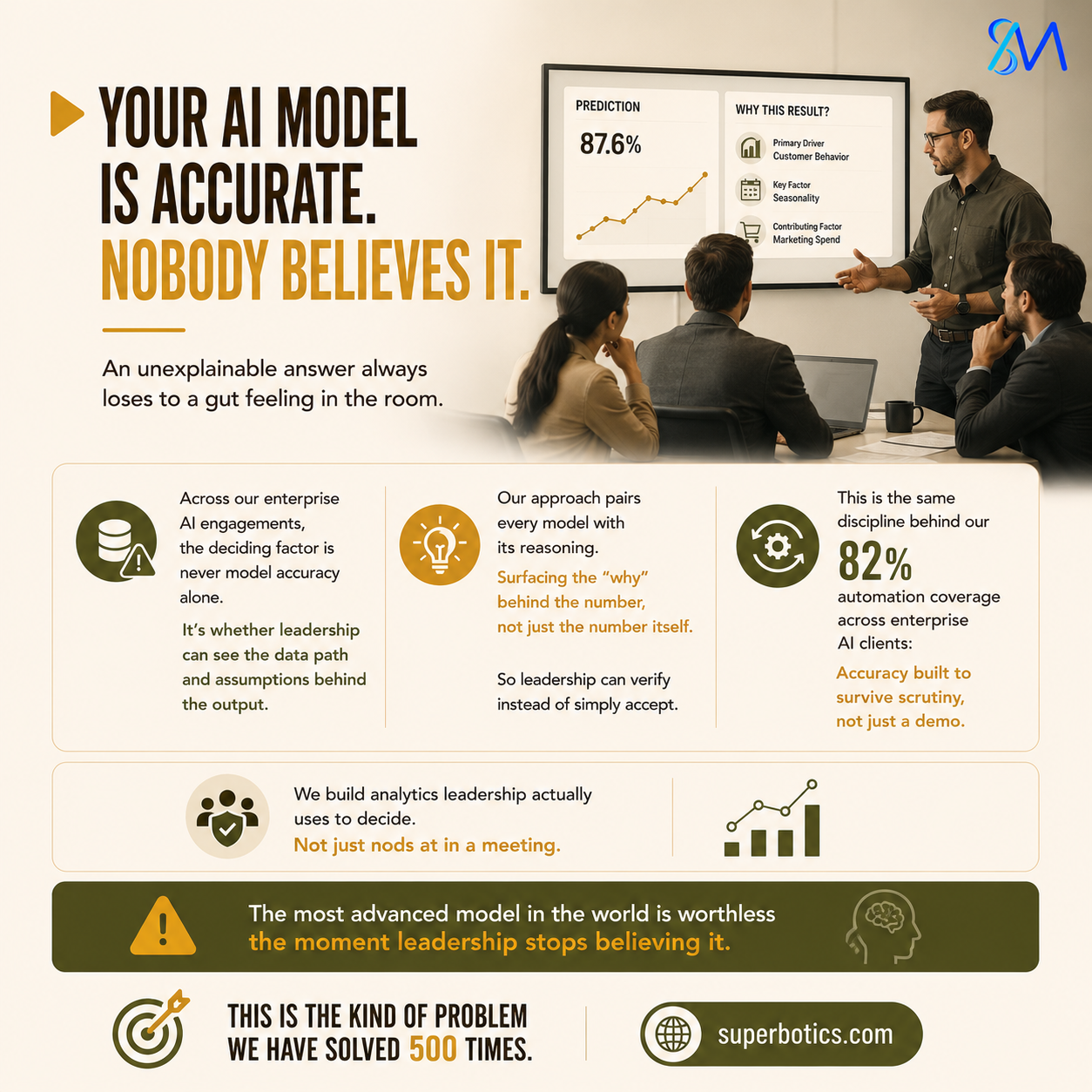
The half second pause before anyone nods at a number in a leadership meeting is the most reliable, least discussed signal that a decision intelligence gap exists inside the organization.
How SuperBotics Approaches Decision Intelligence
SuperBotics builds decision intelligence layers that sit above the raw reporting each function already produces, using AI assisted reconciliation to catch drift between finance, revenue operations, and other reporting functions before it ever reaches a leadership deck. Rather than asking every team to manually agree on a shared definition once and hope it holds, we build automated checks that flag the moment two systems start measuring the same metric differently.
| Decision Intelligence Layer | What It Resolves |
|---|---|
| Metric definition registry | One agreed definition per key metric, versioned and owned across functions |
| AI assisted drift detection | Automatic flagging when two systems’ figures diverge before a meeting happens |
| Decision cycle instrumentation | Visibility into how long a decision actually sits pending confirmation, and why |
| Governance ownership | A named owner for every shared metric, accountable when drift appears |
We build this on platforms including OpenAI, Google Gemini, Azure AI, Anthropic Claude, and Amazon Bedrock, orchestrated through LangChain and LlamaIndex where retrieval augmented reasoning is needed to reconcile figures pulled from multiple source systems in real time. Responsible AI governance is embedded at every stage, since a decision intelligence layer that leadership cannot audit is simply a new version of the same trust problem it was built to solve.
We also build the decision intelligence layer so it explains itself in plain terms when it flags a discrepancy, rather than simply raising an alert nobody can interpret quickly. A finance leader looking at a flagged drift needs to see, in one glance, which two systems disagree, by how much, and which of the two definitions is the currently governed one, so the meeting conversation shifts from re litigating whose number is right to deciding what to do about the gap that has already been identified automatically.
In one engagement, we found that revenue operations and finance had been using different definitions of an active customer for over a year, a gap that had never surfaced because both numbers looked directionally reasonable on their own. Once the drift detection layer flagged the discrepancy automatically, the two teams resolved the definition mismatch in a single meeting, something the organization had been quietly working around for months without realizing the root cause was this simple.
The Proof Behind This Work
Across our AI and data engagements, clients running this kind of drift detection consistently report 4x faster insight cycles, because decisions that used to sit pending confirmation for over a week now surface a flagged discrepancy automatically, days before the meeting where it would otherwise cause a half second pause. One finserv client reduced manual review time by 45 percent after we restructured how decision data moved between finance and operations reporting.
Our model to production benchmark of 14 weeks applies here as well. A decision intelligence layer that takes longer than that to reach production usually signals that the underlying metric definitions were never agreed before the technical build began, which is the same root cause behind the original dashboard distrust.
What SuperBotics Specifically Offers
SuperBotics designs and delivers decision intelligence programmes that sit above existing finance and operations reporting, using AI assisted reconciliation to catch metric drift before it reaches a leadership meeting, with clear ownership assigned per metric so the gap does not quietly resurface a quarter later. This work is part of our broader enterprise AI integration practice, and it is often the fastest path to measurable trust recovery inside a leadership team, well ahead of any larger platform rebuild.
The next time a number gets read aloud in your leadership meeting and produces that half second pause before anyone nods, that pause is worth investigating directly rather than working around quietly for another quarter.
The half second pause is easy to dismiss as a minor moment in an otherwise productive meeting. Left unaddressed, it compounds quietly across every leadership meeting held over a year, in hours nobody tracks and trust nobody quite wants to name as missing. Naming it directly is usually the fastest way to recover it.
To see where your own leadership numbers might be diverging before your next board meeting, visit superbotics.com.
The right first question is not which AI tool — it is what does our data and team need to be ready for this to work.
That question, answered clearly, is worth more than any vendor comparison.