
Why Executives Don’t Trust the AI Analytics They’re Given

Abitha Jeyaraj, Marketing Executive
August 25, 2026 · 5 min read
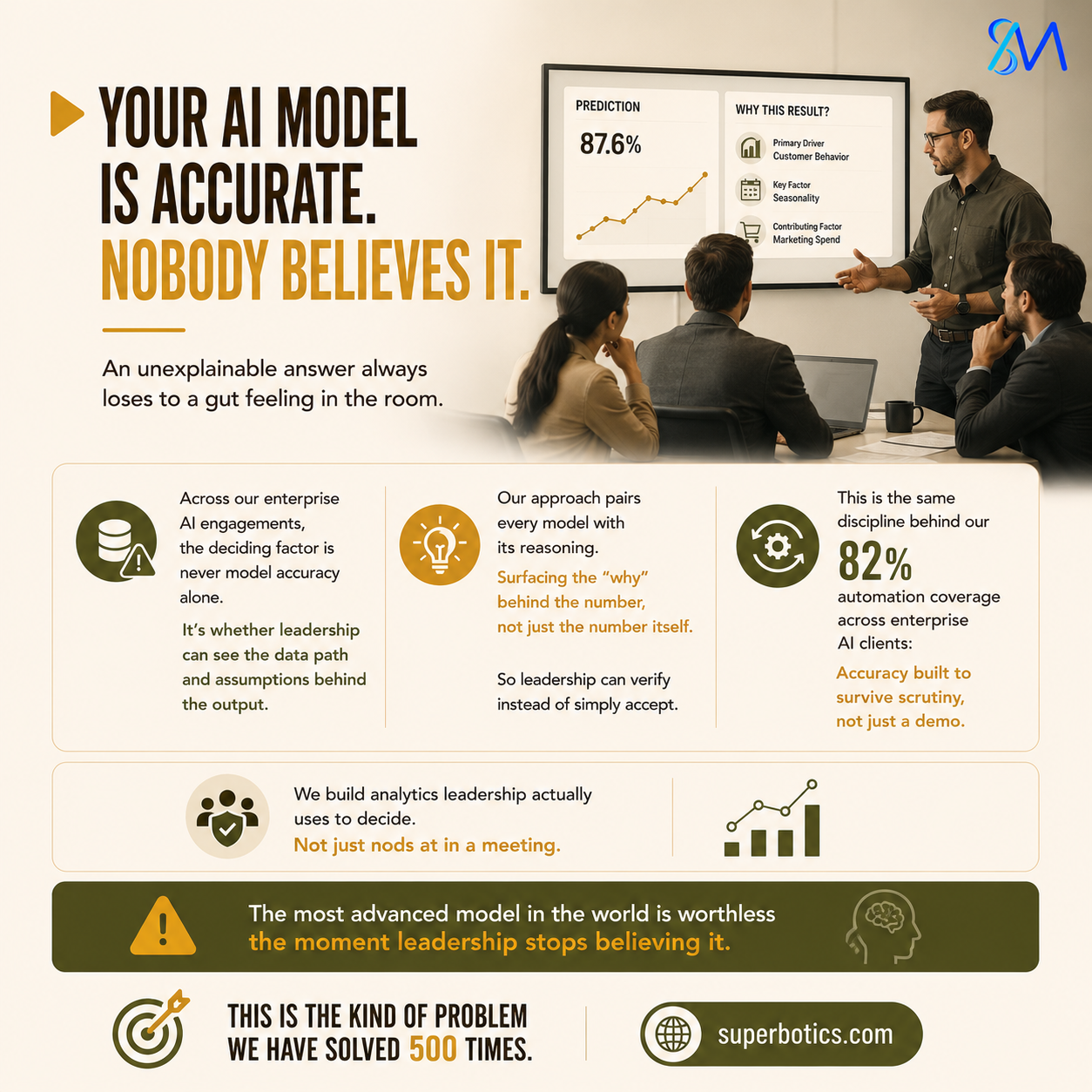
Your AI model is accurate. Nobody in the leadership meeting believes it. That gap between technical performance and organisational trust is one of the most consistent patterns we see across our enterprise AI engagements, and it rarely gets fixed by improving the model itself. An unexplainable answer, no matter how statistically sound, always loses to a confident gut feeling in the room, because a number without a visible reasoning path is indistinguishable from a guess to the person deciding whether to act on it.
The deciding factor in whether an AI output gets used is never accuracy alone. It is whether leadership can see the data path and the assumptions behind the output well enough to verify it rather than simply accept it on faith. Without that visibility, even a genuinely correct answer gets quietly treated as one more opinion in the room, competing with intuition that at least comes with a story attached.
The organisations getting sustained value from AI all start with the same question: what are we actually ready to automate, and what needs to be solved first?
We have mapped that starting point across 50 plus enterprise deployments. If it is useful for where you are right now, we will share the framework directly.
Why an accurate model still fails to change a decision
Most enterprise AI programmes are evaluated on model accuracy during the pilot phase, and reasonably so. The gap opens later, once the model reaches production and starts producing outputs that leadership is expected to act on without the benefit of a data science team standing by to explain the reasoning. At that point, accuracy stops being the limiting factor. Explainability is. A model that is right 95 percent of the time but cannot show its work will lose to a confident executive’s instinct in a live meeting, every time, because the instinct comes with a narrative and the model does not.
This is not a flaw unique to any one platform or vendor. It is a structural gap in how most AI programmes are scoped from the outset, with governance and explainability treated as a compliance checkbox rather than a design requirement built in from day one. Across our enterprise AI engagements, the pattern holds consistently, teams that scope explainability alongside accuracy from the start end up with analytics that leadership actually uses. Teams that treat it as an afterthought end up with a technically sound model quietly ignored in every meeting that matters.
How SuperBotics pairs every model with its reasoning
Our approach pairs every model we deploy with its reasoning, surfacing the why behind a number rather than presenting the number alone. This means building the data lineage and assumption trail into the output itself, so that a leader reviewing an AI generated recommendation can see which inputs drove it and how confident the model actually is, rather than being asked to accept a black box conclusion on faith. This is the same operational discipline behind our 82 percent automation coverage across enterprise AI clients, accuracy that is built to survive scrutiny in a live meeting, not just perform well in a demo environment.
Our AI delivery model covers strategy, model engineering, RAG pipelines, agentic workflows, and MLOps end to end, with governance embedded at every stage rather than layered on at the end. Platforms we work across include OpenAI, Google Gemini, Azure AI, Anthropic Claude, Amazon Bedrock, LangChain, and LlamaIndex, selected based on what the specific use case and governance requirement actually demand, not on a single vendor relationship.
The proof: what happens when the reasoning is visible
One finserv client came to us with an AI model that was performing well on every technical benchmark, yet manual review volumes had barely changed six months after deployment, because the operations team did not trust the output enough to act on it without independently checking the work. After we restructured the deployment to surface the model’s reasoning alongside its output, that client reduced manual review time by 45 percent. The model itself did not change. What changed was whether the people using its output could verify it quickly enough to act on it with confidence.
Across our broader AI delivery track record, a 14 week model to production benchmark and 4x faster insight cycles reflect the same underlying principle, that AI investment only compounds into real operational change once the people receiving the output trust it enough to build their decisions on it.
What SuperBotics specifically offers
We build analytics that leadership actually uses to decide, not analytics that get a polite nod in a meeting and then get quietly double checked afterward. That means model engineering paired with explainability from the design phase, RAG based reasoning trails that show which data informed a given output, and a governance layer that satisfies both technical and executive scrutiny at once. The most advanced model in the world becomes worthless the moment leadership stops believing what it tells them, and closing that gap is the specific problem our AI delivery model is built to solve.
The right first question is not which AI tool. It is what does our data and team need to be ready for this to work.
That question, answered clearly, is worth more than any vendor comparison.
This is the kind of problem we have solved before
Every leadership team we have worked with initially assumed their AI trust gap was a communication issue, something a better dashboard or a clearer summary slide would eventually solve. In practice, the gap sits earlier, in whether the model’s reasoning was ever designed to be visible in the first place. Solving that once, at the architecture level, is what turns an accurate model into one the room actually acts on without a second opinion.

