The Operational Efficiency Investment That Creates More Exceptions Than It Eliminates

Abitha Jeyaraj, Marketing Executive
July 12, 2026 · 5 min read
The Investment That Keeps Growing Without the Efficiency That Should Follow It
The organisations investing most heavily in operational efficiency tools are often the ones managing the most exceptions. This is not a paradox. It is a sequencing problem. The tools exist. The team understands the goal. The investment has been approved. And yet the operating rhythm remains reactive, because the solutions arrived before the root cause was understood.
More automation applied to a poorly connected process does not reduce exceptions. It produces them faster, at higher volume, across more systems simultaneously. This is a consistent operational pattern, observed across industries and company sizes, and it has a consistent origin: the decision to implement preceded the decision to diagnose. The automation accelerated the workflow and exposed the structural gap underneath it that was invisible when the workflow was running manually.
Technology debt rarely begins in code. It begins in the decision to automate before the foundation is clean. That decision, made at the planning stage with the best intentions, becomes the most expensive choice in the programme when the exception rate post-launch is higher than the one it was designed to eliminate.
The gap is rarely where it first appears. Most operations leaders who take the ERP Fit Quiz find the real friction point is one layer deeper than where they have been looking.
→ See Where Your Operations Actually Stand — 2 Minutes→ Speak with Our Team
The Decisions That Build Operational Efficiency — and the Ones That Delay It
The organisations that achieve lasting operational efficiency consistently make the same sequence of decisions. The ones that remain in exception management consistently skip the same steps. The difference is not ambition or investment. It is the order in which things happen.
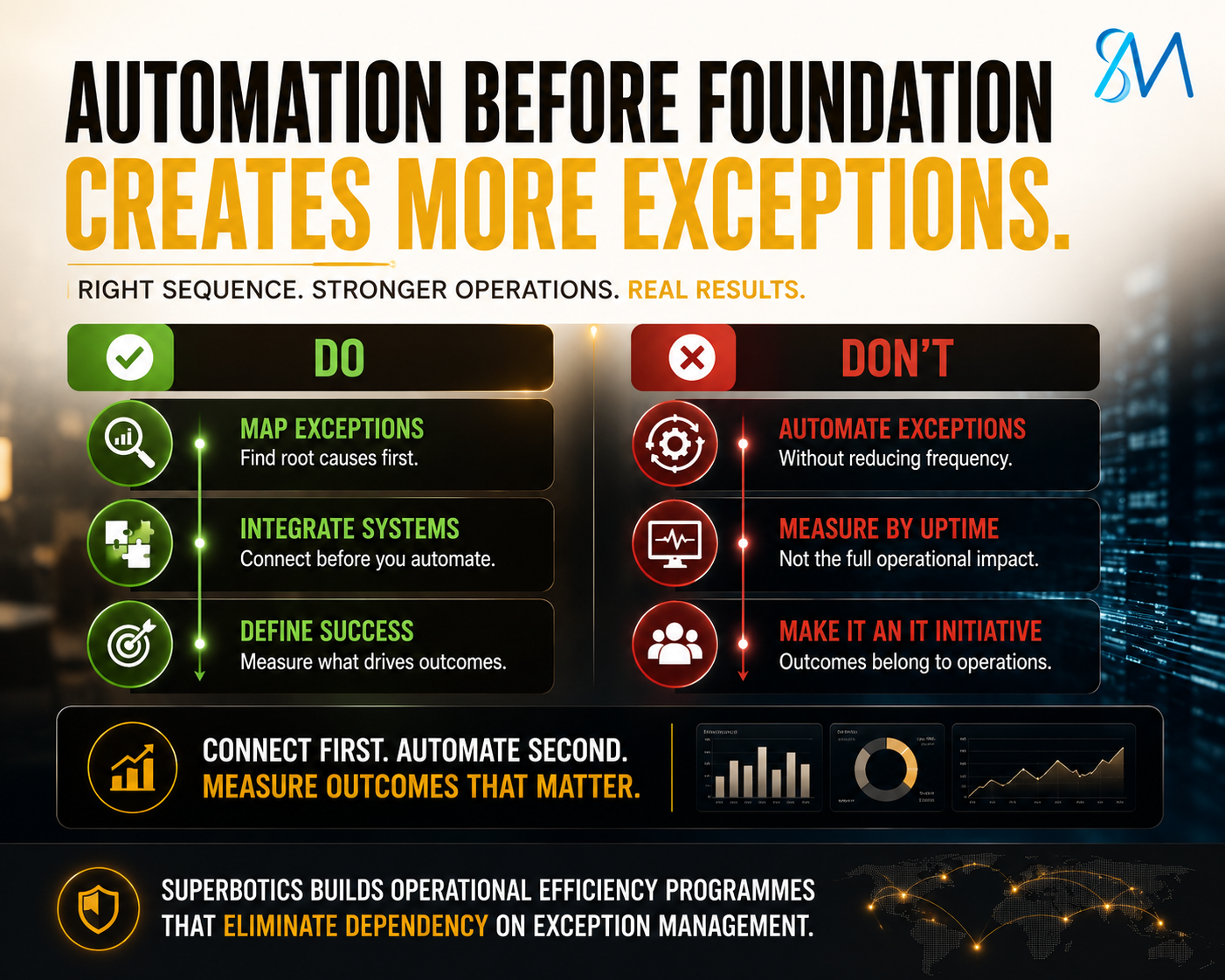
Mapping exceptions by origin before designing any solution is the foundational step that most operational efficiency programmes compress or skip. Every recurring exception has a cause: a disconnected system, a process gap, a data quality issue, an approval dependency that was never formalised. Separating exceptions caused by technology from those caused by process design is the diagnostic work that makes every subsequent decision more precise and less expensive. Without it, solutions address symptoms that reappear under different names after go-live.
Connecting systems before automating workflows is the sequencing principle that most consistently separates high-ROI operational programmes from low-ROI ones. Automation built on clean, validated, real-time data between systems eliminates manual steps durably. Automation built on disconnected or inaccurate data creates automated inconsistencies that require more manual intervention than the original manual process.
Defining success in measurable business terms before implementation begins is the governance decision that determines whether the programme delivers accountability or only activity. The number of manual reconciliation cycles eliminated per week. The reduction in escalation volume at 90 days. The decision cycle time improvement measured in hours. These are leadership-visible outcomes. Go-live is not an outcome. It is an event that precedes the outcome.
Technology debt rarely begins in code. It begins in the decision to automate before the foundation is clean.
The Decisions That Consistently Keep Organisations in Exception Management
Exception management is not maintained deliberately. It is maintained through a series of individually reasonable decisions that collectively produce a system designed to react rather than anticipate.
Automating exception handling rather than eliminating the conditions that create exceptions is the most common of these decisions. Building better exception workflows is a legitimate response to an operational problem. It is not a solution to it. The exception frequency stays the same. The exceptions are processed more efficiently. And the team continues running an operation that is fundamentally structured around managing failure rather than preventing it.
Measuring integration success by uptime alone creates a false confidence that the integration delivered its value. Uptime is a technical outcome. It confirms the systems are connected and running. It does not confirm that the manual process the integration was designed to eliminate has actually been retired. In a significant proportion of post-launch reviews, the manual process continues running in parallel with the integration, either as a verification step or as a backup that became permanent. Uptime measures miss this entirely.
Treating operational efficiency as an IT initiative transfers ownership from the stakeholders who are accountable for the business outcome to the team that is accountable for the technical delivery. The outcomes that matter to the organisation, hours recaptured, decisions made faster, escalations prevented, are owned by operations. When IT owns the programme entirely, those outcomes become secondary to technical delivery milestones. The alignment that produces business outcomes requires both.
| Decision | What It Produces | The Approach That Works |
|---|---|---|
| Automate before integrating | Faster exception production | Clean data between systems first |
| Scope for features not outcomes | No success measure | Define what the business stops doing |
| Exclude operations from design | Rework at go-live | Operations co-designs the process |
| Automate exception handling | More efficient symptom management | Eliminate the conditions that create exceptions |
| Measure success at go-live | Regression after project closes | Measure stability at 90 days post-launch |
What SuperBotics Operational Efficiency Programmes Deliver
SuperBotics builds operational efficiency programmes that address root cause before implementation begins. Every engagement maps the exception landscape first, connecting recurring exceptions to their origin in systems, process design, or data quality before any solution architecture is proposed. The remediation sequence follows the diagnostic finding: connect systems first, automate clean processes second, measure outcomes that appear on leadership dashboards from the first week of operations.
The adoption design that accompanies every engagement ensures that operational teams are involved in the process redesign, not handed a new system after it is built. Go-live is not the milestone we measure against. Stable, predictable operations at 90 days is the benchmark that determines whether the programme delivered its business case.
The goal is not fewer exceptions in a better-managed exception workflow. The goal is a business that no longer depends on exception management as an operating rhythm, because the conditions that produce exceptions were addressed at their origin rather than optimised in their management.
Operational efficiency is a design outcome. It is available to every organisation that approaches it in the right sequence.
Ready to solve this for your organization? Visit SuperBotics MultiTech to see how our team can help.
The clearest starting point we have seen: know what your operations are actually ready for before deciding what to change.
The ERP Fit Quiz surfaces that picture honestly — no interpretation required.