
Why Financial Operations Still Depends on Spreadsheets, and How to End It

Abitha Jeyaraj, Marketing Executive
August 21, 2026 · 5 min read
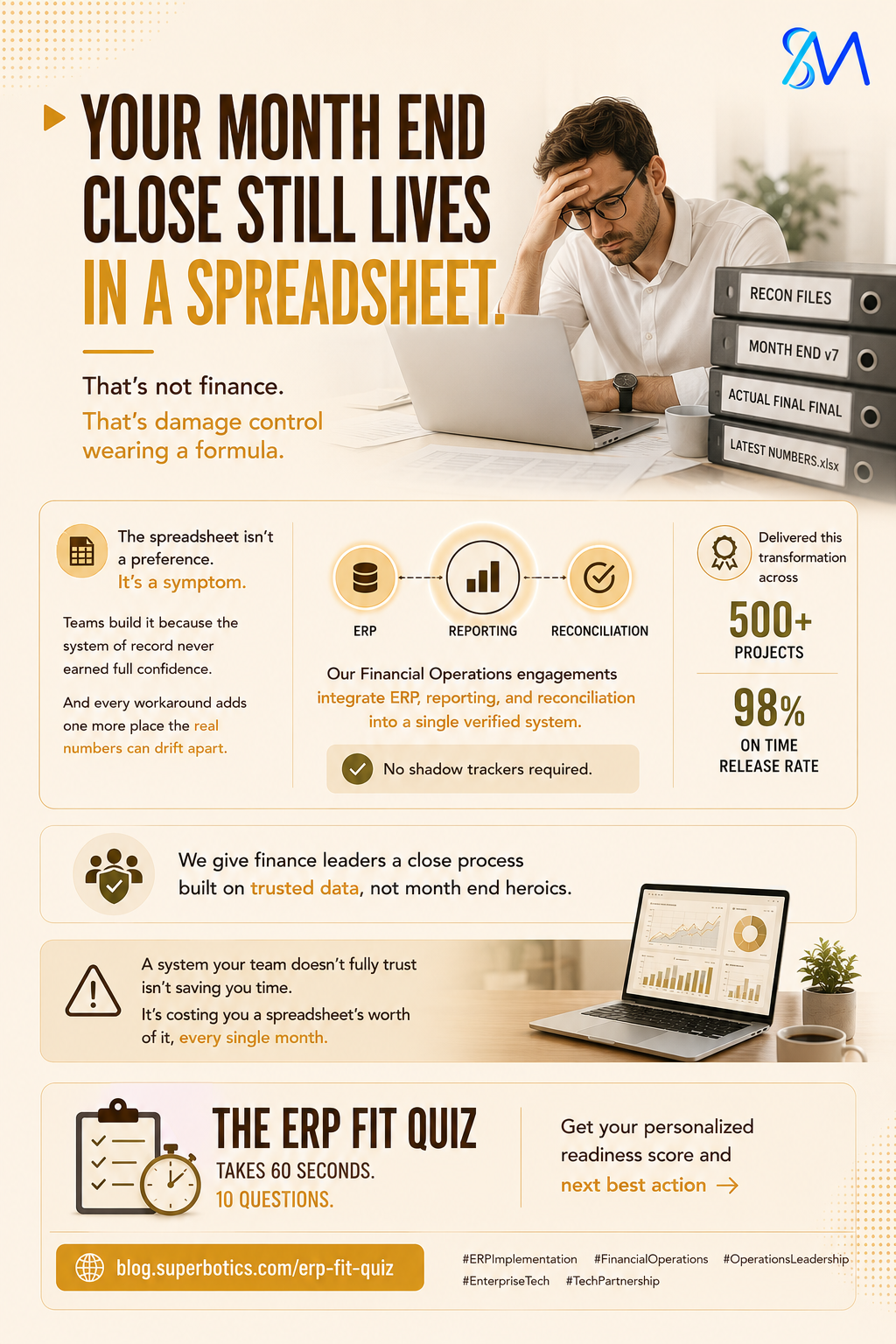
Your month end close still lives in a spreadsheet somewhere, even after the ERP rollout that was supposed to make it unnecessary. That is not a finance team preference. It is a symptom of a system of record that never quite earned full confidence, and a workaround that has been running quietly for so long nobody remembers deciding to build it. Across 500 plus engagements, this is the single most consistent pattern we see in Financial Operations, and it rarely gets named for what it is until someone finally adds up the hours.
Every workaround adds one more place the real numbers can drift apart. One team rounds differently. Another logs revenue a day early to hit a reporting deadline. A third is still working from last quarter’s exchange rate because nobody updated the reference sheet. None of these are dramatic failures. Individually, each is defensible. Together, they are why the close cycle that should take one day still takes four, every single month, across twelve months a year.
Most finance leaders have never actually calculated how many closes last year involved an unscheduled spreadsheet rebuild.
The ERP Fit Quiz takes 60 seconds and hands back your personalised readiness score.
Why the spreadsheet never actually goes away
The spreadsheet was never the plan. It became the plan the first time a controller noticed a number that did not feel right the night before a board meeting, and quietly rebuilt it by hand rather than raise a concern about the system everyone else trusted. That single decision, repeated across finance teams everywhere, is how a workaround becomes an operating rhythm. Once the pattern exists, it is nearly invisible from the outside, because the ERP dashboard still shows a number, it is simply not always the number finance is actually reporting on.
The root cause is structural. Reporting, reconciliation, and the ERP itself are usually implemented as separate initiatives, each configured by a different team at a different point in the company’s history, with no single source of truth defined across them. Financial Operations does not fail because finance teams lack discipline. It fails because the systems underneath their work were never connected well enough to remove the need for a manual layer.
How SuperBotics rebuilds financial operations from the source
Our Financial Operations engagements begin by mapping exactly where the close cycle currently depends on a manual step, department by department, before any platform conversation starts. From there, we integrate ERP, reporting, and reconciliation into a single verified system, so that every number in a leadership review traces back to one source rather than five exports stitched together the night before the meeting.
We have delivered this transformation across 500 plus projects with a 98 percent on time release rate, which matters specifically in Financial Operations, where the migration itself cannot become the next fire drill sitting on top of an already stretched finance calendar. The goal of every engagement is a close process that finance trusts without having to verify it twice, not a new tool added on top of the same underlying gap.
The proof: what changes when the manual layer is removed
Across our AI powered Financial Operations work, clients moving from a manual reconciliation model to a connected one consistently report the same shift, the close cycle compresses from days to a single verified pass, and the confidence in the number presented to leadership stops requiring a private backup calculation. Our broader delivery record of 38 percent average cost optimisation and a 98 percent on time release rate across 500 plus enterprise projects in 14 countries reflects the same underlying discipline applied specifically to financial systems, where the cost of an error is measured not just in hours but in how long it takes leadership to trust the next number they see.
What SuperBotics specifically offers finance leaders
We deliver a close process built on trusted data rather than month end heroics. That means ERP, reporting, and reconciliation systems connected so financial data moves once and stays accurate everywhere it is consumed, validation built in so a small rounding difference or a stale exchange rate is caught before it reaches a leadership deck, and a clearly defined data ownership model so nobody has to guess which system holds the real number. This is delivered as a structured engagement, not a generic tooling recommendation, with the same 500 plus project track record and 98 percent on time delivery standard that governs every SuperBotics engagement.
A system your finance team does not fully trust is not saving anyone time. It is costing a spreadsheet’s worth of hours every single month, quietly, to whoever notices the discrepancy first.
The clearest starting point we have seen: know what your financial operations are actually ready for before deciding what to change.
The ERP Fit Quiz surfaces that picture honestly, no interpretation required.
Q3 is closer than the calendar suggests
The next close cycle will look exactly like the last one, unless the process underneath it changes before it starts. Every finance team we have worked with initially assumed their reconciliation pattern was specific to their industry, their legacy systems, or the size of their close calendar. In almost every case, the real gap sits one layer deeper than where it first appears, in the connection between systems rather than the discipline of the people working within them. Fixing that connection is what turns Financial Operations from a monthly penalty into a process leadership can rely on without checking twice.