Why Your CRM Can’t Tell You Why Deals Are Stalling

abitha
August 12, 2026 · 8 min read

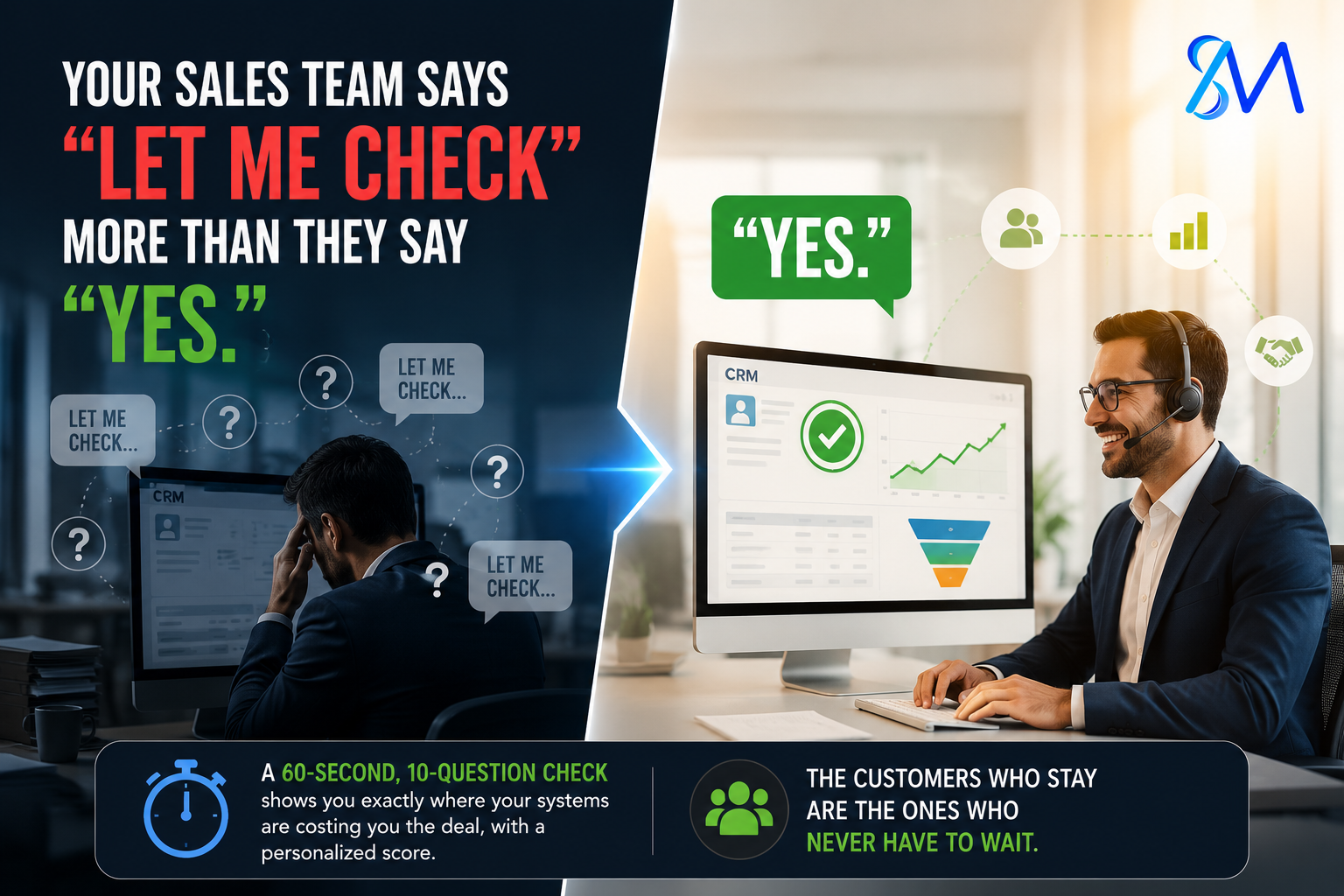
A deal that was moving well for three weeks suddenly goes quiet. The sales rep sends a follow-up. Then another. Each one is framed as a gentle nudge, but underneath it is a guess dressed up as a check-in, because nobody on the team can actually say why the buyer stopped responding.
This is the moment that separates CRM environments that drive revenue from CRM environments that simply store it. In our engineering reviews across Salesforce, Zoho, and Microsoft Dynamics environments, we consistently observe that most platforms can confirm a deal exists, log the last activity date, and show a stage in the pipeline. What they rarely surface is the one thing a revenue leader actually needs: whether the deal is cooling because of price, because of timing, or because the decision-maker who championed it internally has gone quiet without saying so directly.
Across our 500+ successful deployments, this gap shows up in almost every enterprise sales organisation we work with in the US, UK, and Europe, regardless of the platform they have standardised on. The CRM was configured correctly. The fields are technically complete. But the engagement data that would explain buyer hesitation sits disconnected from the pipeline view, which means every follow-up email is written without knowing what actually needs to be said.
The gap is rarely where it first appears. Most operations leaders who take the ERP Fit Quiz find the real friction point is one layer deeper than where they have been looking.
See Where Your Operations Actually Stand — 2 Minutes
→ Speak with Our Team
Why CRM Pipeline Visibility Breaks Down After Implementation
It is worth naming directly why this problem persists even in organisations with mature revenue operations functions and dedicated CRM administrators. The tooling to close this gap has existed for years: engagement tracking, intent data, and conversation intelligence platforms are widely available and well understood. The barrier is rarely awareness of the technology. It is that connecting these tools into a CRM’s pipeline view in a way reps actually trust and use daily requires a level of workflow-specific integration work that a generic CRM administrator, however skilled, is not typically resourced or scoped to deliver as part of routine platform maintenance.
The root cause is rarely the platform itself. It is the sequencing of what got connected first. Most CRM rollouts prioritise activity logging, pipeline stages, and reporting dashboards, because those are the features procurement teams evaluate during the sales cycle. Engagement signal data, the kind that reveals intent, hesitation, and buying-committee dynamics, is treated as a phase two enhancement that rarely gets funded once the initial rollout is declared complete.
The consequence compounds quietly. A sales manager reviewing the pipeline sees a deal sitting in the same stage for three weeks and has two options: trust the rep’s read on the account, or ask for a status update that puts the rep in the position of admitting they do not fully know either. Neither option produces the kind of clarity that shortens a sales cycle. Over a full quarter, across a team of fifteen reps, that ambiguity adds up to dozens of deals moving on gut feel rather than signal.
We also see this pattern intensify during multi-stakeholder enterprise deals, where three or four buying-committee members interact with a vendor across different channels: a product demo, a pricing call, a technical evaluation, an internal champion conversation. If those touchpoints are not unified inside the CRM, the picture leadership sees is fragmented by design, not by accident.
There is also a compounding effect specific to how sales teams are measured. Most sales compensation plans reward closed deals, not the diagnostic work of understanding why a deal is cooling. This means the incentive structure itself discourages the kind of investigative follow-up that would actually surface the real blocker, because a rep’s time is better spent, from a compensation standpoint, moving to the next opportunity than digging into why this one stalled. The CRM was supposed to remove that trade-off by surfacing the diagnosis automatically. When it does not, the trade-off remains, and reps rationally choose speed over depth.
How SuperBotics Closes the CRM Visibility Gap
Our approach starts with a workflow audit before any configuration changes are proposed. We map how the sales team actually engages prospects across email, calls, and product touchpoints, then identify exactly where that engagement data currently lives outside the CRM’s line of sight. This is different from a standard CRM health check, because it is built around the specific question of what causes a deal to cool, not just whether the fields are filled in correctly.
From there, our CRM and API orchestration teams connect the disconnected engagement sources directly into the platform’s data model, whether that is email engagement tracking, call transcription signals, or product usage data for PLG-influenced enterprise sales. The objective is a pipeline view where a stalling deal surfaces its likely cause automatically, rather than requiring a rep to reconstruct the story from memory during a forecast call.
Most CRM setups can tell you a deal exists. Very few can tell you why it is stalling. That second answer is the one that actually changes how a sales team spends its time.
We also build in adoption support as a structural part of the engagement, not an afterthought. A CRM connected to richer signal data only creates value if reps trust it enough to act on what it shows, so every implementation includes training built around how the sales team actually works day to day, not a generic platform walkthrough.
The specific integration pattern depends on where the disconnect actually sits. For some organisations, the gap is email engagement data that never syncs beyond a basic open-and-click log. For others, it is product usage signals from a free trial or PLG-influenced motion that never reaches the enterprise sales team managing the eventual contract negotiation. And for organisations running multi-stakeholder deals, the gap is often internal champion tracking, knowing which specific person inside the buying committee has gone quiet, rather than treating the account as a single undifferentiated contact. Each of these requires a different integration approach, which is why the workflow audit comes first rather than a standard connector being applied by default.
The Proof: What Connected Visibility Actually Changes
Across our CRM integration engagements in Salesforce, Zoho, and Dynamics environments, the operational shift is consistent: sales managers move from reviewing pipeline stage and last-activity-date to reviewing an actual engagement trend per deal. That shift changes what a forecast call looks like. Instead of asking “where is this deal,” the conversation becomes “here is what changed in the last two weeks, and here is what we are doing about it.”
| Before Connected Visibility | After Connected Visibility |
|---|---|
| Stage and last-activity-date only | Engagement trend and stakeholder signal per deal |
| Follow-up written on assumption | Follow-up written on observed buyer behaviour |
| Forecast accuracy based on rep confidence | Forecast accuracy based on engagement pattern |
This is the same underlying discipline behind the 4x faster insight cycles we have delivered across our AI and data engagements: the technology does not need to be more complex, it needs to surface the right signal at the right decision point. Applied to sales pipelines, that discipline is what turns a CRM from a system of record into a system that actively improves how a team closes.
This shift also changes how sales leadership coaches underperforming reps. Instead of a generic pipeline review that asks a rep to justify their own read on an account, a manager working from connected engagement data can point to the specific signal that changed, whether that is a champion who stopped opening emails or a decision-maker who joined a competitor’s demo. That specificity turns coaching from a subjective conversation into a concrete, actionable one, which is often the difference between a rep improving their close rate and a rep leaving the organisation believing the feedback was arbitrary.
What SuperBotics Specifically Delivers
For organisations facing this exact gap, our CRM and ERP integration practice delivers a defined engagement: a workflow audit of how the sales team actually operates, engagement data connected directly into the CRM’s pipeline view, and adoption training built around the team’s real day-to-day process rather than a platform’s default configuration. This work spans Salesforce, Zoho, SAP, Microsoft Dynamics, and Odoo environments, and is scoped around the specific reason deals are stalling in your pipeline today, not a generic CRM optimisation checklist.
The clearest starting point we have seen: know what your operations are actually ready for before deciding what to change.
The ERP Fit Quiz surfaces that picture honestly — no interpretation required.
The sales teams closing fastest this quarter are not the ones sending more follow-ups. They are the ones whose CRM finally tells them what a follow-up should actually say. That distinction sounds small in a demo and becomes the entire difference in a forecast review six months later.
Every enterprise sales team we have worked with assumed their pipeline visibility gap was unique to their industry or their platform. It almost never is. The gap is structural, and it is fixable, and once a sales leader sees what a connected pipeline actually looks like, going back to stage-and-date reporting stops being an option worth considering.