Why Your Sales Team Says Let Me Check More Often Than They Say Yes

Abitha Jeyaraj, Marketing Executive
September 9, 2026 · 5 min read
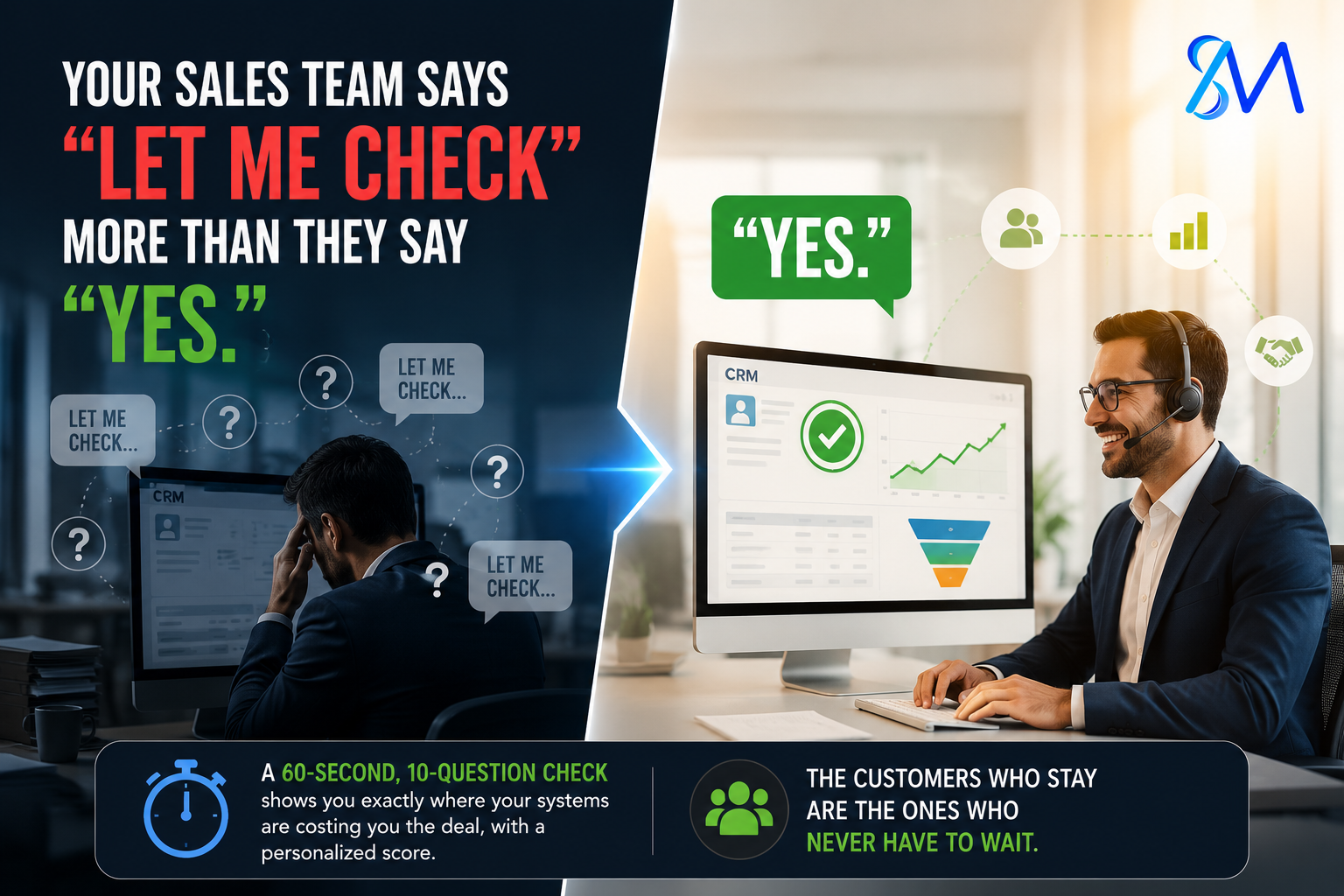
Your sales team says let me check more often than they say yes, and every one of those replies is a customer quietly losing confidence. Let me check usually means one of two things: the CRM does not actually have the answer, or nobody trusts what it says enough to answer without verifying it somewhere else first. Multiply that across every deal in the pipeline, and the delay is not measured in minutes. It is measured in deals that go cold while your team is still checking.
For a VP of Sales or Customer Engagement leader, this pattern is easy to normalise because it happens quietly, one conversation at a time, rather than showing up as a single dramatic failure. But the cumulative cost is significant. A customer who hears let me check once will wait. A customer who hears it three times starts looking for a vendor who already knows the answer.
The gap is rarely where it looks like it is from the inside. Most operations leaders who take the ERP Fit Quiz find their real friction point sits one layer deeper than expected.
A 60 second, 10 question check shows you exactly where your systems are costing you the deal.
Why the CRM Rarely Has the Answer When It Matters Most
Most CRM implementations are technically complete. The platform is live, the data has been migrated, training has happened. But completion is not the same as adoption, and adoption is not the same as trust. A rep who has learned, through repeated experience, that the CRM’s answer does not always match reality will stop relying on it as a source of truth, even if the underlying data has since improved.
This usually traces back to how the platform was configured in the first place. When a CRM is set up around the process a vendor assumed the business ran, rather than the process the team actually runs every day, the fields never quite match reality. Reps adapt around the gap by keeping their own notes, their own spreadsheets, their own private version of the pipeline, and the CRM becomes one more system to work from instead of the one place the team runs the business through.
Once that adaptation sets in, every customer facing answer routes through an extra manual verification step, because nobody trusts the system enough to answer directly from it. That extra step is where let me check comes from, and it is rarely a training gap. It is a configuration gap that has been quietly compensated for so long that nobody remembers deciding to work around it.
How SuperBotics Rebuilds CRM Around How the Business Actually Operates
Our CRM engagements begin with a process audit before any configuration work starts. We map how the team actually sells, services, and tracks customer engagement, then configure the platform to match that reality rather than a generic template. Across 150 plus enterprise launches, this sequencing is what separates a CRM the team fully trusts from one they quietly work around.
Once the process is understood, we connect the CRM to the other systems a customer facing answer actually depends on, including ERP, support, and billing platforms, so a rep can answer a question with confidence the first time it is asked rather than promising to check and get back to the customer. This includes implementation and integration work across Salesforce, Zoho, and Microsoft Dynamics, configured around the specific engagement model each client runs.
The result is a system that reflects how the business actually works, so the answer a customer needs is one click away instead of a follow up call away.
The Proof: What Connected CRM Changes for Customer Engagement
Across CRM environments in Salesforce, Zoho, and Dynamics, we have closed this exact visibility gap for clients across 14 countries, connecting engagement data so sales and support teams see the real reason a deal is cooling or a customer is asking a question, not just that they are.
| Disconnected CRM | Connected CRM |
|---|---|
| A rep says let me check and follows up later, if at all | A rep answers with confidence in the same conversation |
| The team keeps a private spreadsheet alongside the official system | The CRM is the one place the team actually runs the pipeline from |
| A stalling deal looks the same as a healthy one until it is too late | The real reason a deal is cooling is visible while there is still time to act |
The customers who stay are the ones who never have to wait. Trust is built one answered question at a time, and lost the same way.
What SuperBotics Specifically Offers Customer Engagement Teams
We deliver CRM implementation and integration purpose built around how your team actually engages customers, across Salesforce, Zoho, and Microsoft Dynamics, with the process audit, platform configuration, and cross system integration all included in a single engagement. This is not a generic CRM rollout. It is a system configured so your team can answer with confidence the first time a customer asks, because the platform finally reflects how the business really operates.
For a sales or customer engagement leader evaluating why adoption has stalled, the fix is rarely more training. It is usually a configuration that was built for the wrong process from the start, and correcting that sequence is what turns let me check back into a confident yes.
A CRM your team uses every day is worth significantly more than one they quietly work around.
The ERP Fit Quiz takes 60 seconds and hands back a personalised score showing exactly where your systems stand.
The businesses winning on customer engagement right now are not answering faster because their reps got better at improvising. They simply stopped making customers wait for an answer the system already had, because the system was finally built to give it.
Every let me check that gets replaced with a confident, correct answer is a small trust deposit with a customer who was quietly deciding whether to keep waiting or start looking elsewhere. Fixing the system behind that moment is rarely as disruptive as leadership teams expect it to be, and it is almost always worth doing before the next quiet exit.


