
Your Equipment Is Already Telling You Its About to Fail

Abitha Jeyaraj, Marketing Executive
September 30, 2026 · 5 min read
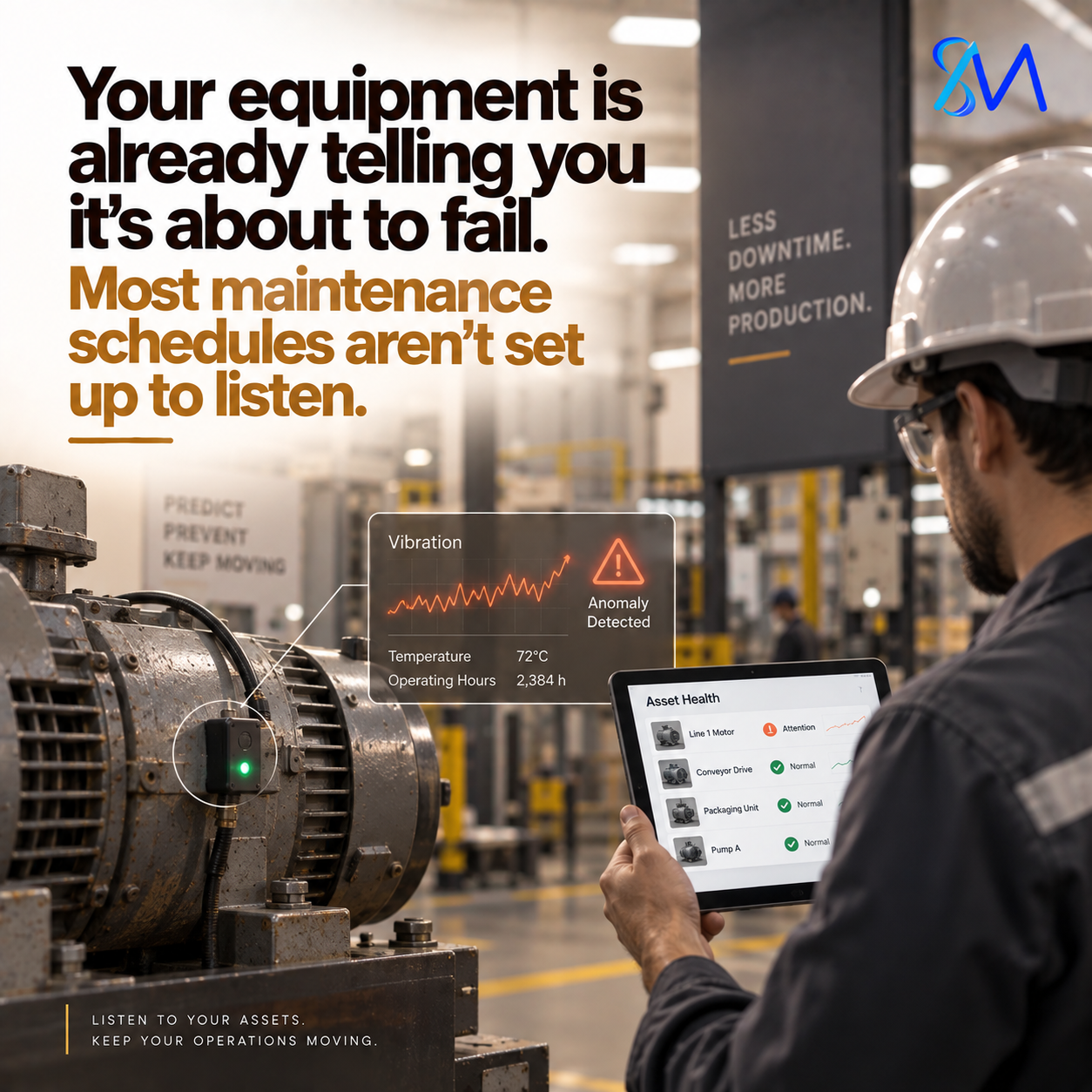
Your equipment is already telling you it’s about to fail. Most maintenance schedules simply aren’t set up to listen. A machine that fails right on schedule, exactly when the calendar predicted, is rare. One that fails between scheduled checks, mid-shift, with no warning anyone was watching for, is the normal case, and it’s the expensive kind of normal. Across manufacturing floors, the cost of unplanned downtime is usually higher than the entire maintenance program was ever budgeted to prevent in the first place.
Calendar-based maintenance persists because it’s simple to plan around and easy to justify in a budget review. Every ninety days, inspect the line. Every six months, replace the part. This works well for components with genuinely predictable wear patterns and fails quietly for everything else, which in a modern manufacturing environment is most of what actually breaks. A machine doesn’t know it’s supposed to wait until the next scheduled check to develop a fault, and by the time the fixed calendar catches up to a developing issue, the failure has often already happened mid-shift, with a line stopped and a production window lost.
The frustrating part of this pattern is that the data to catch these failures earlier usually already exists. Modern equipment generates a continuous stream of signals, vibration, temperature, load, that reflect actual condition far more accurately than a fixed calendar ever could. The gap isn’t a lack of information. It’s that the information isn’t connected to the systems that decide when maintenance actually happens, so a machine can be quietly signalling a developing fault for weeks while the maintenance schedule remains blind to it, waiting for its next calendar-driven check.
The machines already know when something’s wrong long before it fails. The real question is whether your systems are actually listening to them.
See Where Your Operations Actually Stand — 2 Minutes
→ Speak with Our Team
Why Calendar-Based Maintenance Was Never Going to Catch Everything
Calendar-based maintenance is built on an assumption that made sense decades ago, before continuous sensor data was widely available: that equipment wear is roughly predictable across a fixed time interval, and that inspecting on a fixed schedule is close enough to inspecting when it actually matters. That assumption holds reasonably well for some components. It holds poorly for the equipment most likely to cause an expensive unplanned stoppage, because real-world wear is influenced by load variation, environmental conditions, and usage patterns that don’t move in a straight line matching a calendar.
The result is a maintenance program that’s simultaneously over-servicing equipment that didn’t need attention yet, wasting labour and consuming parts inventory on components with plenty of remaining life, and under-servicing equipment that’s already developing a fault the calendar hasn’t reached yet. Both failure modes are expensive, and both are largely invisible until the second one produces a stoppage, at which point it becomes very visible very quickly, usually in the middle of a production run.
This isn’t a failure of the maintenance team’s diligence. It’s a structural limitation of scheduling maintenance around time intervals rather than around actual, observable equipment condition. The fix isn’t a more frequent calendar. It’s replacing the calendar as the trigger entirely, with a signal that reflects what’s actually happening inside the machine right now.
How SuperBotics Connects Asset Data to Drive the Maintenance Schedule
Our approach connects asset condition data directly into the ERP and maintenance systems that decide when work gets scheduled, so a machine’s actual condition drives the maintenance trigger instead of a fixed calendar interval. This means maintenance happens when it’s genuinely needed, based on real signals, not just when the calendar says it’s due, regardless of whether the underlying condition supports that timing.
| Calendar-Based Maintenance | Condition-Based Maintenance |
|---|---|
| Servicing triggered by a fixed time interval | Servicing triggered by actual observed condition |
| Healthy components serviced unnecessarily | Resources directed to equipment that actually needs it |
| Developing faults invisible until the next scheduled check | Developing faults surfaced as soon as the signal appears |
This is implementation and integration work across ERP and asset management systems, connecting the sensor and condition data that already exists on the equipment to the scheduling logic that decides what gets serviced and when. The shift alone tends to catch the failures a fixed calendar was always going to miss, simply because the trigger for action is now the machine’s actual state rather than an arbitrary date on a maintenance plan built months or years earlier.
The Proof: What Condition-Based Maintenance Actually Changes
Across the ERP and asset integration work we’ve delivered for manufacturing clients, the pattern that shows up consistently is a meaningful reduction in the specific category of failure that hurts the most: the mid-shift, unplanned stoppage that a fixed calendar had no chance of anticipating. This sits alongside the broader delivery discipline behind our 98% on-time release rate across 500+ projects, applied here to a maintenance program that finally reflects what the equipment is actually telling the business, rather than what a schedule assumed months in advance.
The machines already know when something’s wrong long before it fails. The question that actually matters is whether your systems are set up to listen.
What SuperBotics Specifically Delivers
For manufacturing organisations still running maintenance on a fixed calendar, SuperBotics delivers implementation and integration across ERP and asset management systems, connecting real-time condition data directly into the systems that schedule maintenance work. This replaces calendar-based maintenance with condition-based maintenance, built on the same integration discipline we bring across Salesforce, Zoho, SAP, Microsoft Dynamics, and Odoo environments, so maintenance resources go where the equipment’s actual condition says they’re needed, not where a fixed date says they should be.
The gap is rarely where it looks like it is from the inside. Most operations leaders find the real friction point one layer deeper than expected.
A machine that fails on schedule is rare precisely because failure doesn’t run on a calendar in the first place. The manufacturing operations avoiding the expensive, unplanned kind of downtime aren’t the ones inspecting most frequently. They’re the ones who stopped relying on a calendar to tell them when to look, and started letting the equipment tell them instead.