Manual Data Entry Is Costing You More Than Time: Fixing Disconnected CRM and ERP Systems

Abitha Jeyaraj, Marketing Executive
August 20, 2026 · 6 min read

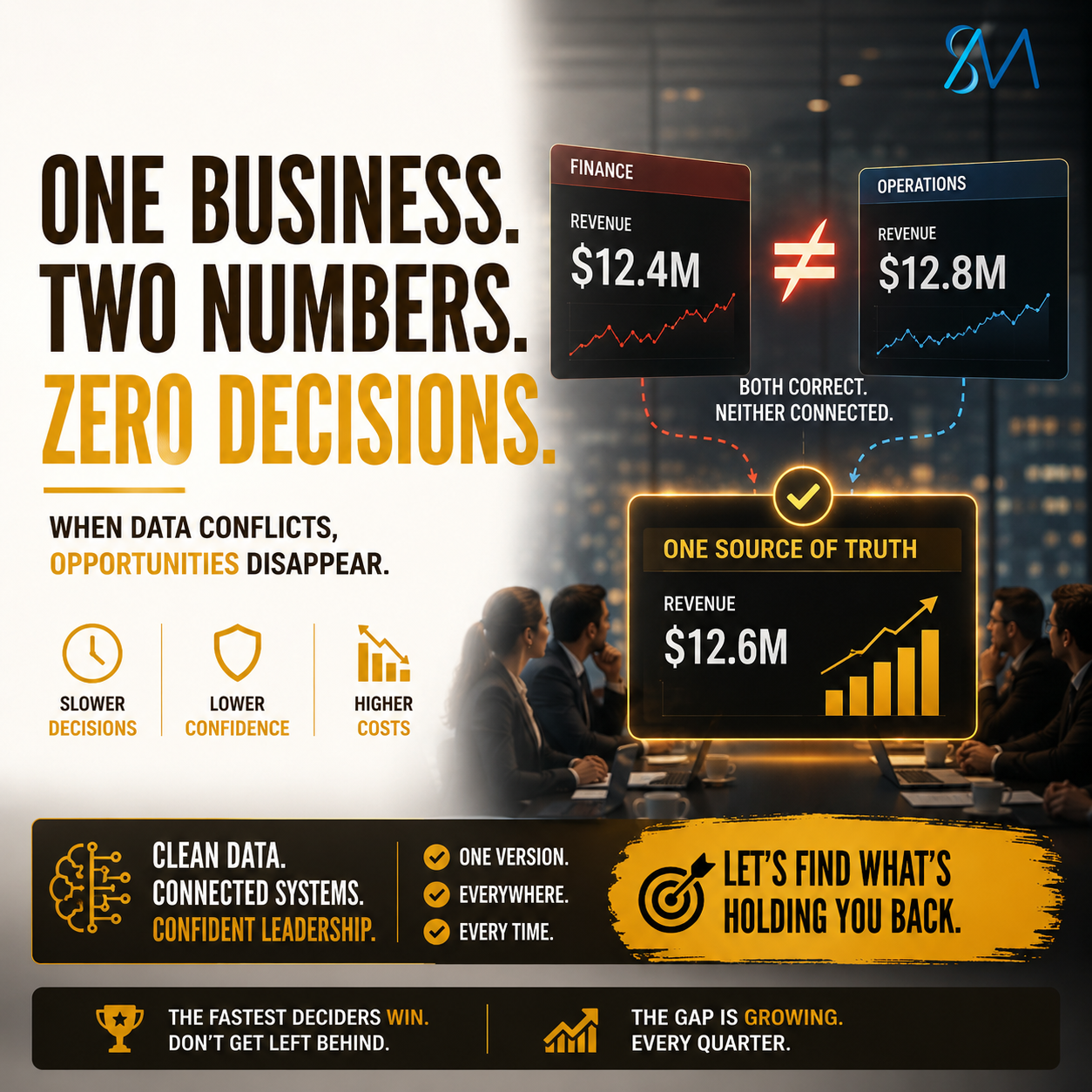
Your best engineers spend part of every week retyping data that already exists somewhere else in the business. Not because they lack better things to do, but because the CRM, the ERP, and the operational tools your teams rely on were never built to talk to each other. In our engineering reviews across 500+ projects, this pattern shows up almost everywhere: three versions of the same record, one in the CRM, one in the ERP, one in someone’s private spreadsheet, and nobody quite sure which one is current.
The cost rarely shows up as a single line item on a budget review. It shows up as an hour here, a reconciliation there, a decision delayed because two departments pulled different numbers for the same customer. Across our enterprise AI integration and CRM and ERP integration engagements, we consistently see leadership underestimate this cost by a wide margin, simply because manual data entry never gets billed as a project. It gets absorbed quietly, one retyped field at a time, until the business has normalised a tax nobody approved.
Most operations leaders who take the ERP Fit Quiz find that the real friction sits one layer deeper than where they were looking.
A 60 second, 10 question check hands back your personalised readiness score and the exact next step.
See Where Your Operations Actually Stand
→ Speak with Our Team
Why disconnected systems survive long after everyone notices them
Smart, well-resourced teams do not tolerate broken workflows on purpose. The pattern persists because each individual workaround feels small enough to live with. Someone exports a CRM report into a spreadsheet because the ERP does not reflect the latest deal status. Someone re-enters a customer address in a second system because the first one was never connected to it. None of these choices look like a crisis in the moment they are made. Multiplied across a year and across every department that touches customer or operational data, they compound into an organisation running on three or four slightly different versions of the truth at any given time.
The deeper issue is architectural, not behavioural. When systems are not connected at the API level, every team closest to the data becomes an unofficial integration layer, translating and re-entering information by hand. Across our 500+ projects in 14 countries, we consistently trace the root cause back to the same starting point: platforms that were implemented in isolation, without a plan for how data would move between them once the initial rollout was complete.
How SuperBotics closes the gap through direct API orchestration
Our engineering teams start every integration engagement by mapping how data actually moves through the business today, not how the org chart assumes it moves. CRM, ERP, finance systems, and operational tools are each audited for where a human currently bridges the gap between them. That map becomes the blueprint for the integration layer we build, using direct API orchestration so that a record entered once in any system propagates correctly everywhere it needs to live, without a second manual step.
This is not a dashboard layered on top of the existing mess. It is a structural fix at the point where data enters the business. We connect Salesforce, Zoho, SAP, Microsoft Dynamics, Odoo, and OpenText environments to the operational tools around them, with validation built in at the point of entry so an error is caught before it propagates downstream rather than after it has already cost someone a reconciliation cycle.
The proof: what this looks like inside a real engagement
One finserv client came to us with exactly this pattern: a CRM, an ERP, and a set of operational tools that each held a partial version of the customer record, with a team of analysts spending significant hours every week reconciling the differences before any report could be trusted. After we rebuilt the integration layer connecting these systems through direct API orchestration, that client reduced manual review time by 45 percent. The number was not the goal in itself. It was the visible result of removing the human bridge that had been quietly absorbing the cost of disconnected systems for years.
Across our broader Enterprise Integration and CRM and ERP Integration work, this outcome repeats with enough consistency that it has become a benchmark we hold ourselves to on every engagement: if a client’s team is still retyping data between systems six months after go live, the integration was not finished.
What SuperBotics specifically delivers for this problem
We deliver the integration layer itself, not a recommendation to build one. That means API orchestration between your CRM, ERP, and operational tools, validation rules at the point of entry so errors are caught before they spread, and a data ownership model that names exactly which system is the source of truth for each type of record. Every engagement is scoped against your actual workflow, not an idealised version of it, because a platform configured for the process it was sold on rather than the process your team runs every day degrades from the moment it goes live.
Our delivery track record across 500 plus enterprise projects, with a 98 percent on time release rate, exists specifically so that this kind of integration work does not become the next fire drill sitting on your roadmap. The team building your integration layer is the same team that has done this across 14 countries and multiple industries, which means the edge cases your systems will inevitably hit have very likely already been solved once before.
Fewer systems to manually reconcile is not a nice to have. It is margin your organisation is currently giving away, one retyped record at a time.
See exactly where your systems stand today, in 60 seconds.
The fix is almost always the same, and it is almost always available now
Every organisation we have worked with initially believed its data fragmentation problem was unique to its industry or its history of mergers and legacy platforms. In practice, the pattern is remarkably consistent: systems implemented separately, no integration layer planned from the start, and a team of skilled people quietly absorbing the gap by hand. The fix is equally consistent, connect the systems at the API level, validate data at the point of entry, and give every record a single source of truth.
What changes between organisations is not the diagnosis. It is how quickly leadership decides that the cost of staying disconnected has become larger than the cost of fixing it. For the teams that make that call, the transformation is measured in months, not years, and the return shows up as time given back to the people who were never supposed to be full time data entry clerks in the first place.