Turning Supply Chain Delays Into Early Warning Signals

Abitha Jeyaraj, Marketing Executive
August 17, 2026 · 8 min read
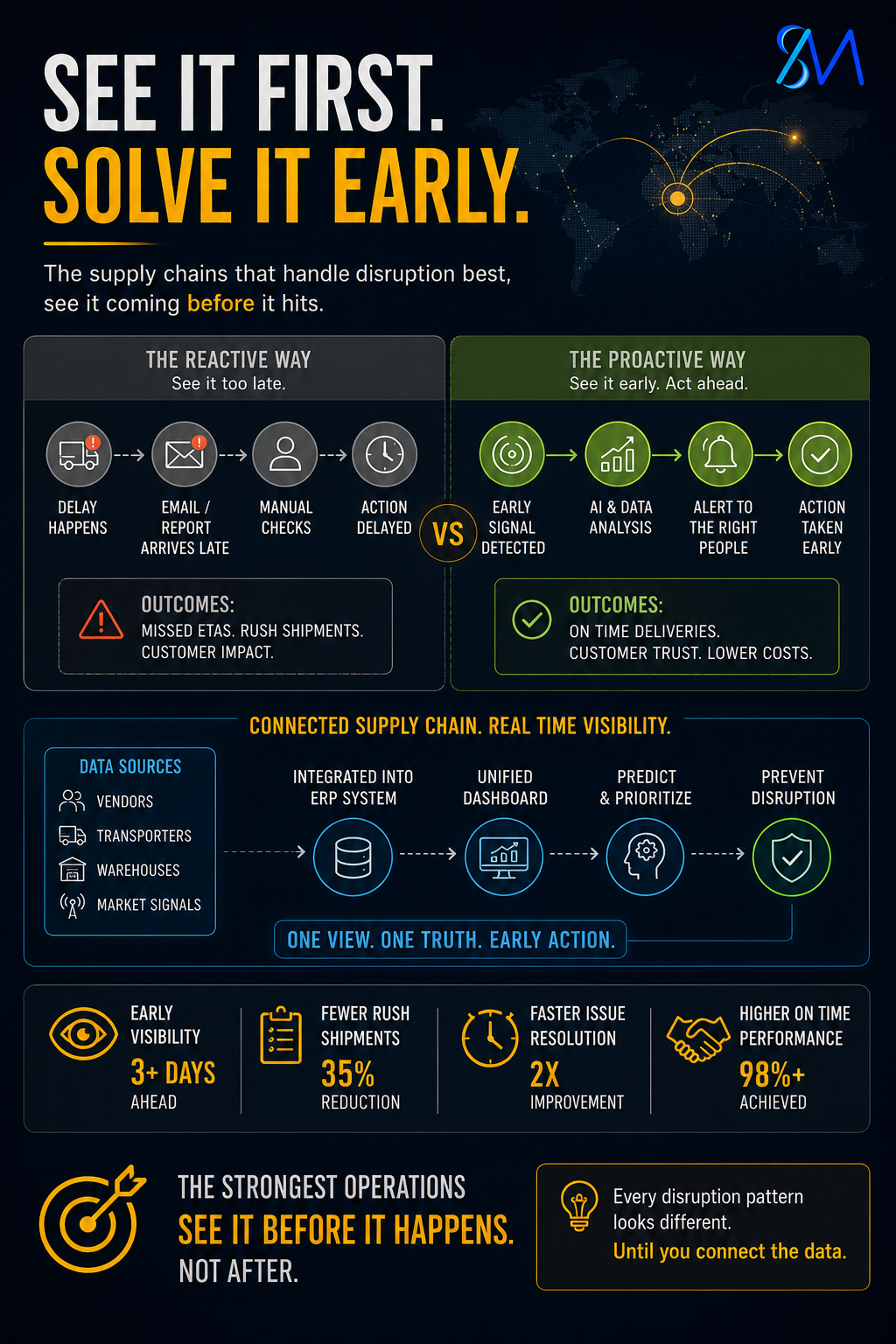
A customer emails asking where their order is. That single email is usually the first moment leadership finds out something went wrong, even though the delay itself began three or four days earlier, quietly, somewhere in the middle of the supply chain, where someone on the operations floor already knew about it.
This gap between when a disruption starts and when it becomes visible to the people who could act on it is the defining difference between supply chain operations that absorb disruption smoothly and ones that spend every week apologising for it. In our engineering reviews across manufacturing and retail operations, we consistently observe that most supply chain teams already know where their delays tend to originate: the same vendor, the same shipping lane, the same seasonal capacity pinch. Awareness is not the problem. The problem is that the warning signal arrives in a system nobody is actively watching until the delay has already become a missed delivery window.
This is rarely a data availability issue. Most enterprise supply chains already generate the tracking data that would reveal a developing delay early. The gap is that this data lives in logistics and carrier systems that are not connected to the ERP and operational systems where purchasing, planning, and customer service teams actually make decisions. The signal exists. It simply never reaches the people who need it in time to act.
The gap is rarely where it first appears. Most operations leaders who take the ERP Fit Quiz find the real friction point is one layer deeper than where they have been looking.
See Where Your Operations Actually Stand — 2 Minutes
→ Speak with Our Team
Why Supply Chain Disruption Signals Rarely Reach the Right Person in Time
It is worth naming directly why this gap persists even in supply chains run by experienced logistics and operations professionals. The carrier tracking data and ERP systems involved are each individually mature, well-supported platforms. The barrier is that integrating them in a way that respects both systems’ specific data models, and routes the resulting signal to the correct decision-maker rather than a generic notification list, requires integration expertise that sits outside what either the logistics team or the ERP administrator is typically resourced to build independently, which is why the gap tends to persist for years even as both underlying systems continue to improve on their own.
Enterprise supply chains typically run across several specialised systems: a transportation management system tracking carrier and shipment status, a warehouse management system tracking inventory movement, and an ERP system tracking purchase orders, production schedules, and customer commitments. Each of these systems does its individual job well. The problem is that they were rarely built, or integrated, with the assumption that a delay signal in one system needs to reach a decision-maker operating in a different one, in real time, before the delay compounds.
The result is a structural lag. A carrier delay gets logged in the logistics platform the moment it happens. But the purchasing team relying on that shipment for a production run, or the customer service team responsible for communicating with the end client, only finds out once someone manually checks, or once the delay has already cascaded into a missed commitment. That lag is rarely more than a day or two, but in fast-moving manufacturing and retail operations, a day or two is frequently the entire difference between getting ahead of a disruption and apologising for one.
Leadership teams often assume this is a forecasting problem, and invest in better demand planning tools as a result. In our experience across enterprise engagements, the forecasting is usually accurate enough. The gap is in operational signal routing: getting the right disruption data to the right decision-maker at the moment it is still actionable, rather than after it has already become a customer-facing issue.
This lag also carries a hidden cost beyond the immediate disruption: it erodes the credibility of the operations team internally, even when the disruption itself was outside their control. A customer service leader who finds out about a shipment delay from an angry customer email, rather than from an internal system, appears unprepared regardless of whether the underlying cause was a port congestion issue or a carrier capacity shortfall entirely beyond their influence. Over time, this pattern quietly damages leadership’s confidence in the operations function as a whole, even though the actual failure was in signal routing, not in the team’s judgment or effort.
How SuperBotics Connects Supply Chain Signals Into Operational Decision-Making
Our integration work closes this exact gap by connecting supply chain and logistics data directly into the ERP and operational systems where purchasing, planning, and customer service teams already work. This is not a new dashboard layered on top of existing tools. It is a direct data connection that surfaces a developing delay inside the systems the operations team is already using, at the moment the signal first appears, rather than requiring someone to check a separate logistics portal.
We have closed this exact visibility gap across manufacturing and retail operations of varying scale, using enterprise integration and API orchestration to unify carrier tracking data, warehouse movement data, and ERP purchase order and production data into a single operational view. The specific integration pattern varies by the systems already in place, but the underlying principle stays consistent: the signal needs to reach a human who can act on it while there is still time to act.
The strongest operations are not the ones with zero disruptions. They are the ones who saw it three days earlier than the customer did.
We also build in defined ownership as part of the integration, because a signal that reaches the right system but no specific person still gets missed. Every engagement includes clarity on who is notified when a disruption signal crosses a defined threshold, so the response happens automatically rather than depending on someone noticing during a routine check.
The specific systems involved vary by industry and scale. For manufacturing clients, this often means connecting supplier portals and production scheduling systems so a raw material delay surfaces against the specific production run it will affect, rather than as a generic vendor notification. For retail clients, it more often means connecting carrier tracking APIs directly into the order management and customer service platforms, so a delay is visible to the team fielding customer inquiries before the customer has to ask. In both cases, the integration work respects the existing technology investment already in place, connecting rather than replacing the systems the operations team already knows how to use.
The Proof: What Connected Supply Chain Visibility Delivers
Our clients maintain a 98% on-time release rate across enterprise engagements built on exactly this kind of integrated visibility. That figure reflects a broader delivery discipline, but the underlying principle applies directly to supply chain operations: when the right signal reaches the right person early enough, the response happens before the customer ever notices there was a problem to solve.
| Disconnected Systems | Connected Signal Routing |
|---|---|
| Delay discovered via customer email | Delay surfaced in ERP before customer impact |
| Manual cross-checking of logistics portal | Automatic threshold-based notification to defined owner |
| Response begins after commitment is missed | Response begins while recovery is still possible |
Customer trust in a supply relationship is rarely rebuilt by a well-crafted apology. It is protected by never needing to send one, and that protection comes from operational infrastructure, not from a better-worded customer service script.
Beyond the immediate customer relationship, this kind of connected visibility also improves internal planning accuracy over time. Once disruption signals are tracked systematically inside the ERP rather than scattered across individual carrier portals, patterns become visible that were previously anecdotal, such as a specific lane that consistently underperforms during a particular season. That pattern recognition lets procurement and planning teams proactively adjust vendor allocation before the next disruption cycle begins, rather than reacting to the same recurring issue every year as if it were a new surprise.
What SuperBotics Specifically Offers
For manufacturing and retail operations facing this exact disruption visibility gap, our enterprise integration practice connects logistics, warehouse, and ERP systems into a unified signal view, with defined ownership and threshold-based notification built into the design. This work is scoped around your specific vendor relationships, shipping lanes, and existing technology stack, not a generic supply chain visibility template.
The clearest starting point we have seen: know what your operations are actually ready for before deciding what to change.
The ERP Fit Quiz surfaces that picture honestly — no interpretation required.
The operations teams that consistently get ahead of disruption did not eliminate every possible delay. They rebuilt the path a warning signal travels, so it reaches a decision-maker while there is still time to act on it, rather than after the customer has already noticed.
Every manufacturing and retail team we have worked with initially believed their disruption pattern was unique to their industry or their vendor base. It almost never is. The fix is structural, and it is the same fix, applied to the specific systems already running inside your operation.