The 3 Hidden Secrets to Achieving Real-Time Operational Command and Eliminating Daily Firefighting (A CEO/VP Guide)

abitha
May 14, 2026 · 9 min read

Every fire you manage manually is a strategic decision you delayed. Most executives leading scaling organisations recognise this truth, often in the middle of the escalation itself. The pressure arrives not as a single event but as a pattern: decisions made on data that is already a cycle old, escalations surfacing after the window to manage them cleanly has passed, and operations that remain reactive when the business has already moved into territory that demands anticipation.
The cost of this pattern extends well beyond the operational layer. Every hour a CEO or VP spends resolving an escalation is an hour not spent building the system that prevents the next ten. Over a quarter, that accumulation becomes visible in delayed market decisions, slower response to competitive signals, and leadership bandwidth consumed by the day’s noise rather than the organisation’s next horizon. The organisations that compound strategic advantage most reliably are not the ones with the most sophisticated technology. They are the ones where leadership sees what is happening before it requires managing.
What separates organisations with genuine operational command is not a function of technology investment. It is a function of the sequence in which that investment is made. The organisations that achieve real-time visibility, measurable reductions in escalation volume, and faster executive response windows all apply a specific set of principles, in a specific order, before a single dashboard goes live.
The organisations getting sustained value from AI all start with the same question: what are we actually ready to automate, and what needs to be solved first?
We have mapped that starting point across 50+ enterprise deployments. If it is useful for where you are right now, we will share the framework directly.
Why Operational Visibility Efforts Stall in Well-Resourced Organisations
The organisations that continue to operate reactively despite significant technology investment are almost always facing the same root condition: they have instrumented before they have integrated. Visibility tools, reporting layers, and AI platforms have been deployed into environments where the underlying data signals are fragmented, inconsistent, or untrustworthy. The result is dashboards that create the appearance of operational command while the real signals remain buried in disconnected systems.
This pattern persists because the pressure to show progress is real. Boards want to see the dashboard. Leadership teams want to see the AI pilot. The instinct to deploy visible outputs before establishing reliable foundations is understandable, and it is also the primary reason operational visibility programmes fail to deliver their intended outcome. When the signals feeding the system are fragmented, no amount of visualisation or machine learning overhead will produce the clarity that strategic leadership requires. The system optimises the presentation of noise.
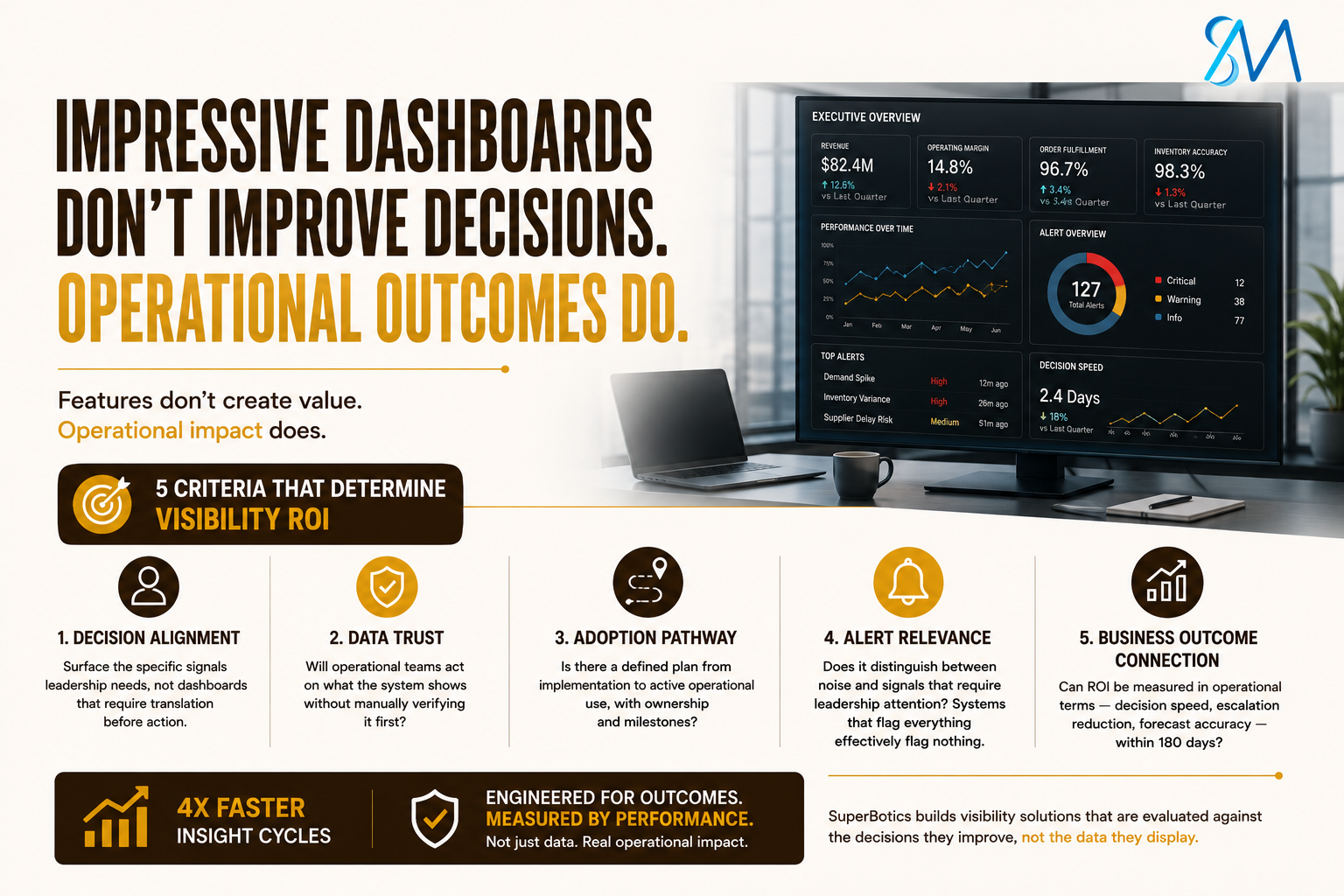
There is a second layer to this challenge that is less frequently named. Most operational visibility programmes are designed around reporting rather than decisions. The natural tendency in enterprise environments is to build comprehensive dashboards, surface every available metric, and let leadership interpret the output. The organisations achieving measurable operational command have reversed this logic entirely. They define the decisions that need to be faster before they design the instruments that support them. The resulting systems are simpler, more trusted, and significantly more actionable at the executive level.
The 3-Principle Sequence That Produces Real Operational Command
SuperBotics has observed this pattern across more than 500 enterprise engagements. The organisations that achieve genuine operational command, consistently and sustainably, apply three principles in a specific sequence. Each one builds the foundation for the next. Reversing or skipping any step in the sequence produces the reactive environment the organisation was attempting to exit.
Principle 1: Integration before instrumentation. Operational visibility fails when disconnected systems produce fragmented signals. Before any visibility layer is designed, the data environment must be unified. Source systems need to communicate reliably and consistently. The foundation must connect first, because every insight layer built above an unintegrated data environment inherits the fragmentation below it. This is not a technology preference. It is a structural requirement.
Principle 2: Signal design before dashboard design. The best operational visibility systems in enterprise environments are designed around actions, not screens. This means defining, before any dashboard is built, which signals represent decision-relevant changes in the organisation’s operating state. Which signal, if it moved in a certain direction, would require a specific response within a specific time window? That question determines which data points matter and at what granularity. Dashboards built from this logic surface what leadership needs to act on. Dashboards built without it produce reporting volume that competes for the same executive attention they were designed to support.
Principle 3: AI-assisted pattern recognition before manual bottlenecks appear. Enterprise operations generate more data than any manual review cycle can realistically process at the pace the business requires. The organisations that have eliminated reactive operations have not hired more analysts. They have deployed AI-assisted visibility layers that surface anomalies early, before they become escalations. The role of leadership in these environments shifts from managing exceptions to reviewing flagged signals and making decisions on pre-identified conditions. That shift is what transforms operational culture from reactive to anticipatory.
These three principles, applied in this sequence, consistently produce a different operating environment than the one most scaling organisations are navigating.
What This Approach Delivers Across Enterprise Environments
The outcomes SuperBotics has delivered through this sequence across enterprise AI integration engagements provide a precise picture of what becomes possible when the sequence is applied correctly.
Clients applying this approach have achieved four times faster insight cycles. The reduction in time from signal to decision is not a marginal improvement. It is a structural change in how quickly leadership can respond to operating conditions, which compounds across every domain where speed of response creates competitive or operational advantage. One finserv client reduced manual review time by 45 percent through AI-assisted operations built on this foundation, allowing their senior team to redirect that capacity toward higher-order analytical work.
Measurable reductions in operational escalations have followed consistently across engagements. When the signal design is built around decision-relevant conditions and the AI layer surfaces anomalies early, the volume of issues that reach the executive layer as escalations drops significantly. Leadership sees the signal before it becomes an incident. The cultural effect of this shift is substantial: teams that stop operating in escalation mode develop the capacity to operate in planning mode, which changes the quality of decisions made at every level of the organisation.
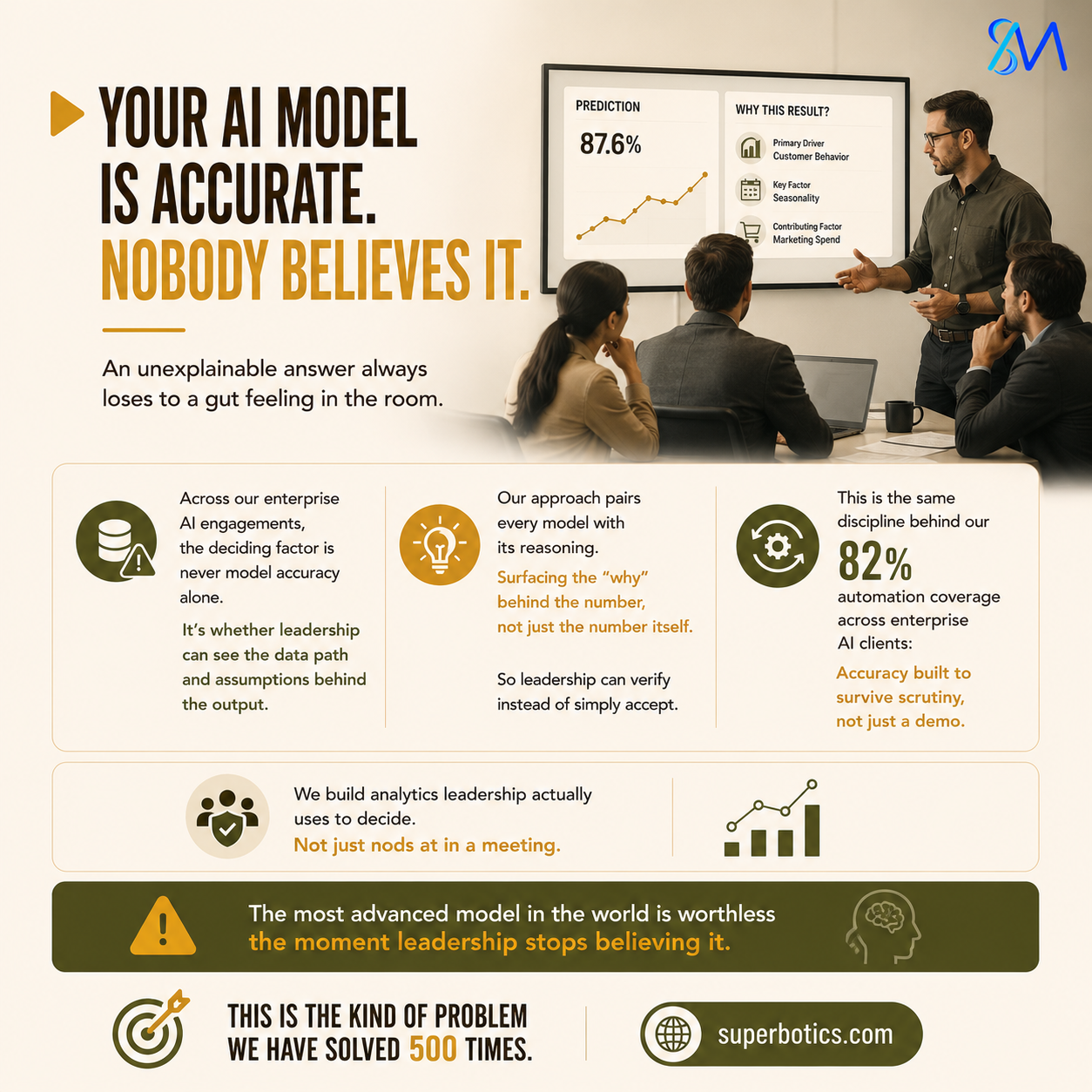
Faster executive response windows within the first quarter are a consistent outcome. The 14-week AI model to production timeline that SuperBotics has maintained across 150-plus enterprise launches is designed specifically to deliver this. The programme moves from strategy and data readiness assessment through model engineering, RAG architecture, and MLOps deployment to a production environment that is trusted, governable, and operationally embedded, not piloted in isolation. The 82 percent automation coverage achieved across enterprise AI engagements reflects a deployment approach built for operational adoption, not technology demonstration.
What SuperBotics Builds for Organisations Seeking Operational Command
SuperBotics constructs the operational intelligence layer that gives CEOs and VPs command-level visibility across their enterprise. The engagement begins with an AI strategy and discovery workshop that maps value before a single technical decision is made. Data readiness is assessed and addressed at the source. Signal design is completed in collaboration with leadership before the visibility architecture is specified. The result is a system that reflects how the organisation actually makes decisions, not a generic reporting layer applied over existing complexity.
The delivery model brings together AI model engineering, RAG-powered knowledge systems, multi-agent workflows, predictive analytics, and MLOps infrastructure within a structured programme that moves from strategy to production in 14 weeks. Responsible AI governance is embedded at every stage, not added at the end. Every model and workflow is deployed with the compliance architecture the enterprise environment requires, including alignment with GDPR, CCPA, HIPAA, PCI DSS, ISO 27001, and SOC 2 standards where applicable. IP is assigned to the client as standard in every agreement.
The engineering team brought to each engagement carries an average of seven years of enterprise delivery experience. The 120-plus specialists available on demand ensure that the programme is staffed precisely to the complexity it requires, with no unnecessary overhead and no capacity gaps. The 98 percent on-time release rate across 500-plus projects reflects not a performance claim but a delivery model designed and governed to produce it.
The Organisations That Lead Their Markets See Sooner
Operational command at the executive level is not a technology outcome. It is a thinking outcome that technology then supports. The organisations that have built genuine real-time visibility into their operating environments did not achieve it by purchasing a more advanced platform or deploying a larger analytics team. They achieved it by establishing the right foundations in the right sequence, defining their decision architecture before their data architecture, and deploying AI-assisted pattern recognition as a structural capability rather than a point solution.
The competitive distance between organisations that operate with this clarity and those that continue to manage fires manually compounds each quarter. The organisations in the first category are making decisions faster, preserving executive bandwidth for strategic work, and building the institutional knowledge that comes from operating in a learning system rather than a reactive one. The organisations in the second are managing the same category of escalations they were managing twelve months ago, with the same cycle time, and the same strategic cost.
Operational command is not a function of working harder. It is a function of seeing sooner, and building the system that makes that permanent.
Ready to Build Operational Command Across Your Enterprise?
SuperBotics designs and delivers the AI-powered operational intelligence layer that gives CEOs and VPs real-time visibility, from strategy through production in 14 weeks.
Request a Call Back — Talk to our enterprise AI team about your operational environment.
Explore Enterprise AI Solutions — See how SuperBotics builds the visibility layer that eliminates daily firefighting.
View Our Capabilities — Procurement-ready, compliance-aligned, and proven across 500+ enterprise projects.
Ready to solve this for your organization? Visit SuperBotics MultiTech to see how our team can help.
The right first question is not which AI tool — it is what does our data and team need to be ready for this to work.
That question, answered clearly, is worth more than any vendor comparison.