
The Five Parameters That Separate Real-Time Visibility Investments That Pay Off From Ones That Do Not

Abitha Jeyaraj, Marketing Executive
July 22, 2026 · 9 min read
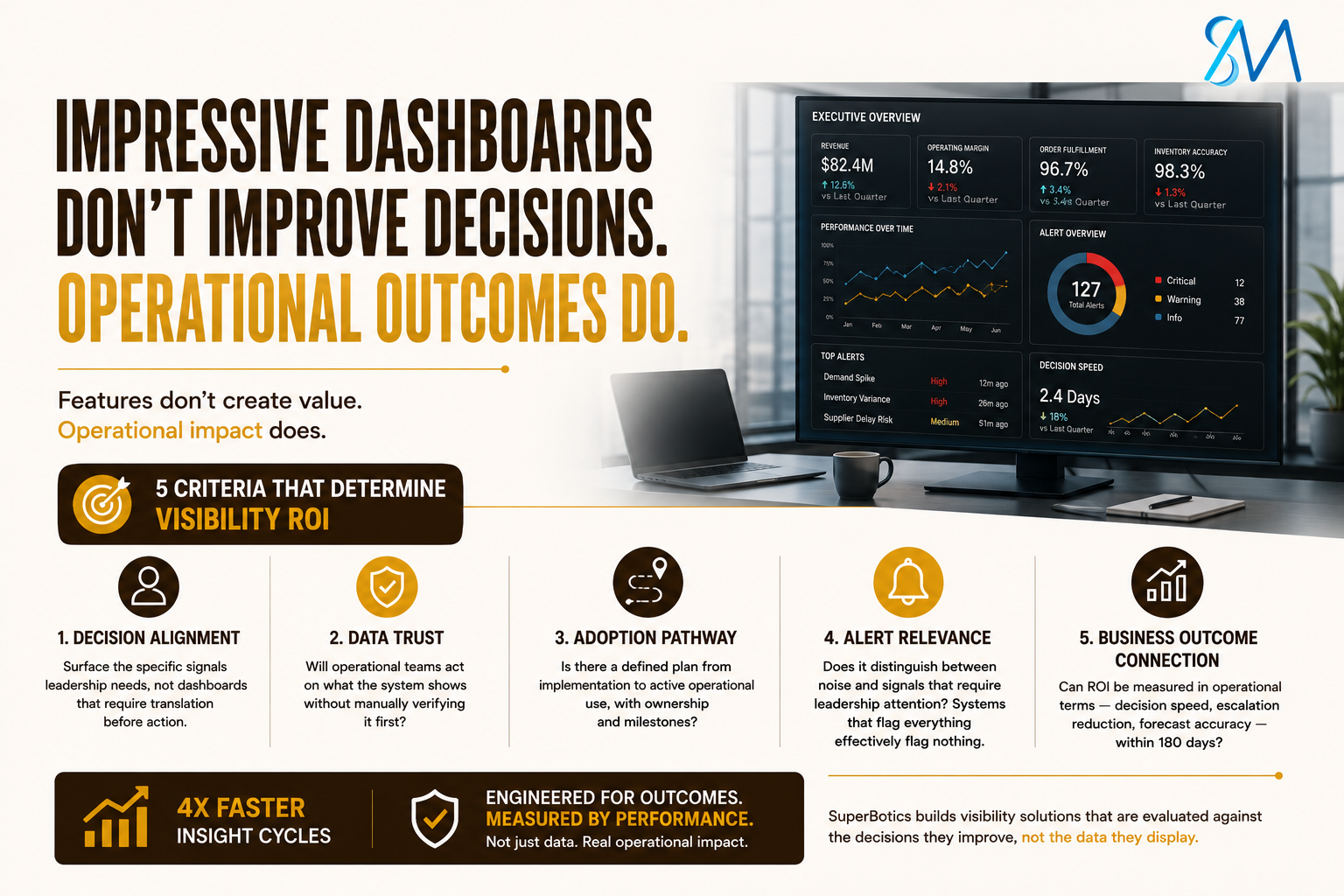
The dashboard looked impressive in the demo. Six months after implementation, the leadership team was still making the same decisions at the same speed, with a more expensive technology stack sitting underneath them. For CTOs and COOs evaluating real-time visibility solutions, this outcome is more common than the procurement process usually admits, and it rarely gets traced back to where the actual failure began.
The pattern is consistent across manufacturing, retail, and logistics operations we have supported. The evaluation process focused almost entirely on features: refresh rates, integration counts, dashboard customisation, mobile access. The operational outcomes were assumed to follow automatically once the technology was live. In practice, they rarely do, because a dashboard that displays information faster does not automatically change how fast a leadership team acts on it.
This is the gap that separates real-time visibility investments that reshape decision speed from ones that simply add a new screen to an already crowded operations centre. It is not a technology gap. It is an evaluation gap, and it opens long before a single line of code gets written.
The organisations getting sustained value from AI all start with the same question: what are we actually ready to automate, and what needs to be solved first?
We have mapped that starting point across 50+ enterprise deployments. If it is useful for where you are right now, we will share the framework directly.
Why Feature Comparison Cannot Predict Operational Impact
Most procurement processes for visibility platforms are built around a familiar exercise: a feature matrix, scored against competing vendors, weighted by IT and reviewed by finance. This process is thorough, and it is also structurally incapable of predicting whether the platform will change a single decision inside the business.
A feature matrix answers the question of what the system can display. It does not answer the question of whether the person receiving that display will trust it enough to act on it without checking three other sources first. Across our enterprise engagements, that second question is the one that actually determines return on investment, and it is almost never scored during vendor selection.
Systems that flag everything effectively flag nothing. A visibility platform that treats every fluctuation as urgent trains its own users to stop paying attention.
This is why the organisations seeing measurable operational improvement within ninety days of go live are not necessarily the ones with the most sophisticated dashboards. They are the ones that evaluated the investment against decision outcomes from the outset, before a single vendor demo was scheduled.
The Five Parameters That Predict Real ROI
Across our AI and data engagements, we have found that five evaluation criteria consistently separate visibility investments that deliver measurable operational improvement from ones that add cost without changing behaviour. Most procurement processes underweight all five.
- Decision alignment. Does the platform surface the specific signals a leader needs to act, or does it produce dashboards that require an analyst to interpret and translate before anyone can move? Translation time is decision lag, no matter how fast the underlying data refreshes.
- Data trust. Will operational teams act on what the system shows without manually verifying it against a spreadsheet first? If the answer is no, the platform has added a step to the workflow rather than removed one.
- Adoption pathway. Is there a defined plan from implementation to active daily use, with named ownership and clear milestones? Without this, adoption tends to plateau at the pilot team and never reaches the operations floor.
- Alert relevance. Does the system distinguish between background noise and signals that genuinely require leadership attention? A platform that flags everything effectively flags nothing, because the team learns to filter it out within weeks.
- Business outcome connection. Can return on investment be measured in operational terms, such as decision speed, escalation reduction, or forecast accuracy, within a defined window such as one hundred and eighty days?
Every one of these criteria requires the buying organisation to define its own decision landscape before evaluating a single platform. That sequencing, decision mapping first and technology second, is the single largest predictor of whether a real-time visibility investment delivers the outcome it was approved to deliver.
How This Plays Out Across Different Operating Environments
The table below reflects the pattern we consistently observe across manufacturing, retail, and logistics environments when visibility platforms are evaluated against outcomes rather than features alone.
| Evaluation Approach | Typical Time to Measurable Impact | Common Failure Point |
|---|---|---|
| Feature led procurement | Rarely measured; often assumed at go live | Dashboards require translation before action |
| Outcome led procurement | Within 90 days | Requires upfront decision mapping effort |
| Alert volume unmanaged | Adoption declines within weeks | Teams disengage from noisy systems |
| Alert relevance engineered | Sustained beyond 6 months | Requires ongoing threshold calibration |
How SuperBotics Approaches Real-Time Visibility Programmes
In our engineering reviews, the visibility programmes that succeed all share the same starting point: they begin with the decisions the business needs to make faster, not with the data the business happens to already collect. SuperBotics designs and delivers visibility solutions that are evaluated against the decisions they improve, not the data they display.
This starts with a discovery phase mapped directly against operational decision points. We identify where decisions currently lag, who owns each decision, and what information that person would need in hand for the decision to move faster. Only after this mapping is complete does the platform architecture conversation begin, covering data pipelines, model engineering where predictive signals are required, and the alerting logic that determines what actually reaches a human.
Alert engineering deserves particular attention here, because it is the stage most vendor led implementations skip entirely. We build alert thresholds around historical variance in the specific operation, not generic industry benchmarks, so that what reaches a leader’s screen is genuinely the exception rather than routine fluctuation dressed up as urgency.
Adoption Design Runs Alongside Technical Build, Not After It
The adoption pathway is scoped from week one, with named ownership on the client side and milestones tied to actual usage, not system uptime. This is where most visibility platforms lose momentum. The technology goes live successfully, uptime metrics look strong, and usage still plateaus at the pilot team because no one owned the transition to daily operational reliance.
Across our AI and data engagements, four times faster insight cycles are achievable when the implementation is built around operational outcomes from the design phase rather than retrofitted onto a platform that was purchased on feature strength alone.
The Proof Behind This Approach
One finserv client we partnered with reduced manual review time by forty five percent after we restructured how AI generated signals were embedded into their daily operations, rather than simply layering a new dashboard on top of an unchanged review process. The technical build was a smaller portion of that engagement than the workflow integration and governance layer that determined whether the signals were actually trusted and used.
This mirrors what we see across our five hundred plus delivered projects. The technical implementation of a visibility platform is rarely the constraint. The constraint is whether the organisation mapped its decisions before it mapped its data, and whether adoption was designed with the same rigour as the architecture.
What SuperBotics Specifically Delivers
SuperBotics delivers end to end real-time visibility programmes that begin with decision mapping, proceed through data architecture and model engineering built on platforms including Azure AI, Amazon Bedrock, and LangChain, and conclude with an adoption plan owned jointly by our delivery team and named leaders inside your organisation. Governance is embedded at every stage, so the platform that goes live is accountable to the decisions it was built to improve, not just to an uptime dashboard.
This is not a dashboard build. It is an operational decision infrastructure engagement, scoped around the specific signals your leadership needs and measured against the specific decisions those signals are meant to accelerate.
Why Procurement Timelines Need to Change Alongside Evaluation Criteria
One consequence of evaluating decision alignment and adoption pathway ahead of feature capability is that procurement timelines tend to extend at the front end. Decision mapping workshops take weeks, not days, particularly in operations spanning multiple sites or business units where the same decision might be owned differently depending on the location. Leadership teams accustomed to a faster vendor selection cycle sometimes read this as a delay rather than as the investment that determines whether the platform succeeds after go live.
In practice, the additional weeks spent on decision mapping consistently pay for themselves within the first quarter of live operation. Platforms selected primarily on feature strength tend to require a second, unplanned phase of rework once adoption stalls, and that rework almost always costs more in elapsed time and internal credibility than the upfront mapping would have. Treating decision mapping as a discovery investment rather than a procurement delay is one of the clearest signals we see of an organisation that is set up to realise return on investment from a visibility platform rather than simply operate one.
What This Means for CTOs Building the Internal Business Case
For a CTO or COO building the internal business case for a real-time visibility investment, the strongest position is one grounded in named decisions rather than named features. Instead of presenting a platform comparison to the board, present a list of the five or six decisions inside the operation that currently move too slowly, quantify the cost of that lag in hours or dollars, and frame the platform selection as the mechanism for closing that specific gap. This reframing changes the conversation from a technology purchase to an operational outcome commitment, which tends to secure faster internal approval and creates a much clearer basis for measuring success at the one hundred and eighty day mark.
The Investment That Actually Changes How Decisions Get Made
Real-time visibility only becomes a genuine competitive advantage when the organisation evaluating it asks the harder question before the easier one. Not what will this platform display, but which decision will move faster because of it, and how will we know within one hundred and eighty days that it did.
Across every engagement where SuperBotics has led with decision mapping ahead of technology selection, the visibility investment stopped being a line item under review and became infrastructure the leadership team relies on daily. That shift is available to any organisation willing to define its decisions before it defines its dashboard.
The next real-time visibility conversation your organisation has should start there. Visit superbotics.com to see how our teams approach this from day one.
The right first question is not which AI tool — it is what does our data and team need to be ready for this to work.
That question, answered clearly, is worth more than any vendor comparison.