The Proactive Ops Mindset: How Real-Time Operational Command Transforms Enterprise Performance

abitha
May 21, 2026 · 21 min read
The Cost of Running a Talented Team in Reactive Mode
The most persistent and expensive operational pattern in enterprise organisations today is not a technology problem. It is a timing problem. Operations teams across manufacturing, logistics, financial services, and professional services are built from experienced, capable people who have spent years mastering their domain. They understand the business. They know the systems. They are trusted enough to sit in leadership reviews and own critical outcomes. And yet, in organisation after organisation, these same people spend the majority of their working day managing situations that have already developed rather than shaping the ones that are still forming. That is not a reflection of their capability. It is a reflection of the infrastructure they are operating within, and it is one of the most underexamined sources of operational cost in enterprise today.
The pattern presents the same way regardless of industry or geography. The morning review opens with the same questions it opened with last Monday. Which escalation came in overnight. Which handoff missed its window. Which system produced results that no one saw until the problem had already cascaded two levels down. The team responds with precision and professionalism, and by the end of the day the incident is resolved. The following morning, a different incident, built from the same structural conditions, is waiting. Over weeks and months, this cycle consumes something more costly than budget. It consumes the strategic capacity of the people who should be building, optimising, and advancing the business rather than reconstructing what happened and why. When an organisation’s most capable operations leaders are primarily performing post-mortems, the compounding cost is measured not just in hours but in the strategic decisions that were never made, the growth initiatives that never received sustained attention, and the operational improvements that were always deprioritised because the floor needed tending first.
What makes this pattern difficult to address at the leadership level is that it does not appear as a single failure. The data exists. The dashboards run. The teams are responsive. The reporting cadence is intact. From a governance perspective, the operational infrastructure appears functional. What it obscures is that the entire system is calibrated around visibility that arrives after the decision window has passed. The operational intelligence reaching leaders reflects the business as it was at the close of yesterday rather than the business as it is moving right now. And in environments where conditions shift within hours, that lag is the structural origin of every escalation, every bottleneck, and every missed handoff that fills the morning agenda. Organisations that have built real-time operational command have not simply upgraded their technology. They have fundamentally changed the conditions under which their teams operate, and the outcomes that follow from that change are consistent and measurable across every sector where SuperBotics has delivered it.
The gap is rarely where it first appears. Most operations leaders who take the ERP Fit Quiz find the real friction point is one layer deeper than where they have been looking.
→ See Where Your Operations Actually Stand — 2 Minutes→ Speak with Our Team
Why the Visibility Gap Persists in Well-Resourced Organisations
The question that every COO and CTO navigating this challenge eventually reaches is the same: if the data exists, if the systems are running, and if the team is capable, why does the visibility gap persist? The answer is structural, and it operates at three distinct levels that reinforce each other in ways that make the gap self-sustaining even when individual components are addressed in isolation.
The first level is data fragmentation across systems that were never architecturally designed to communicate at the speed that modern operations require. In most enterprise environments, operational data lives across ERP platforms, logistics management systems, CRM records, IoT feeds, service management tools, custom applications, and legacy infrastructure that was built to serve a reporting cadence rather than a real-time decision cycle. Each of these systems captures valuable operational signals. The problem is not that the data is absent. The problem is that by the time it is aggregated, normalised, formatted, and routed through the existing reporting architecture to the person with the authority to act, the conditions that generated the signal have already evolved. A supply chain anomaly that appeared at 09:00 becomes visible on a leadership dashboard at 16:00 and lands in a written summary the following morning. At that point, the operations team is not making decisions. They are performing structured reconstruction of what happened in the past and planning how to prevent a recurrence. The decision window that existed at 09:00 is closed, and the cost of that closure accumulates silently across every similar cycle every week of the year.
The second level is alert architecture that was designed for system monitoring rather than operational intelligence. Many organisations that have recognised the visibility gap have responded by deploying monitoring tools that generate high volumes of notifications across multiple channels. The intent is sound. The outcome is frequently the opposite of what was intended. When alert volume exceeds the team’s capacity to contextualise and triage signals, the response is alert fatigue, and alert fatigue produces the same outcome as no alerting at all. Operations teams learn to discount notifications because the ratio of actionable signals to informational noise is too low to justify the attention each alert demands. The monitoring infrastructure is running. The team’s confidence in it is not. The result is a paradox in which the organisation is generating more data about its own operations than ever before, and the people positioned to act on that data are less certain than ever about which signals actually matter.
The third level is the governance model itself. Most enterprise operational governance is built around periodic reporting cycles. Weekly summaries. Daily standups. Monthly reviews. These cadences create the organisational rhythm, but they also embed a structural assumption: that the business moves at the pace of the reporting cycle rather than the reporting cycle moving at the pace of the business. When conditions in the business shift faster than the cadence can capture, the governance model produces a leadership team that is perpetually one reporting cycle behind the reality it is responsible for steering. The organisations that have addressed this at a structural level have not simply accelerated their reporting cadence. They have replaced periodic reporting with continuous intelligence, and in doing so, they have changed not just how fast their teams see the business but how their teams think about their role in operating it.
What Real-Time Operational Command Actually Looks Like as an Architecture
The term real-time operational command is used broadly, and it is worth establishing precisely what it means in the context of how SuperBotics designs and delivers it, because the outcomes it produces are specific to the architectural choices made at each stage of the build. Real-time operational command is not a dashboard upgrade or a monitoring tool deployment. It is a structural redesign of how operational data moves from the point of origin to the point of decision, with intelligence layered across that flow to ensure that the signal reaching a decision-maker is already filtered, contextualised, and routed to the right person at the moment it can still change an outcome.
The architecture begins with what SuperBotics calls operational data mapping. Before any technology decision is made, the SuperBotics engineering and strategy team works directly with the client’s operations leadership to trace every critical data signal from its origin in a source system through to the moment a human decision is required. This mapping exercise is comprehensive and deliberately unhurried, because the quality of every subsequent design decision depends entirely on the accuracy of what is understood at this stage. The mapping reveals three things with remarkable consistency across engagements. It identifies where the most valuable operational signals are being generated but not yet flowing at the speed they need to flow. It identifies where data is being transformed or delayed in transit in ways that consume the decision window before the signal arrives. And it identifies the specific decision types that each role in the operations structure is responsible for, which determines how the intelligence layer must be configured to serve each person rather than serving the system in the abstract.
The second phase is the design and construction of the real-time operational layer itself. This layer sits between the client’s existing source systems and the monitoring, alerting, and decision-support infrastructure that will be built on top of it. It is designed to be additive and integration-first, meaning it connects to and enhances the systems the client has already built rather than requiring those systems to be replaced. SuperBotics engineers have built real-time operational layers across legacy mainframe environments, modern cloud-native architectures, and hybrid infrastructure spanning both, and the design principles remain consistent regardless of the starting point. The layer must pull data from its source at the speed the business requires, normalise it into a consistent format that can be processed by the intelligence layer, and route it with enough context attached that the monitoring system can make sense of what it is receiving without requiring a human to interpret raw data before any intelligence can be applied.
The third phase is the configuration of AI-assisted monitoring and alert intelligence. This is the component that most organisations have attempted in some form and found unsatisfying, typically because off-the-shelf monitoring tools apply generic thresholds to operational data that requires contextual understanding to interpret correctly. SuperBotics builds the monitoring intelligence specifically for each client’s operational patterns, which means training the system on the client’s historical data to understand what normal looks like in their specific environment, what deviation patterns precede the incident types that have historically created the most operational cost, and what the appropriate escalation path is for each signal type given the client’s team structure and governance model. The monitoring is built on platforms including OpenAI, Anthropic Claude, Google Gemini, and Azure AI, selected based on the specific requirements of the client’s data environment and the nature of the operational intelligence being generated. The alert workflows that emerge from this configuration are not volume-driven notifications. They are contextualised, prioritised signals that arrive with enough information attached that the recipient can act immediately rather than investigate first.
The Phase That Determines Whether the Investment Delivers
Every enterprise technology programme reaches a moment that determines whether it delivers its intended outcome or becomes another infrastructure layer that the organisation works around. For real-time operational command programmes, that moment is the integration of the live intelligence layer into the team’s actual operating rhythm. This is the phase that receives the least attention in most technology implementation plans, and it is where the gap between a functioning system and a transformative one is created.
SuperBotics approaches this phase as a delivery discipline rather than a change management formality. The work begins in the discovery phase, when the operational data mapping exercise surfaces not just data flows but decision flows. Understanding where data originates is the technical problem. Understanding how the people who receive that data are currently making decisions, what information they reach for first, what context they need to feel confident acting, and what friction in the current process causes them to delay or defer action is the adoption problem. Both must be solved together, and solving them together requires a team that understands both the engineering architecture and the operational reality it is being built to serve.
The dashboard and reporting design that SuperBotics delivers is built around the specific decision types each role in the operations structure is responsible for, not around a generalised operational view that is comprehensive but navigationally demanding. A COO reviewing the live operational picture needs to see the three to five signals that require a decision at the leadership level, with enough context to make that decision immediately. A regional operations manager needs a different view built around the workflows and handoffs that fall within their accountability. A frontline team lead needs alerts that are specific to their scope with action already suggested rather than analysis still required. Building these views requires a deep understanding of how each role in the operations structure actually works, what their decision-making process looks like under time pressure, and what the single most valuable piece of information they could receive in any given moment would be. This is the design work that separates an operational intelligence platform that transforms how a team operates from one that sits open in a browser tab and is checked occasionally.
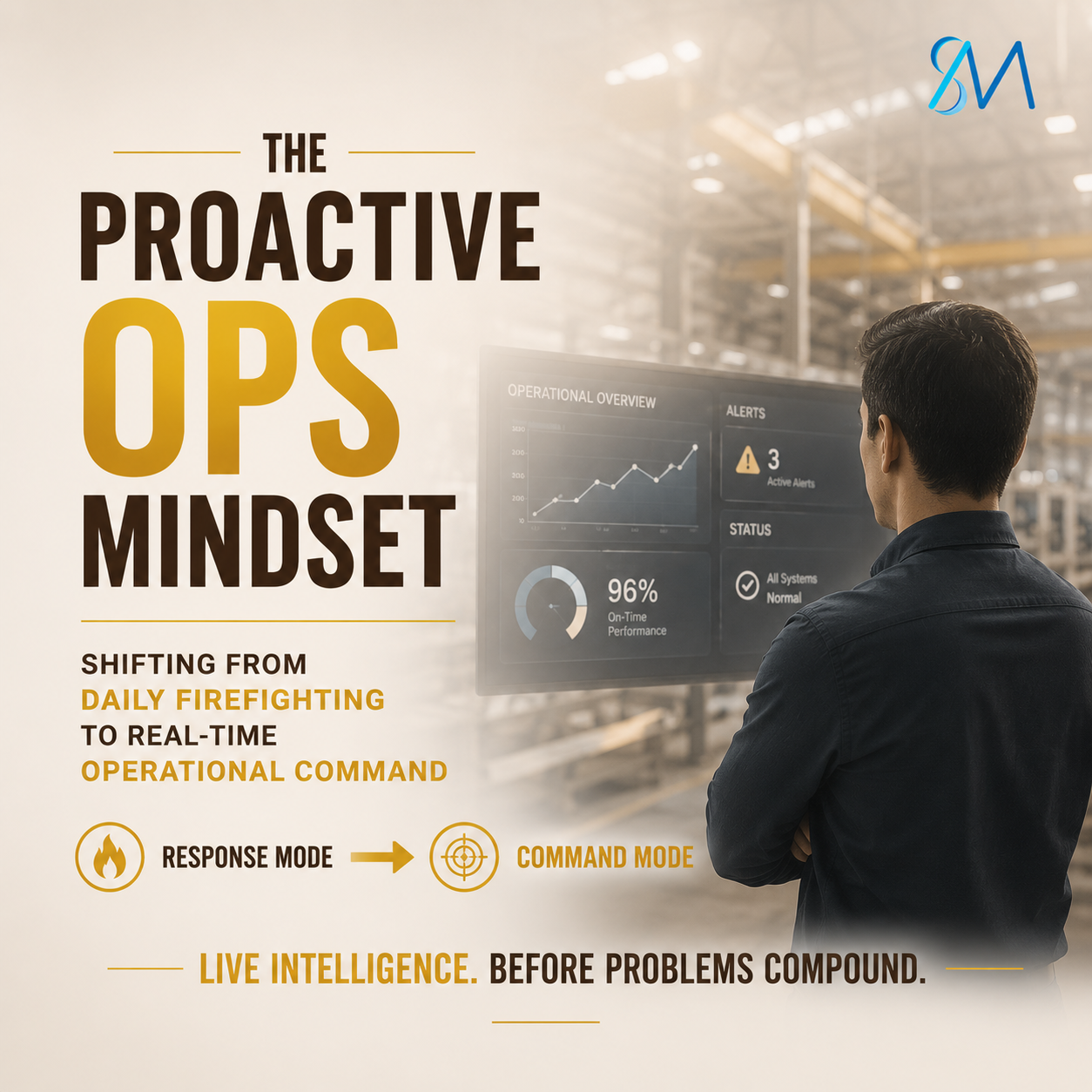
The final component of this phase is the governance redesign that allows the organisation to operate from continuous intelligence rather than periodic reporting. This means replacing the end-of-day summary with a live operational view that is already current when the morning begins. It means replacing the weekly review of what happened with a standing agenda that opens from the current operational picture and moves immediately to decisions rather than context-setting. It means giving the operations leadership team the same relationship to their business’s current state that a pilot has to a cockpit instrument panel: not a periodic report of where the aircraft was, but a continuous, real-time representation of where it is and what it is doing right now. The organisations that have made this transition do not describe it as a technology change. They describe it as a fundamental shift in how confident they feel about the decisions they are making and the speed at which they can make them.
What the Delivery Data Shows Across SuperBotics Engagements
The outcomes that SuperBotics delivers through real-time operational command programmes are grounded in 500-plus enterprise engagements and are specific enough to give the organisations considering this investment a clear picture of what they are building toward. The headline metrics are 4x faster insight cycles and 82% automation coverage, and both of those figures carry precise meaning that is worth unpacking in the context of what they produce at the operational level.
A 4x improvement in insight cycle speed means that the time between an operational event occurring and the right person having the intelligence to act on it compresses by a factor of four. For an organisation where that cycle currently takes eight hours, it becomes two. For an organisation where it takes twenty-four hours, it becomes six. The practical significance of this compression is that decision windows which were previously closed before the intelligence arrived are now open. Interventions that were previously reactive become proactive. Conditions that were previously managed after they had compounded are now addressed at the point where the course correction is simplest and least costly. The 4x figure is a delivery metric. The business value it represents is the cumulative cost of every delayed decision, every compounded incident, and every escalation that was avoidable if the intelligence had arrived in time, which in most enterprise environments is substantial.
The 82% automation coverage figure represents the proportion of operational monitoring, alerting, first-tier triage, and routine decision support that is handled by the automated intelligence layer rather than by human attention. This figure has two significant implications for the operations team. The first is capacity: the proportion of the team’s time currently allocated to monitoring, alerting, and routine triage is largely redirected toward the analytical, strategic, and growth-oriented work that represents the highest value contribution of an experienced operations professional. The second is consistency: automated coverage does not degrade under volume, does not suffer from attention fatigue in the third hour of monitoring a stable system, and does not vary its response to a given signal based on who is on shift that day. The intelligence layer applies the same threshold, the same contextualisation, and the same escalation logic at 03:00 on a Sunday as it does at 10:00 on a Tuesday morning.
In a financial services engagement where SuperBotics implemented AI-assisted operational monitoring across a complex multi-platform environment, the client achieved a 45% reduction in manual review time within the first operational quarter following deployment. That outcome was not produced by reducing the rigour of the review process. It was produced by ensuring that the intelligence reaching reviewers was already filtered, prioritised, and formatted for decision rather than requiring the reviewer to perform the filtering themselves before the substantive work could begin. The time saved was not time removed from value-adding work. It was time recovered from the preparatory overhead that existed only because the intelligence infrastructure had not yet been designed to handle it. That is the consistent pattern across SuperBotics engagements in this space: the time that is recovered through real-time operational command is almost always time that was never meant to be spent on what it was being spent on.
The Specific Capabilities SuperBotics Delivers for Operational Command
The real-time operational command programme that SuperBotics delivers is structured around four interconnected capabilities, each of which is designed to address one of the four structural conditions that sustain the visibility gap in enterprise operations. They are designed to work together as an integrated system, and their collective outcome is materially different from the sum of their individual parts.
The first capability is enterprise operational data integration. SuperBotics engineers connect every relevant source system in the client’s operational environment into a unified, real-time data stream. This includes ERP and MRP platforms, logistics and supply chain management systems, CRM and customer service infrastructure, IoT device networks, financial management systems, custom-built operational applications, and legacy infrastructure of any age or architecture. The integration work is performed using API orchestration, event streaming, and custom connector development as required, and it is designed with the understanding that enterprise data environments are never static. The integration architecture accommodates new source systems, changing data schemas, and evolving operational requirements without requiring the entire layer to be rebuilt each time the business environment changes. SuperBotics’ engineering team, with an average of seven years of experience per engineer across a core team of twenty and 120-plus specialists on demand, has built data integration layers in environments ranging from decade-old mainframe infrastructure to the most recent cloud-native architectures, and that breadth of experience is reflected in the quality and durability of what is delivered.
The second capability is AI-assisted operational monitoring, configured specifically for the client’s environment rather than deployed from a generic template. The monitoring intelligence is trained on the client’s historical operational data to understand the specific patterns, seasonal variations, and anomaly types that are meaningful in their context. The model is built with responsible AI governance embedded from the outset, including transparency in how signals are generated, explainability in how thresholds are set, and clear human-in-the-loop escalation paths for decisions that require judgment beyond the scope of automated intelligence. The platforms used include OpenAI, Google Gemini, Azure AI, Anthropic Claude, Amazon Bedrock, LangChain, and LlamaIndex, selected based on the specific data characteristics and operational requirements of each engagement. The monitoring layer does not generate a high volume of undifferentiated alerts. It generates a calibrated stream of contextualised signals, each of which carries enough information for the recipient to understand what is happening, why it matters, and what their options are.
The third capability is automated alert and escalation workflow design. The workflows that SuperBotics builds for this capability are structured around the client’s actual team organisation, governance model, and communication channels, which means they are designed to route the right signal to the right person through the channel they are most likely to act on, at the threshold that reflects the actual decision authority of the recipient. A signal that requires a frontline response is routed with the context needed for frontline action. A signal that requires leadership awareness is escalated with the summary and recommendation that allows a senior leader to engage immediately rather than request a briefing. A signal that is informational and requires no immediate action is logged and made available through the operational dashboard without consuming the attention of anyone whose capacity should be reserved for action-required signals. These workflows replace manual check-ins, end-of-day escalation summaries, and the informal communication chains that currently carry much of the real-time operational awareness in most enterprise environments, and they do so with greater consistency, speed, and auditability than any manual process can sustain at scale.
The fourth capability is integrated operational dashboards designed for command-level visibility rather than data-level comprehensiveness. SuperBotics designs these dashboards from the decision outward rather than from the data inward, which is the design orientation that most enterprise dashboards do not take. Starting from the data produces a comprehensive view of the operational environment that requires the viewer to navigate toward the signal that matters. Starting from the decision produces a view that surfaces the most time-sensitive and high-priority signals immediately, with depth available on demand for anyone who needs to move from operational awareness to detailed investigation. The dashboard design process involves direct engagement with each role in the operations structure to understand what a commanding view of the business looks like for their specific accountability, and that understanding is translated into a live operational interface that reflects the business as it is moving rather than as it was.
The full programme follows the same 14-week model-to-production cadence that SuperBotics applies across all enterprise AI and operational intelligence engagements, with governance and outcome review embedded at every stage and the specific metrics that define success defined before the build begins. The delivery team is embedded and delivering within 10 business days of engagement commencement, and the programme is designed to produce measurable outcomes at each phase rather than deferring all value to a single go-live event.
The Operations Leadership Teams That Have Already Made This Transition
The organisations that have built real-time operational command and are operating from it today share a perspective on what changed that is worth understanding in full, because it reframes the investment decision in a way that purely financial analysis tends to miss. When the leaders of these teams describe the difference between operating with and without real-time operational intelligence, they do not lead with the metrics, though the metrics are consistently strong. They lead with the change in how their teams feel about their work and how effective they feel in their roles.
Operations professionals who have spent years in reactive mode develop a particular posture toward their own capability. They are responsive, thorough, and skilled at managing situations that have already developed. But the experience of always operating behind the event rather than ahead of it produces a quiet professional frustration that is rarely surfaced in performance reviews or leadership conversations. These are people who chose operations because they believed they could build something well-run and hold it there. The experience of spending the majority of their time in incident management rather than in the strategic and analytical work they are most qualified to do is a professional cost that accumulates over years. The organisations that have invested in real-time operational command consistently report that the improvement in team engagement and retention that follows the transition is among the least-anticipated and most significant outcomes of the programme. The technology investment produces a measurable return. The human investment it represents produces a return that compounds across the entire organisation’s ability to attract, retain, and develop operational leadership capability.
At the strategic level, the shift from reactive operations to real-time command changes the character of the decisions that leadership teams are positioned to make. When the operational intelligence arriving in leadership reviews is current rather than historical, the conversation in those reviews moves from reconstruction to direction. Leaders are not reviewing what happened and why. They are looking at what is developing and making decisions about where to direct the organisation’s resources and attention in the hours and days ahead. That shift in the character of leadership conversation is not a soft outcome. It is a structural improvement in the quality and speed of the decisions that determine how effectively the organisation is steered, and it is the reason that the organisations which have made this transition consistently describe it as one of the highest-return investments in their operational infrastructure.
The sharpest operations teams that SuperBotics has worked with across 500-plus engagements in 14-plus countries over more than a decade of enterprise delivery have arrived at the same understanding through different paths and different industries. The conditions that create operational chaos are not a reflection of the team’s capability. They are a reflection of the infrastructure that team is operating within. When those conditions are removed, when the data moves at the speed of the business, when the intelligence is trained to surface what matters to the person who can act on it, and when the operational picture is live rather than historical, the same team that was managing incidents becomes a team that is building the business. That is the transition that real-time operational command delivers, and it is the transition that the organisations partnering with SuperBotics are making, one structured, governed, and precisely delivered programme at a time.
SuperBotics MultiTech | superbotics.com
The clearest starting point we have seen: know what your operations are actually ready for before deciding what to change.
The ERP Fit Quiz surfaces that picture honestly — no interpretation required.