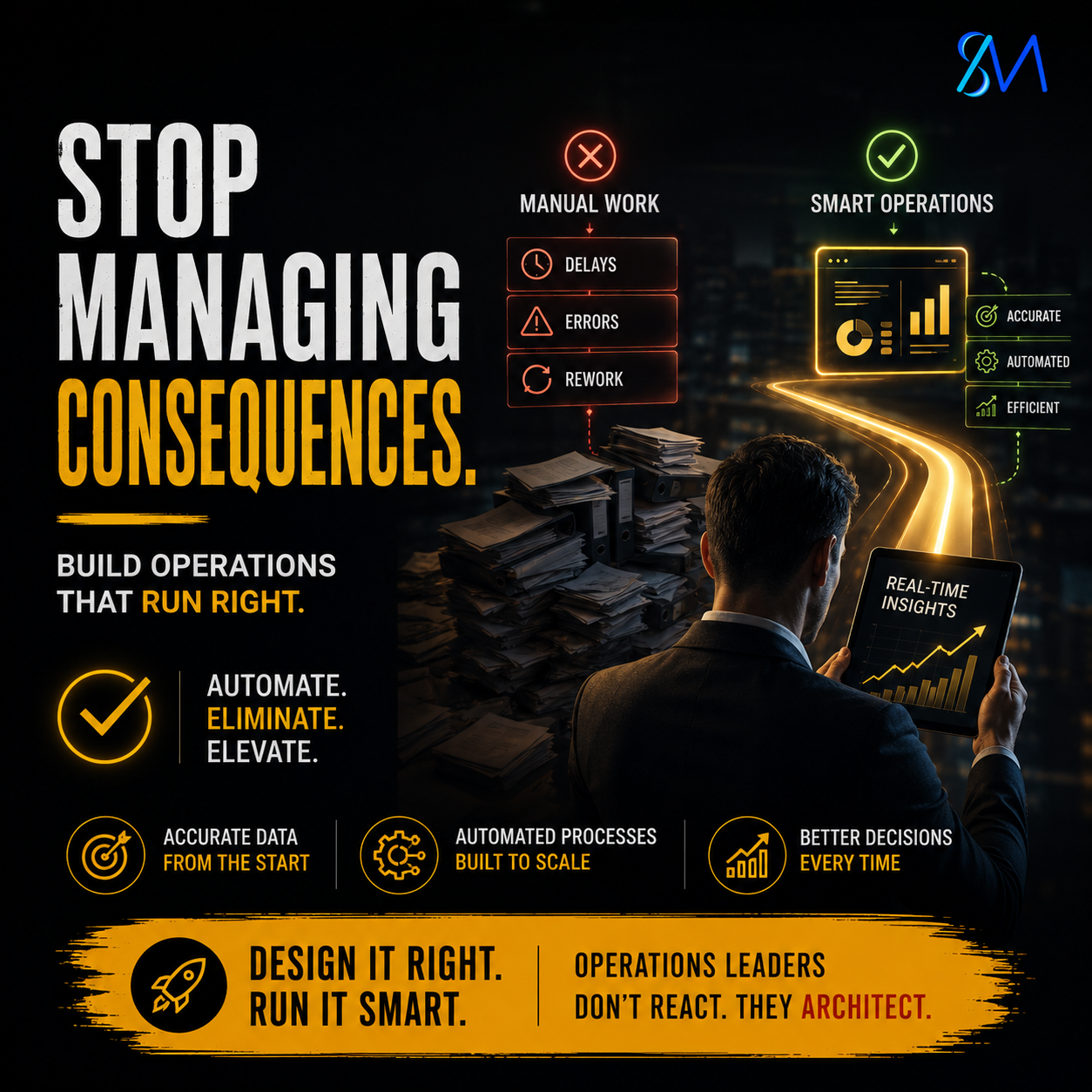
The Sequence That Doubled Operational Efficiency — Without Extraordinary Technology

Abitha Jeyaraj, Marketing Executive
July 14, 2026 · 5 min read
What Operational Efficiency Actually Looks Like When It Works
The organisations that doubled operational efficiency and eliminated exception management as a daily operating rhythm do not usually explain what they did differently. Their operations run quietly. Decisions get made on accurate, current data. The team is focused on work that advances the business rather than on managing the gap between systems. There is nothing dramatic to describe because the design outcome, predictable operations, becomes the unremarkable background against which growth happens.
What they did to get there is consistent, observable, and reproducible. It was not the platform they chose. It was not the size of the investment. It was the sequence of decisions that preceded implementation, and the precision with which success was defined before a single system was configured.
Operational efficiency is not a technology outcome. It is a design outcome, enabled by technology when the sequence is right. The organisations that understand this distinction arrive at predictable operations faster, sustain it longer, and spend significantly less to maintain it than those that discover the sequence by trial and error.
The gap is rarely where it first appears. Most operations leaders who take the ERP Fit Quiz find the real friction point is one layer deeper than where they have been looking.
→ See Where Your Operations Actually Stand — 2 Minutes→ Speak with Our Team
The Three Decisions That Changed the Trajectory
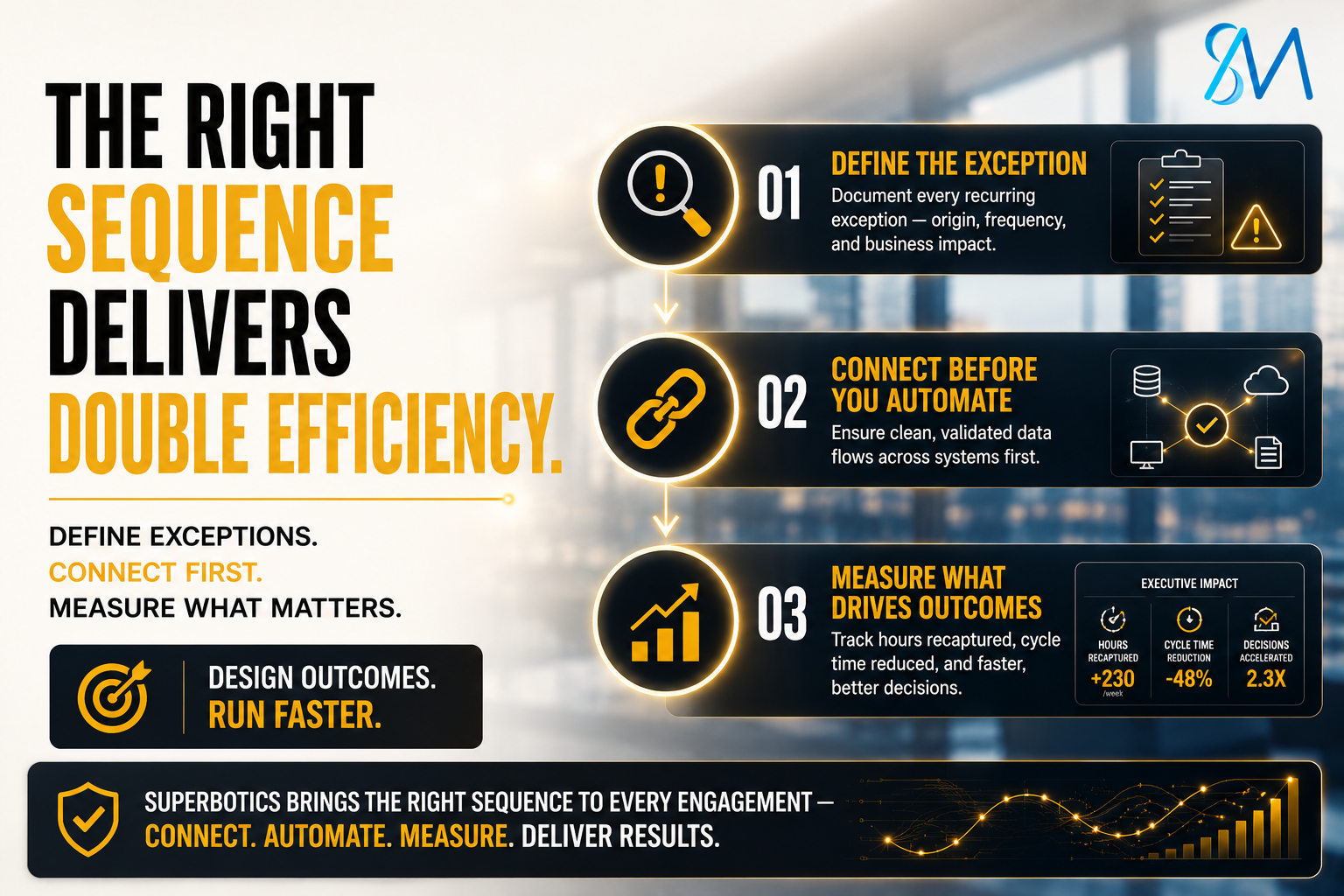
Across enterprise operations programmes, the shift from reactive to efficient operations consistently involved the same three decisions made in the same order. Each one seems straightforward described in isolation. Together, they represent a discipline of sequencing that most organisations do not maintain under the pressure to move quickly.
The first was definitional precision before any solution was proposed. Every recurring exception was documented: its origin, its frequency, its cost in team hours and delayed decisions. This documentation exercise, which typically takes two to three weeks and requires operations leadership involvement, consistently produces a finding that changes the scope of the solution. The exception landscape that looks complex in a firefighting environment almost always traces back to a small number of root causes. Three to five structural gaps, not twenty different problems, account for the majority of operational exceptions. Scoped against the actual root causes rather than the visible symptoms, the remediation effort is both more focused and more likely to deliver lasting results.
The second was integration before automation. Clean, validated, real-time data between the systems that feed operational decisions before any automation layer was introduced. This sequencing principle is consistently the one most compressed under project timeline pressure, and consistently the one whose omission produces the most expensive post-launch outcomes. The automation that functions as designed when it sits on clean data produces exception cascades when it sits on disconnected or inaccurate data. The cost of that distinction is not recoverable at the remediation stage without rebuilding the foundation.
Operational efficiency is not a technology outcome. It is a design outcome, enabled by technology when the sequence is right.
Measuring in Business Terms from the Start
The third decision was the one that made the first two durable. Success was defined in business terms before the first system configuration began. Not go-live. Not uptime. The specific operational outcomes that justified the investment: the number of executive hours recaptured per week, the reduction in manual reconciliation cycles per month, the time between a business event and an informed decision, the reduction in escalation volume at 90 days.
This definition does two things simultaneously. It gives the implementation team a precise target to engineer toward, not a vague improvement direction. And it creates the accountability structure that prevents regression after the project closes. An operational improvement measured in business terms becomes part of how leadership understands performance. It appears on the same dashboard as the metrics that drive business decisions. When it moves, the organisation notices. When it holds, the organisation has confidence in the operational foundation beneath its growth.
None of this required extraordinary technology. The technology choices in these programmes were sound but not unusual. What distinguished the outcomes was the order in which things happened, and the precision with which the organisation defined what it was trying to achieve before it started building toward it.
| Decision | Timing | What It Unlocks |
|---|---|---|
| Document exceptions by root cause | Before solution design | Focused remediation, smaller scope |
| Connect systems before automating | Before automation layer | Durable efficiency, no exception cascade |
| Define success in business terms | Before first configuration | Accountability structure that prevents regression |
What SuperBotics Operational Efficiency Programmes Deliver
SuperBotics brings this sequence to every operational engagement. The exception landscape is mapped before solutions are proposed. Systems are connected with precision before automation is introduced. Success is defined in business terms before the first design session, with the specific operational outcomes agreed and measurable from the first week of operations.
The adoption design that accompanies every programme ensures that operational teams own the new process, not merely operate a system they were handed. The 90-day stability benchmark, not go-live, is the measure that determines whether the engagement delivered its business case. Across 500+ projects, this sequence, applied consistently, has produced the operational outcomes that organisations describe not as a project success but as a change in how the business runs.
The organisations that run predictably do not talk about their operations. They simply use the capacity that predictability creates to grow faster. Their team is focused on building the business rather than managing the gaps between its systems. Their leadership is making decisions on accurate, current data rather than reconciling multiple sources of partial truth.
The sequence that produces this outcome is learnable. The organisations that have already learned it simply started earlier.
Ready to solve this for your organization? Visit SuperBotics MultiTech to see how our team can help.
The clearest starting point we have seen: know what your operations are actually ready for before deciding what to change.
The ERP Fit Quiz surfaces that picture honestly — no interpretation required.