
Three months after go-live, the model is technically working. The integration is complete, the demo held up in production, and the vendor invoice has already been paid. Yet the team running daily operations is still doing the same manual review they did before the AI programme started, because nobody agreed in advance on what “working” was actually supposed to look like once the technology reached their desks.
This is the moment enterprise AI investment cases quietly stall, and it rarely gets flagged in a status report, because the model is technically live and the KPI on the project charter reads “deployed.” In our engineering reviews across 500+ enterprise engagements, we consistently observe that AI programmes do not fail because the underlying model is wrong. They stall because the rollout plan treated deployment as the finish line instead of the starting point of adoption.
The cost of this gap is rarely visible on a single quarterly report, but it compounds. A finance team keeps validating AI-flagged transactions manually because nobody defined the confidence threshold at which the model’s output could be trusted without a second look. A customer operations team keeps routing tickets the old way because the new AI-assisted triage was never connected to the actual queue management workflow leadership expected it to replace.
The organisations getting sustained value from AI all start with the same question: what are we actually ready to automate, and what needs to be solved first?
We have mapped that starting point across 50+ enterprise deployments. If it is useful for where you are right now, we will share the framework directly.
Why AI Programmes Stall Even After a Technically Successful Deployment
It is also worth being direct about why this gap survives even inside organisations with genuinely strong technical teams. Data science and machine learning engineering talent is generally well equipped to build an accurate model. Defining exactly how that model’s output should change a specific team’s daily process, and who owns the decision when the model and a human reviewer disagree, is a different discipline entirely, closer to operational design than to model engineering. Most enterprise AI teams are not resourced with that second discipline in mind, which means the governance question gets asked for the first time only once the model is already live and the first disagreement has already happened.
The pattern is structural, not technical. Most AI procurement decisions are evaluated on model accuracy, integration feasibility, and vendor track record. What rarely gets evaluated with the same rigour is the governance layer: who owns the model’s output once it enters a live workflow, what confidence threshold triggers human review, and how the team’s daily process changes once automation is actually available to them.
Without that governance layer defined before go-live, teams default to their old process out of caution, and that caution is entirely reasonable. Nobody wants to be the person who trusted an automated decision that turned out wrong, especially when no one told them what level of trust the organisation expected them to place in it. The technology becomes a parallel system running alongside the old one rather than a replacement for it, and the ROI case that justified the investment never materialises because adoption never actually happened.
We see this most often in finserv and operations-heavy environments, where the cost of an incorrect automated decision carries real regulatory or customer-facing weight. In those environments, the absence of a clearly defined governance model is not a minor gap. It is the single biggest reason a well-built AI system sits underused for months after its technical launch date.
This gap is often reinforced by how AI pilots get funded internally. A pilot is typically scoped as a technical proof of concept, evaluated on whether the model performs accurately against a test dataset. The budget and timeline rarely extend to the harder question of what specifically changes in a team’s daily workflow once the pilot graduates into production. By the time that question needs answering, the project has already been marked complete on the roadmap, and reopening the conversation about workflow redesign feels like scope creep rather than the natural next step it actually is.
How SuperBotics Builds AI Programmes That Survive Contact With Daily Operations
Our AI delivery model begins with strategy and discovery workshops before any model engineering starts, specifically to map what “working” needs to mean in operational terms for the specific team that will use the system daily. This includes data readiness assessment, responsible AI governance design, and a clearly defined confidence threshold framework that tells every team member exactly when the model’s output can be trusted and when it should be escalated for human review.
From there, our model engineering teams build using RAG, multi-agent workflows, and MLOps pipelines across OpenAI, Google Gemini, Azure AI, Anthropic Claude, Amazon Bedrock, LangChain, and LlamaIndex, depending on the specific workload and data environment. But the technical build runs in parallel with adoption design, not after it. We map exactly how a team’s workflow changes on day one of go-live, so the model is not layered on top of the old process, it replaces the specific manual step it was built to eliminate.
Clarity before code is what turns an AI pilot into an operational result, not another dashboard nobody trusts.
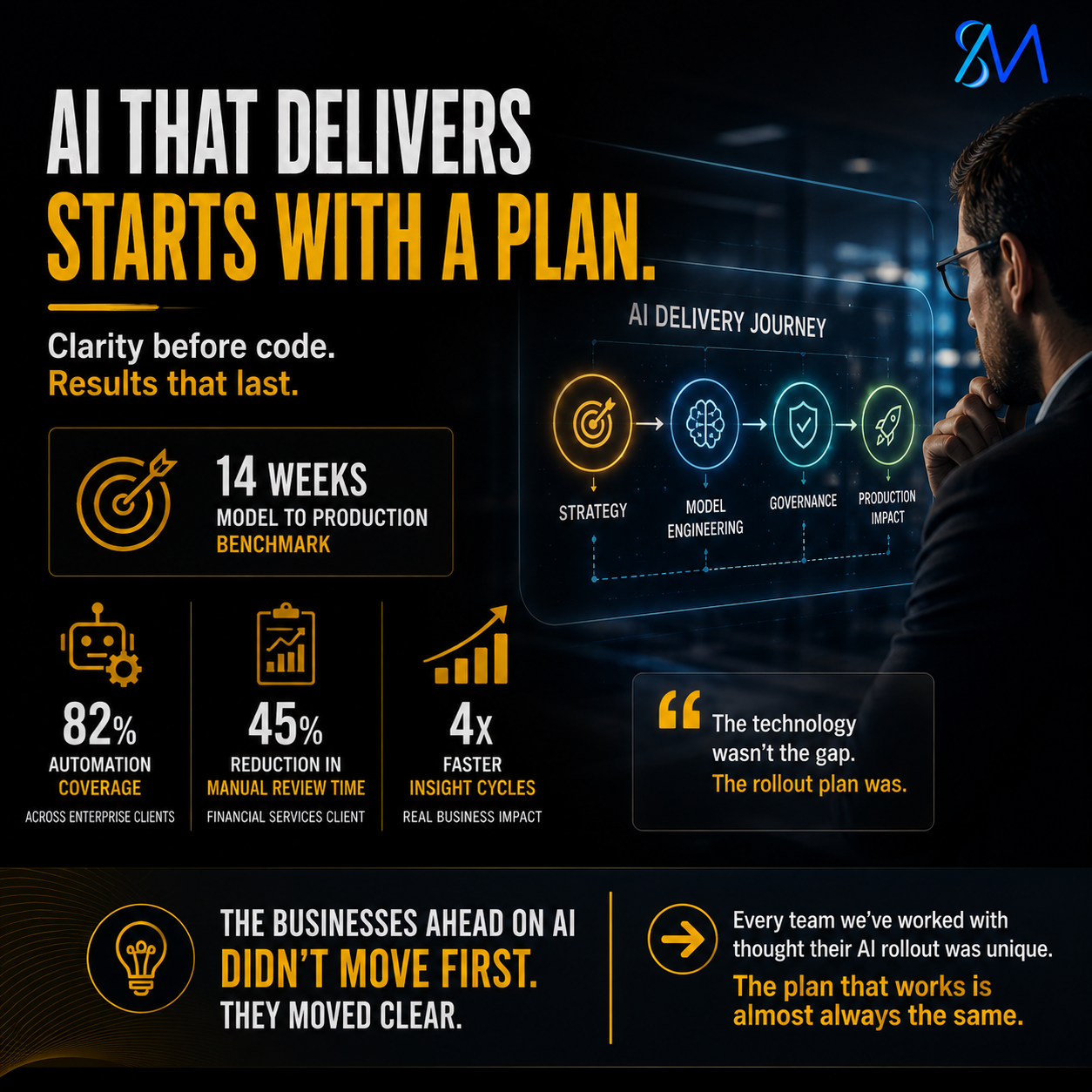
This structured 14-week programme moves from strategy through deployment with governance embedded at every stage, which means the question of who owns the model’s output and what happens when it disagrees with a human reviewer is answered before the system goes live, not debated for the first time during an incident three months later.
The specific governance design varies by workload. A customer service triage model needs a different confidence threshold and escalation path than a financial transaction review model, because the cost of a false positive is different in each context, and the regulatory obligations attached to each workflow are different too. This is why our discovery workshops map the specific business process the AI system will sit inside, including compliance requirements under frameworks such as SOC 2 and GDPR where relevant, before any confidence threshold is finalised. A governance framework that ignores this context tends to be either too conservative, routing far more to human review than necessary and eroding the ROI case, or too permissive, creating exactly the kind of unmonitored automation that erodes trust the first time it gets something visibly wrong.
The Proof: What Embedded Governance Actually Delivers
One finserv client we partnered with reduced manual review time by 45% once AI was embedded directly into the actual workflow rather than layered on top of it as a separate tool. The difference was not a better model. It was a governance framework that told every reviewer exactly which flagged transactions required their attention and which ones the system had already resolved with sufficient confidence.
| Metric | SuperBotics Benchmark |
|---|---|
| Model to production timeline | 14 weeks average |
| Automation coverage achieved | 82% across enterprise AI clients |
| Insight cycle speed improvement | 4x faster through AI and data solutions |
Across our AI and data engagements broadly, clients achieve up to 4x faster insight cycles once the governance and workflow integration layer is in place, because decisions that previously waited on manual validation now move at the pace the model can actually support, with humans focused on the exceptions that genuinely need their judgment.
This governance-first approach also changes how leadership reports AI progress internally. Rather than a status update that says the model is live, a defined governance framework lets a CTO or COO report the actual metric that matters: what percentage of transactions or decisions are now resolved without human intervention, and what specific category of exception still requires it. That distinction is what allows a board or investment committee to see the AI programme as an operational shift rather than a technology purchase still waiting to prove its value.
What SuperBotics Specifically Offers
For organisations whose AI investment has stalled somewhere between deployment and daily operations, our end-to-end AI programme covers strategy and roadmap, model engineering, RAG pipelines, agentic workflows, MLOps, and the governance framework that determines exactly how the model integrates into your team’s real process. We stay engaged until the outcome is measurable inside the business, not simply live in the environment.
The right first question is not which AI tool. It is what does our data and team need to be ready for this to work.
That question, answered clearly, is worth more than any vendor comparison.
The organisations ahead on AI right now were rarely the ones who moved fastest into deployment. They were the ones who moved with a governance plan already defined, so the moment the model went live, the team knew exactly how to use it, when to trust it, and what to do when it disagreed with their own judgment.
Every team we have worked with assumed their AI rollout challenge was specific to their industry or their data. The plan that actually works is almost always the same: define the governance before the deployment, not after the first incident forces the conversation.

