Why Real Time Visibility Software Rarely Changes How Leadership Actually Decides

Abitha Jeyaraj, Marketing Executive
July 23, 2026 · 7 min read
A CTO signs off on a real time visibility platform because the leadership team has felt the same pain for two straight quarters. Decisions that should take a day are taking a week. The data exists somewhere in the business. It just never reaches the room where the decision gets made in time to matter. The buying case is not built on ambition. It is built on exhaustion.
Six months later, the dashboard is live. The demo delivered exactly what the vendor promised. And the leadership team is still making the same decisions at the same speed, with a more expensive technology stack sitting quietly underneath them. Nobody talks about this outcome in the renewal meeting. Everyone quietly recognizes it.
This is the most common failure pattern in real time visibility investments, and it rarely gets named correctly. It is not a data problem. It is not a vendor problem. It is a decision architecture problem that the evaluation process was never built to catch.
The organisations getting sustained value from AI all start with the same question: what are we actually ready to automate, and what needs to be solved first?
We have mapped that starting point across 50+ enterprise deployments. If it is useful for where you are right now, we will share the framework directly.
Why the Investment Stalls After a Clean Deployment
The root cause sits earlier than most teams look. Procurement evaluates visibility software against feature checklists: refresh rate, integration count, chart types, mobile access. None of these determine whether a COO changes a decision because of what the screen shows. In our AI and data engagements, we consistently see that the technical build was rarely the bottleneck. The gap sits in three places that a feature checklist cannot see.
The first gap is data trust. If an operations lead still opens a spreadsheet to double check what the dashboard says, the dashboard has already lost. Trust is not established by uptime. It is established by data lineage that a skeptical operator can verify in under a minute, without calling a data engineer.
The second gap is signal relevance. A platform that surfaces forty metrics on one screen has effectively surfaced none of them. Executives stop looking at dashboards that require translation before action. The system needs to distinguish a genuine leadership signal from routine operational noise, and most implementations never draw that line during design.
The third gap is adoption pathway. Nobody assigned an owner for turning a new signal into a changed decision. The platform went live. The operating rhythm around it did not.
The organizations seeing measurable operational improvement within 90 days evaluate real time visibility against decision outcomes first, and against features only after that. Everyone else evaluates it the other way around.
How SuperBotics Approaches Real Time Visibility Programs
Every SuperBotics visibility engagement begins with a decision audit, not a data audit. In our engineering reviews, we first map which decisions the leadership team is trying to speed up, who owns each one, and what information they currently distrust enough to verify manually. Only after that map exists do we discuss architecture.
We then run the platform selection and configuration against five evaluation parameters that most procurement processes underweight entirely.
| Evaluation Parameter | What It Actually Tests |
|---|---|
| Decision alignment | Does the system surface the exact signal a named leader needs, without translation |
| Data trust | Will an operator act on the number without manually verifying it first |
| Adoption pathway | Is there a named owner and milestone plan from go live to active daily use |
| Alert relevance | Does the system separate noise from signals requiring leadership attention |
| Business outcome connection | Can ROI be measured in decision speed or forecast accuracy within 180 days |
Across our AI and data engagements, we build on OpenAI, Google Gemini, Azure AI, Amazon Bedrock, LangChain, and Anthropic Claude depending on the client stack, with responsible AI governance embedded at every stage rather than bolted on after deployment. Model engineering, RAG pipelines, and agentic workflows are only introduced once the decision map from the audit phase is validated with the executive team that will actually use it.
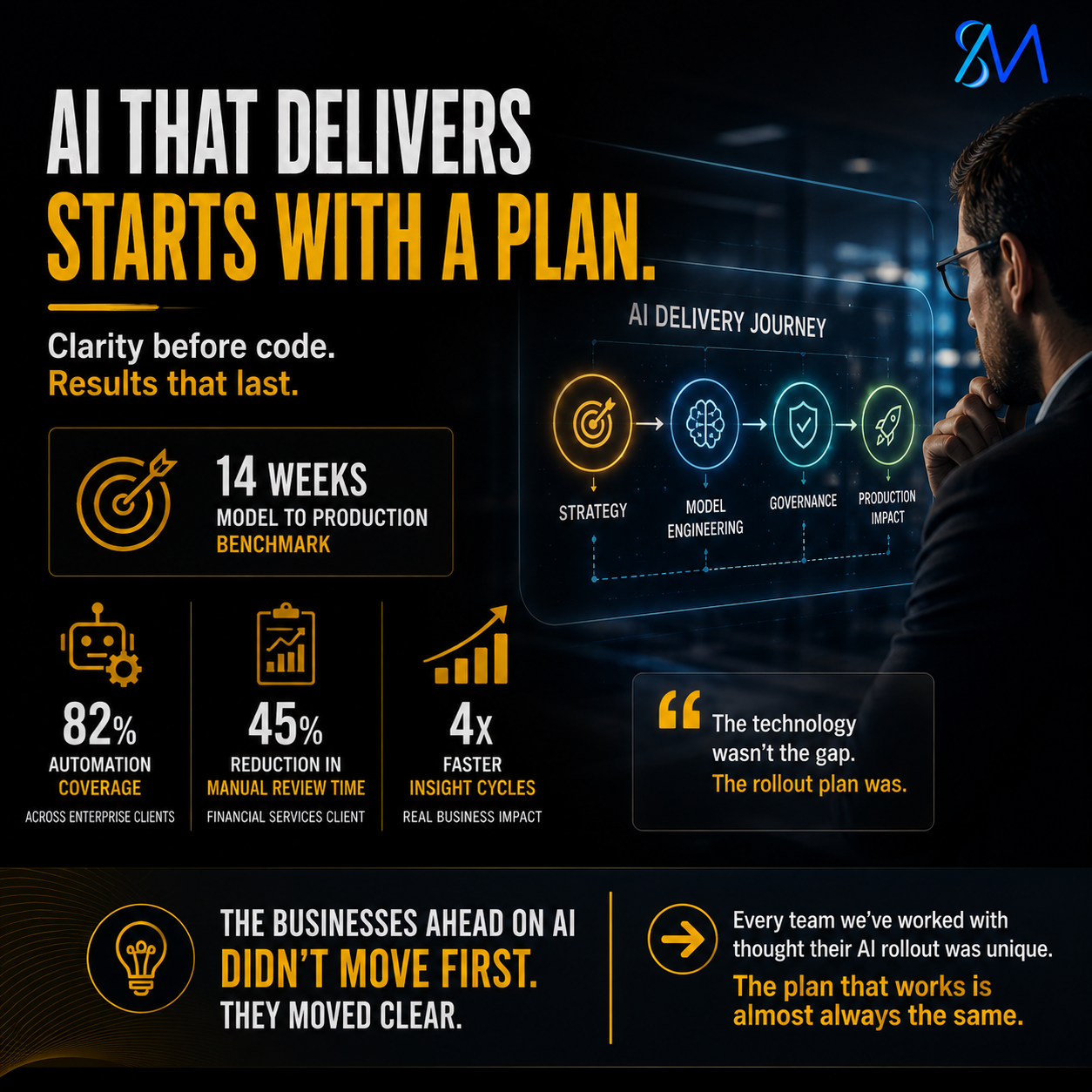
The 14 week model to production benchmark we run against exists precisely because a longer, undisciplined build cycle almost always signals a decision architecture that was never clarified up front. Speed to production is a symptom of clarity, not a separate achievement.
Governance is the part most vendors treat as a compliance checkbox rather than a design input. We treat it as the mechanism that keeps a leadership team using the platform six months after launch, not just during the first excited weeks after go live. Every model, every automated signal, and every alert threshold in a SuperBotics visibility programme has a named owner who can explain why that threshold sits where it does, and who is accountable when the signal proves wrong. Without that ownership, a platform drifts into the same fate as the spreadsheet it was meant to replace: technically live, quietly ignored.
We also rebuild the review cadence around the platform rather than leaving the old meeting structure untouched. A weekly operations review built entirely on last week’s data cannot help a leadership team get ahead of a problem developing this week. Real time visibility only changes decision speed if the meeting where decisions get made is redesigned to use it as the primary input, not a secondary confirmation of what everyone already suspected from last week’s numbers.
The Proof Behind the Approach
One finserv client came to us with a familiar profile. AI assisted analytics were already deployed. Manual review still consumed the same operational hours as before the platform existed. We rebuilt the workflow integration around the decision map rather than the dashboard itself, and manual review time dropped by 45 percent within the following quarters.
Across 500 plus engagements, clients working with SuperBotics on AI and data platforms report 82 percent automation coverage and 4x faster insight cycles once the adoption pathway and governance layer are treated as part of the technical scope rather than an afterthought. These are not marketing figures. They are the operational result of evaluating platforms against decisions before evaluating them against features.
What SuperBotics Specifically Delivers
SuperBotics runs end to end AI and data delivery: strategy and discovery workshops, data readiness assessment, responsible AI governance, model engineering, RAG and multi agent workflows, MLOps, and deployment inside a structured 14 week programme. We stay engaged past go live until the outcome shows up in the decisions your leadership team makes, not only in the environment the platform runs in.
For a CTO or COO evaluating a visibility or analytics investment right now, the useful question is not which platform has the most features. It is which decision, specifically, this investment is meant to speed up, and who currently distrusts the number enough to check it by hand.
That is the conversation worth having before any architecture discussion begins. It is also the conversation that determines whether the platform earns its place in next year’s budget or becomes one more expensive tool nobody fully trusts.
Most vendor conversations start with a platform walkthrough. A more useful first conversation starts with a single leadership decision that currently takes too long, and works backward from there to figure out exactly what data, trust, and ownership gaps sit between the current process and a faster one. That reordering, more than any single feature on a comparison sheet, is what separates a visibility investment that changes how a business operates from one that simply adds another dashboard nobody fully believes.
To think through where your organization’s decision gaps actually sit, visit superbotics.com and start with the decision map, not the demo.
The right first question is not which AI tool — it is what does our data and team need to be ready for this to work.
That question, answered clearly, is worth more than any vendor comparison.