Do’s and Don’ts of System Transition: Maintaining Operational Control and Avoiding Disruption

Abitha Jeyaraj, Marketing Executive
July 15, 2026 · 5 min read
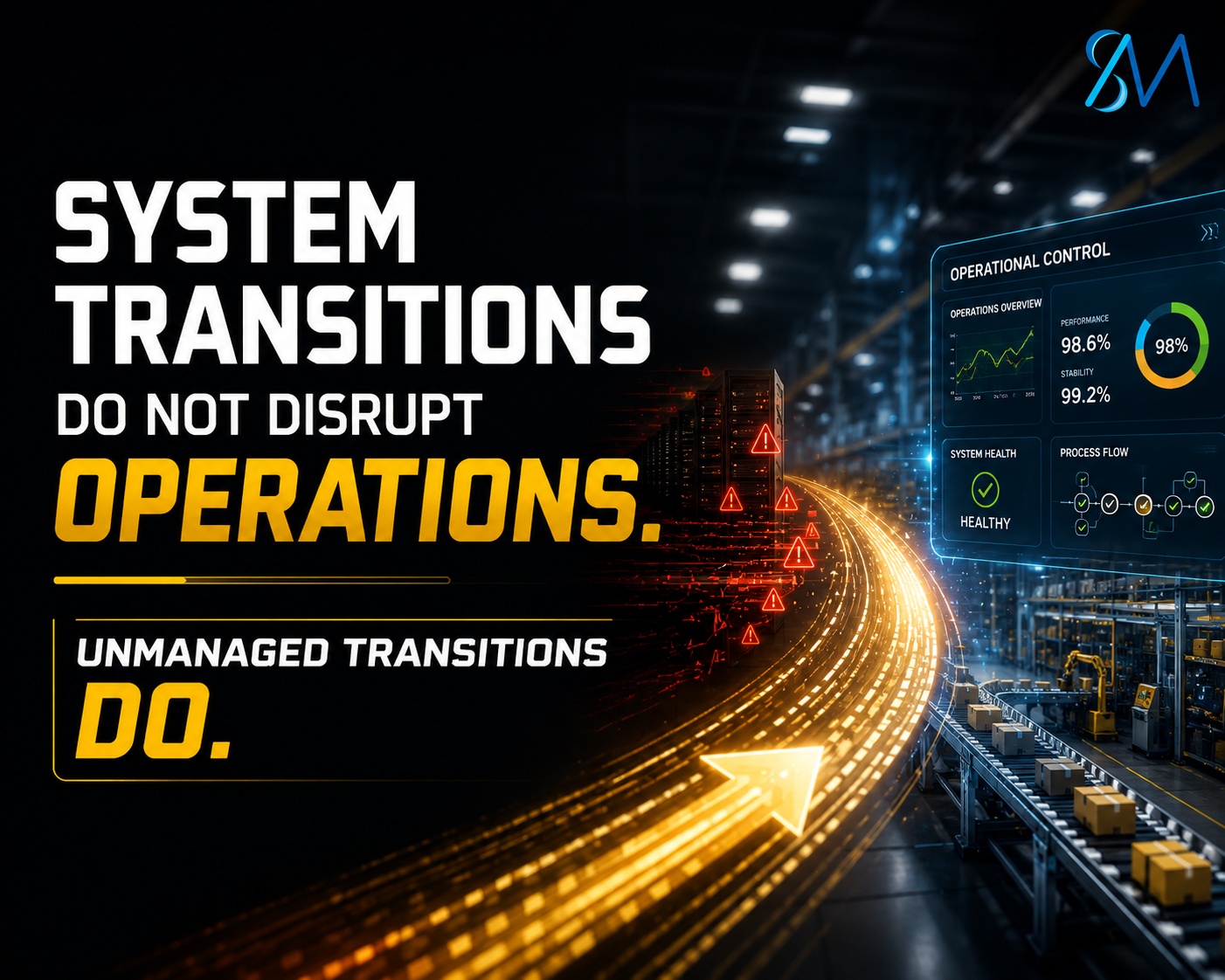
System transitions do not disrupt operations. Unmanaged transitions do.
This distinction matters more than most transition plans acknowledge. Across our enterprise engagements in manufacturing, retail, and financial services, we consistently observe that the organisations navigating major system changes without operational disruption share one characteristic: they define what stability looks like before the transition begins, not after the first escalation arrives.
What Consistently Works in Enterprise System Transitions
The organisations that move through major system changes without losing operational grip approach the transition in fundamentally different ways from those that absorb the cost afterward.
The gap is rarely where it first appears. Most operations leaders who take the ERP Fit Quiz find the real friction point is one layer deeper than where they have been looking.
→ See Where Your Operations Actually Stand — 2 Minutes→ Speak with Our Team
The first distinction is how continuity is defined. Before a single configuration is changed or a cutover window is scheduled, leadership in high-performing transitions has agreed on measurable continuity criteria — order processing rates, data reconciliation timelines, escalation thresholds. These are not project metrics. They are operational commitments that exist independently of the technical delivery plan.
Operational continuity criteria must be defined before the transition begins — not identified after the first escalation surfaces.
The second distinction is decision data availability. The most common source of post-migration operational cost is not system failure. It is leadership making decisions on lagging or incomplete data during a transition window. The organisations that protect against this build a guaranteed reporting layer that functions independently of the new system’s go-live status — so business decisions never rely on a system that has not yet proven stable.
Third, and most consistently overlooked: separate ownership of business continuity from technical delivery. In our 500+ successful project engagements, the transitions that scored cleanly on operational outcomes had a named owner for business stability who was not the technical project lead. These are different accountabilities. Conflating them means that when technical complexity escalates, business continuity management often absorbs the attention deficit.
What Keeps Organisations in Disruption Mode
The patterns that produce post-migration operational stress are remarkably consistent across industries and organisation sizes. Understanding them before a transition begins is what separates a clean cutover from a quarter of recovery effort.
| Pattern | What It Produces | SuperBotics Approach |
|---|---|---|
| Operational reviews run on lagging data | Decisions permanently catching up to events | Real-time signal monitoring with defined response thresholds |
| Workarounds treated as solutions | Structural gaps become invisible until failure | Root cause redesign built into transition governance |
| Technical completion conflated with operational stability | Go-live declared while teams run parallel systems | Stability criteria defined in operational terms, not technical |
| Frontline change absorption unassessed | Operational load concentrated where resilience is lowest | Change capacity assessment before cutover window opens |
Running operational reviews on last week’s data during a transition is particularly costly. The decisions being made are always catching up — never getting ahead of what is developing. In fast-moving operations, a 48-hour data lag during a system cutover is enough to produce reconciliation gaps that take weeks to resolve.
The SuperBotics Transition Framework
In our engineering reviews across 150+ enterprise launches, we have refined a transition governance model that treats operational continuity as a parallel delivery stream — not a dependency of technical completion.
The framework begins in pre-transition discovery with a change absorption assessment: mapping which operational roles, decision points, and data flows are most time-sensitive and building protection around them before the cutover window opens. This is not a risk register exercise. It is a structured analysis of where business decisions depend on operational data, and what guarantees those decisions need during transition.
During transition, we maintain a visibility layer that reports independently of the new system’s status. Leadership has a confirmed data source for the decisions that cannot wait — supply chain calls, financial reconciliation, customer escalations. This layer is designed before go-live, tested before go-live, and owned by a named business continuity lead who reports separately from the technical delivery track.
Post-cutover, we define stability criteria in operational terms: decision cycle time, escalation volume, data reconciliation accuracy, and forecast reliability within defined windows. Technical completion is a milestone. Operational stability is the outcome we are contracted to deliver.
What SuperBotics Delivers for Enterprise System Transitions
SuperBotics brings end-to-end transition governance for organisations moving across CRM, ERP, cloud infrastructure, and enterprise integration platforms. Our cross-functional pods — combining engineering, QA, DevOps, and operational design capability — are onboarded and delivering within 10 business days, with transition governance built from the first week of engagement.
Across our enterprise client base, the 6.8-year average partnership tenure reflects a consistent pattern: organisations that work with SuperBotics on a single critical transition consistently return for the next one. Our 98% on-time release rate across 500+ projects is built on exactly this distinction between technical completion and confirmed operational stability.
For manufacturing and retail clients specifically, we build the operational signal monitoring infrastructure that makes the transition from reactive to proactive operations sustainable — not just during the transition window, but as a permanent capability the organisation retains afterward.
The Transition Organisations Remember Is the One That Did Not Cost Them a Quarter
The measure of a successful enterprise system transition is not whether it went live on schedule. It is whether the business ran better in the 90 days that followed than in the 90 days before. Every operational framework, every continuity metric, and every governance structure SuperBotics builds is designed with that outcome as the standard.
Organisations that define operational stability before a transition begins spend their first post-go-live weeks optimising. Those that discover it afterward spend them recovering.
The organisations that have built their most resilient operational infrastructure on the back of a major system change — rather than in spite of one — all share a single design decision made before the transition began.
Ready to build a transition framework that delivers operational continuity from day one?
SuperBotics partners with enterprise operations and technology leadership to design and deliver system transitions where stability is guaranteed — not assumed.
Talk to SuperBotics about your next migration →
Ready to solve this for your organization? Visit SuperBotics MultiTech to see how our team can help.
The clearest starting point we have seen: know what your operations are actually ready for before deciding what to change.
The ERP Fit Quiz surfaces that picture honestly — no interpretation required.