
Manual Entry Isn’t a Process Problem, It’s an Architecture Decision: A Framework for Operations Leaders

abitha
August 11, 2026 · 8 min read
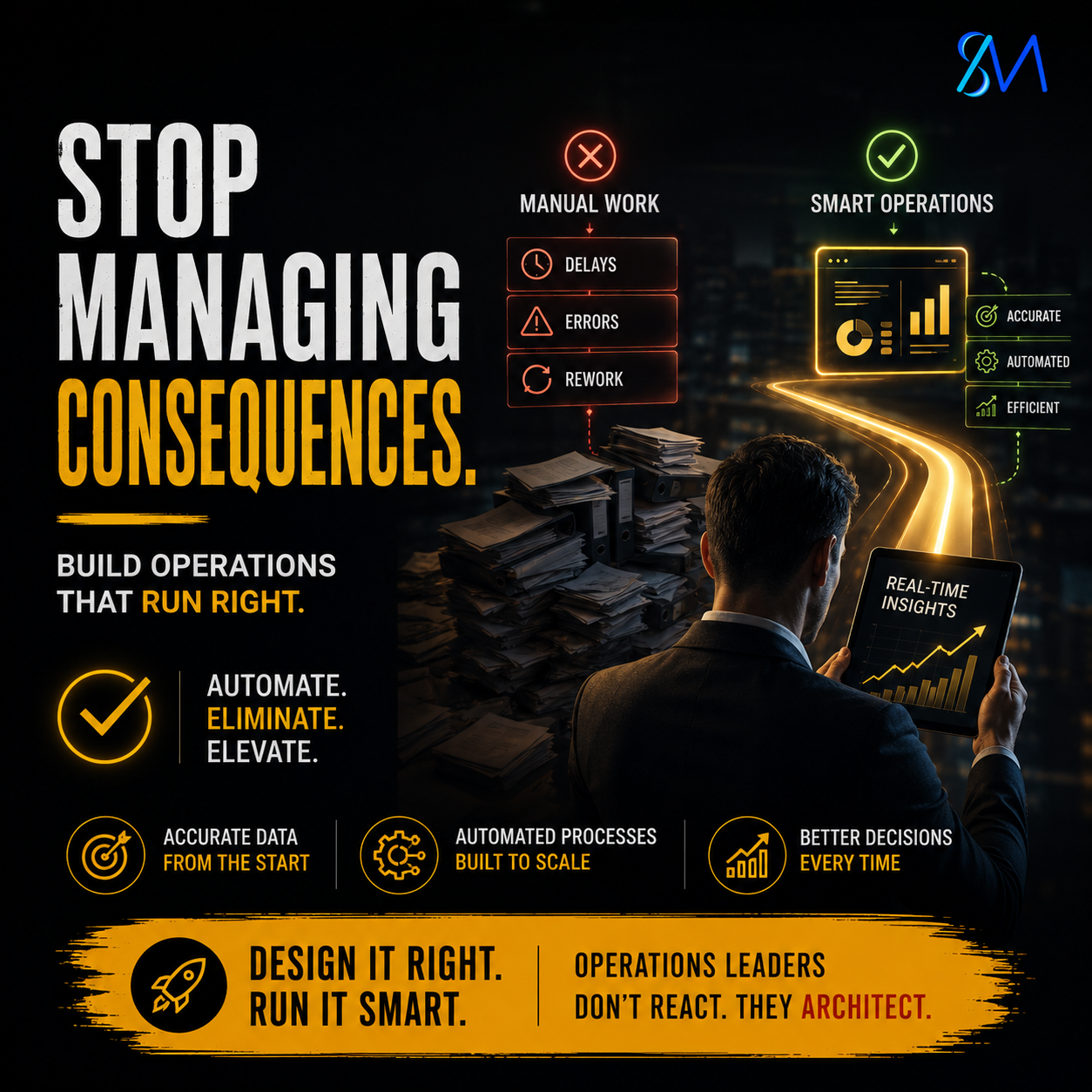
Ask an operations leader whether their team has a manual data entry problem, and most will say yes without hesitation. Ask what it is costing them per month, and the room usually goes quiet. The gap between those two answers is exactly where operational ROI leaks out of an organisation, month after month, without ever being named clearly enough to fix.
The instinct across most operations teams is to treat manual entry as a workload issue, something to be managed with more attention, better training, or a cleaner checklist. Across the 500+ enterprise engagements we have delivered, that framing is precisely why the problem persists for years inside otherwise disciplined organisations. Manual entry is not a training gap. It is an architecture decision that was made, often by default rather than by choice, the moment two systems were allowed to operate without a connection between them.
This blog sets out the five rules the operations leaders who successfully eliminate manual entry apply consistently, why weekly reviews built around fixing last week’s errors keep organisations permanently behind, and what it takes to treat this as the architecture decision it actually is.
Why Ops Leaders Keep Managing the Consequences Instead of the Cause
Every operations team we have worked with can point to a weekly or monthly review where the agenda is dominated by fixing what went wrong last cycle. A shipment record that did not match. An invoice that had to be corrected after the fact. A customer field that was entered incorrectly three systems ago and only surfaced when a support ticket came in. These reviews feel productive because problems genuinely get resolved in them. What they rarely do is ask why the same category of problem keeps appearing month after month.
The answer is almost always structural. If a weekly review is built around fixing last week’s errors, the architecture producing those errors is already behind, because the review is designed for accountability rather than prevention. By the time a manual entry mistake reaches a review, it has already cost something, in corrected records, in a delayed decision, or in a customer relationship that noticed the error before the team did.
In our engineering reviews, we consistently observe that organisations carrying this pattern have usually tried to solve it with more software rather than fewer manual steps. A new dashboard gets added to catch errors faster. A new approval layer gets added to catch them before they ship. Both response are reasonable instincts, and neither one addresses the actual cause, which is that data is still entering the organisation’s systems more than once, through a person, rather than once, through a connection that does not depend on anyone remembering to maintain it.
Ops leaders who eliminate manual data entry do not do it by working harder. They treat it as an architecture decision, made once, rather than a process problem managed forever.
The Five Rules That Turn This Into an Architecture Decision
Across our delivery work, the operations leaders who successfully make this shift apply five consistent rules, each one reframing manual entry from a workload issue into a design choice that can be corrected permanently.
| Rule | What It Means in Practice |
|---|---|
| Data enters your system once, never twice | Every second entry point is evidence of a missing connection, not a missing checklist item |
| Every manual step is a process gap, not a workflow | Treating a manual bridge as normal operating procedure hides the cost of leaving it unfixed |
| ROI is protected at input, not measured at output | Catching an error after it has propagated costs far more than preventing it at entry |
| The team closest to the data owns the automation | Ownership sits with the people who understand the data, not with whoever inherits the error |
| A review built on last week is already behind | Review cadences should surface what is developing now, not only what already went wrong |
The fourth rule tends to be the one most organisations get backward. When a manual entry point causes a downstream error, the team that discovers the error is often not the team best positioned to fix its root cause. A customer service team finds the wrong field. An operations analyst finds the mismatched record. Neither owns the system where the error originated, so the fix becomes a workaround layered on top of the gap rather than a correction to the gap itself. Assigning automation ownership to the team closest to the data, the team that actually understands what a correct record looks like, is what allows a fix to address the cause rather than the symptom.
The gap is rarely where it first appears. Most ops leaders who take the ERP Fit Quiz find the real friction point is one layer deeper than where they have been looking.
See Where Your Operations Actually Stand, 2 Minutes
→ Speak with Our Team
How SuperBotics Builds the Architecture That Makes These Rules Operational
Turning these five rules into a working system requires more than a policy statement. Our engagements start with a discovery phase that maps every point where data currently enters an organisation’s systems more than once, identifying which of those points are true architecture gaps between disconnected platforms and which are process gaps that can be resolved through ownership changes alone.
From there, we build the AI and automation layer that makes single entry operational, connecting the systems that should have exchanged data automatically from the start rather than requiring a person to bridge them. This includes API orchestration across ERP, CRM, and finance platforms, validation embedded at the point of input so an error is caught the moment it occurs, and a governance model that names exactly which team owns each data type going forward. This is not automation applied on top of an unchanged process. It is the connection built first, with automation applied to a foundation that can actually support it, which is the sequence that separates engagements that reduce exceptions from ones that simply produce them faster.
We also redesign the review cadence itself as part of this work, shifting it away from a retrospective on last week’s errors and toward a signal based model where developing issues surface to the right owner while there is still time to act on them, rather than after the cost has already been absorbed.
This distinction between incident resolution and pattern elimination matters more than it first appears. Most operations teams already have a working process for resolving an individual incident once it surfaces. Very few have a separate, deliberate process for asking whether that incident belongs to a recurring pattern, and if so, what architectural change would prevent the next ten occurrences rather than just the one in front of them. Building that second process, distinct from the first, is what allows an operations team to keep responding to what happens today while simultaneously reducing how much there is to respond to next quarter.
The Proof: What Treating This as an Architecture Decision Delivers
Across our enterprise engagements, clients who made this shift achieved a 38% average cost optimisation and a 98% on-time release rate, both outcomes that depend directly on data moving through connected systems rather than through a person prone to the same category of error every cycle. Our clients maintain a 98% on-time release rate across enterprise engagements built on exactly this kind of connected visibility, replacing the reactive firefighting that dominates review meetings built around what already went wrong.
One finserv client we partnered with reduced manual review time by 45% after this exact architecture shift, moving from a review process dominated by correcting last cycle’s errors to one focused on monitoring signals before they became errors at all. The change was not a new dashboard. It was the removal of the condition that made the old dashboard necessary in the first place.
What SuperBotics Specifically Delivers for Operations Leaders
For operations leaders ready to make this an architecture decision rather than another item on a process improvement list, our engagement model runs through the same three phases we apply across every Managed Teams and integration delivery. Discovery and calibration in week zero, where every manual entry point and its true monthly cost gets mapped. Integration and launch across weeks one and two, where the connection replaces the manual bridge. Deliver and optimise from week three onward, where the architecture is monitored and the review cadence is redesigned around what is developing rather than what has already broken.
Another quarter of managing this as a process problem is a decision too, and it is the more expensive one. The ops leaders who fixed this stopped asking their teams to work harder around the gap and started closing it at the level where it was actually created.
Before deciding what to fix, know exactly where the real gap in your operations sits.
The ERP Fit Quiz surfaces that picture honestly, no interpretation required.
Operations that treat manual entry as an architecture decision stop running the same weekly review of the same category of error indefinitely. They make the decision once, at the level where the gap was created, and the review cadence that follows finally has something new to talk about.
The organisations getting ahead of this are not the ones with the most disciplined error correction process. They are the ones who stopped needing one.