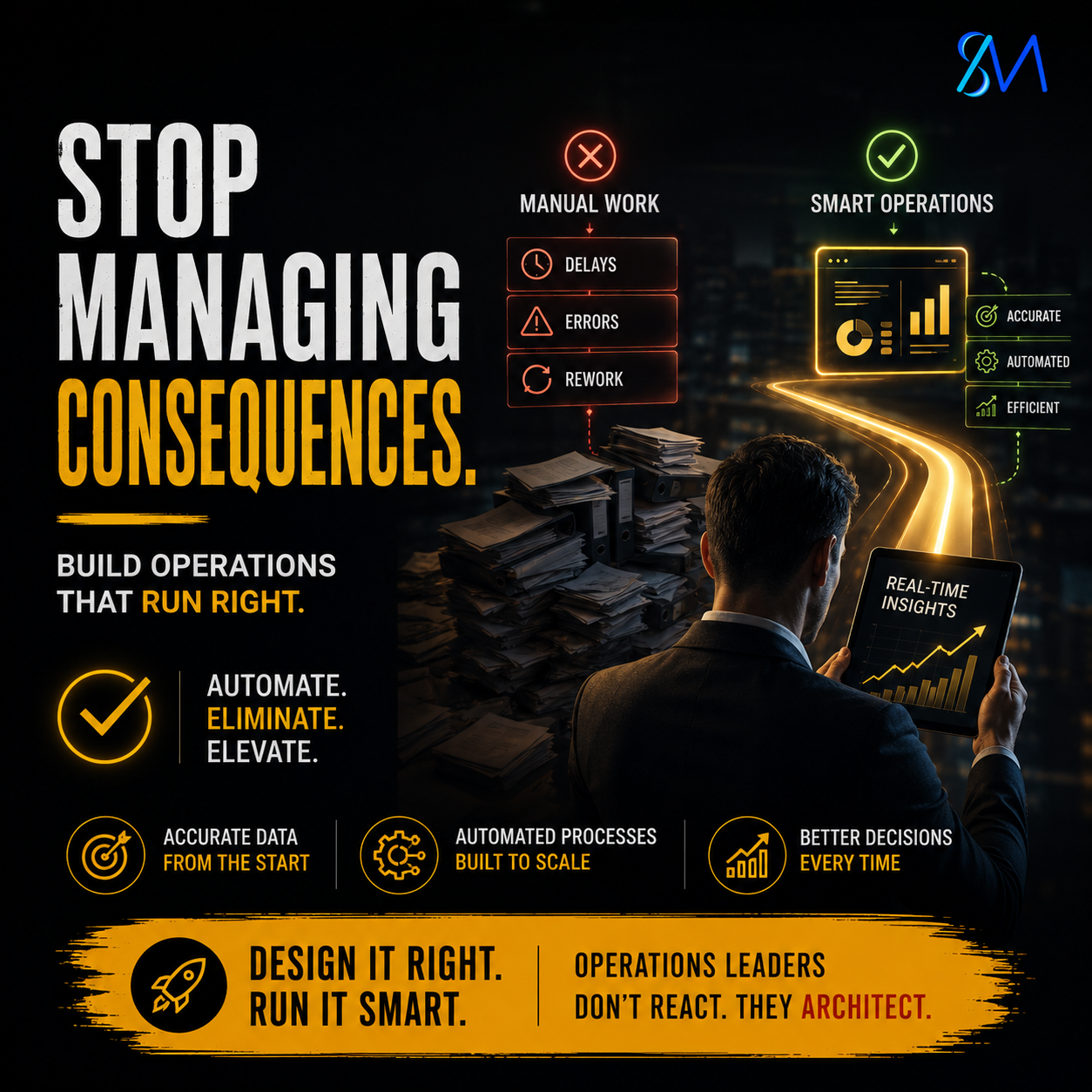
The Three-Week Lag Between a Growing Problem and the Dashboard That Finally Shows It

Abitha Jeyaraj, Marketing Executive
September 3, 2026 · 6 min read

By the time a recurring delay shows up on a leadership dashboard, it has usually been shaping outcomes for three weeks. A vendor lane that keeps slipping. A support queue that quietly grows past what the team can absorb. A margin that erodes half a point at a time across a dozen small decisions nobody flagged as connected. None of it looks urgent on any single day. All of it adds up to a quarter spent reacting to a pattern that started long before anyone noticed it.
For a COO or VP of Engineering running operations across multiple regions, this delay is not a reporting inconvenience. It is the reason mornings get spent explaining last week’s fire instead of deciding this quarter’s direction. Every hour a leadership team spends reconstructing what already happened is an hour it does not spend on what happens next, and across a year that adds up to entire quarters lost to reaction instead of direction.
The gap between when a problem starts and when leadership finds out about it is rarely a data problem. It is an architecture problem with a schedule attached to it.
If it would help to see exactly where that gap sits in your own operation, we are glad to walk through it directly.
Why the Delay Keeps Happening in Well-Resourced Organisations
Most enterprise leadership teams are not short on data. They are short on a single, trusted view of what that data means right now. Systems that were bought at different times, for different teams, rarely speak to each other by default. Operations reports one number. Finance reports another. Both are technically correct, because each is measuring from a slightly different starting point, decided separately, months apart, by two people who never once compared notes.
That fragmentation does not announce itself. It accumulates quietly, one disconnected system at a time, until a leadership meeting spends its first fifteen minutes reconciling numbers instead of acting on them. Across our engagements with clients in the US, UK, France, Europe, and Brazil, this is the single most consistent pattern behind operational surprise. The organisation was never missing information. It was missing a way to see all of its information as one live picture instead of several disconnected ones.
The cost compounds in a specific way. A problem that is visible on day one is a fix. The same problem, invisible until day twenty-one, is a crisis with a paper trail attached, and a leadership team that now has to explain not just the issue but why it took three weeks to surface.
How SuperBotics Builds the Visibility Layer That Closes This Gap
Our approach starts with a mapping exercise before any tooling conversation begins. We trace where operational signals actually originate inside a business, which systems hold them, and where those systems stop talking to each other. In our engineering reviews, this step alone routinely surfaces the specific moment where a signal that should reach leadership in hours instead reaches them in weeks, buried in a report nobody reads until month end.
Once that map exists, the work becomes connecting the systems that were built to run in isolation into one live source of truth. We have done this for clients across 14 countries, pulling operations, finance, and customer systems into a single feed that leadership can act on without translation. The goal is never another dashboard layered on top of existing confusion. It is one picture that replaces the several partial ones a team was reconciling by hand.
The governance layer matters as much as the connection itself. Every signal needs an owner and a threshold that defines when it becomes worth a leadership conversation, or the visibility layer just produces more noise than the fragmented systems it replaced. We build that ownership model alongside the technical integration, so a surfaced problem always has someone accountable for acting on it, not just seeing it.
What This Looks Like in Practice
Once the noise is replaced with signal, our clients consistently report a shift in the pace of decisions rather than just the accuracy of them. Across our AI and data engineering work, this discipline has helped clients reach 4x faster insight cycles, moving from raw operational data to an executive decision without the multi-week reporting cycle that used to sit in between.
| Before Connected Visibility | After Connected Visibility |
|---|---|
| A problem surfaces in a monthly report, weeks after it began | A problem surfaces the day the pattern starts, while it is still small |
| Two departments open a meeting reconciling two different numbers | Leadership opens the meeting already agreeing on the number |
| Decisions wait on someone available to pull a report | Decisions move at the speed the business actually requires |
Across 500 engagements, this is the pattern that repeats regardless of industry: the technology gap is rarely the constraint. The visibility gap is.
What SuperBotics Specifically Delivers
We deliver a connected operational visibility layer built around your actual decision points, not a generic reporting template. That means mapping your specific signal sources, building the integration between the systems that currently run in isolation, and defining clear ownership for every threshold that should trigger a leadership conversation. This work draws on the same platforms and integration discipline behind our broader Enterprise AI Integration practice, including OpenAI, Google Gemini, Azure AI, Anthropic Claude, and Amazon Bedrock, applied wherever the operational signal calls for predictive or automated response rather than a static report.
For a technology leader weighing where to start, the value is not another tool to manage. It is one place where the business can see what is actually happening while there is still time to act on it, instead of learning about it after the moment to act has already passed.
Every leadership team we have worked with assumed their visibility gap was unique to their industry or their systems.
The starting point is almost always the same, and it usually takes one direct conversation to see exactly where yours sits.
The leadership teams operating ahead of their competitors right now are rarely working longer hours or making sharper guesses. They have simply closed the distance between when a problem starts and when they find out about it, so every decision after that point is made on what is actually happening rather than what happened three weeks ago.
That distance is not fixed. It is an architecture decision, made once, that either keeps paying dividends in faster, calmer decisions, or keeps costing a leadership team its mornings for another year. The organisations pulling ahead this year are the ones who decided to close it before the next fire, not after.
Why This Is an Architecture Decision, Not a Culture Fix
It is tempting to treat a slow-to-surface problem as a communication issue inside a team, something a better weekly meeting could solve. In practice, across the enterprise engagements we run, better meetings rarely fix what a disconnected system architecture created. A team can review its numbers as often as it likes; if those numbers only update once a system export runs, the review is still working from data that is already out of date the moment the meeting starts.
This is why the fix has to sit at the architecture level rather than the process level. Once operational, financial, and customer systems feed one connected view, the review cadence itself becomes more useful, because it is finally built around what is developing right now instead of what already happened last week. The meeting did not get better because people tried harder. It got better because the information reaching the room changed.