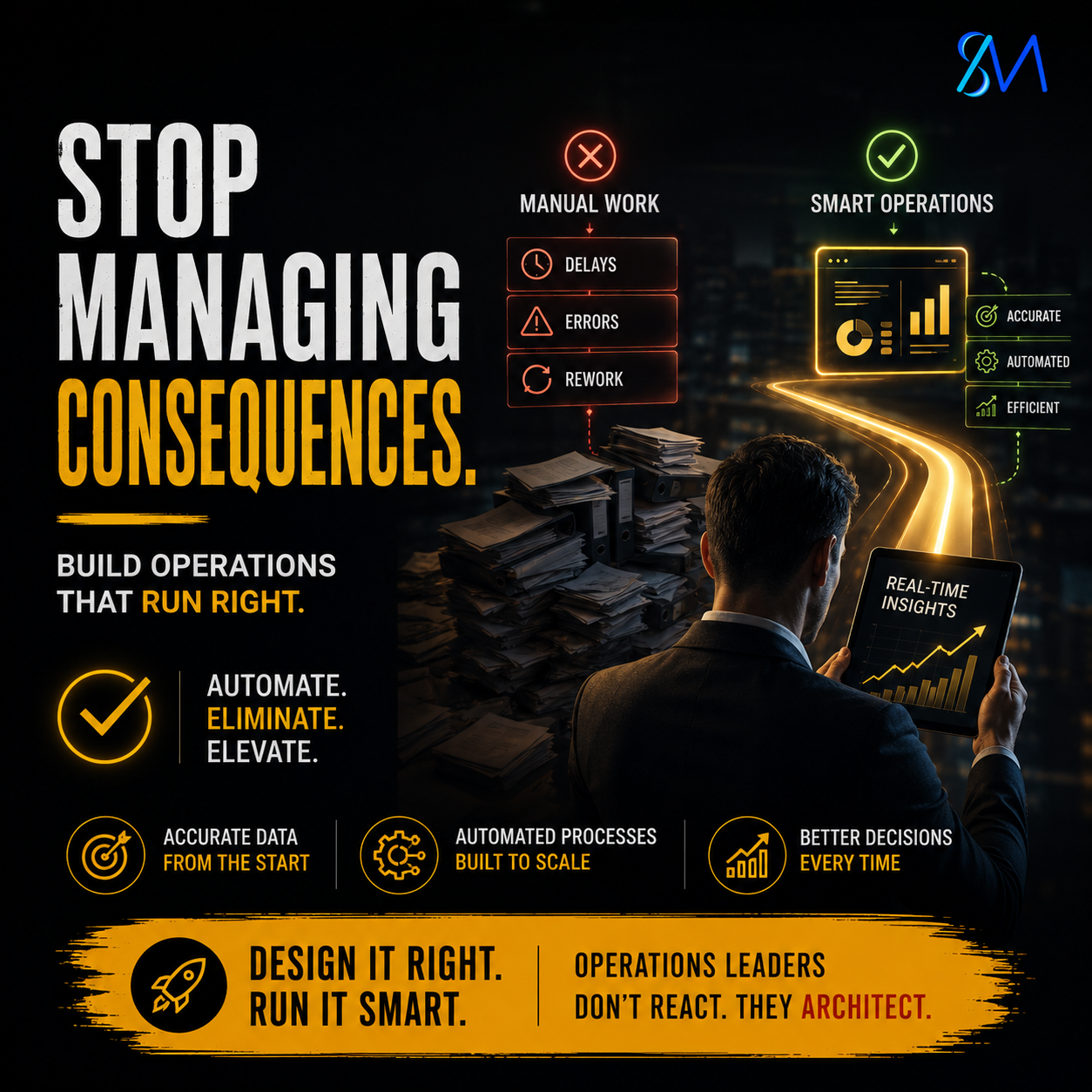
The Hidden Cost of Manual Data Entry: A CFO’s Guide to Calculating Operational ROI Leakage

abitha
August 6, 2026 · 9 min read

Every enterprise operations leader we have worked with can describe the moment precisely. A record gets keyed into the ERP system, then keyed again into the CRM, then keyed a third time into a finance spreadsheet because the two systems were never designed to talk to each other. Nobody scheduled this. Nobody approved it as a process. It simply became the way work gets done, one correction at a time, until it was invisible enough to stop questioning.
The cost of manual data entry rarely shows up as a line item a CFO can point to in a board deck. It is absorbed quietly into headcount that never gets scrutinised, into the extra hour a controller spends before a leadership review, into the customer escalation that traces back to a field that was typed incorrectly three systems ago. Across the 500+ enterprise engagements we have delivered, operational ROI leakage from manual data entry is one of the most consistent and least measured drains on a technology budget.
This blog sets out how to calculate that leakage in terms a CFO and a COO will both recognise, why the problem persists even inside well-resourced organisations, and what it takes to eliminate manual entry at the architecture level rather than manage it forever with more process.
Why Manual Data Entry Survives Inside Well-Run Organisations
It would be easy to assume manual data entry is a symptom of under-investment. In our engagements, the opposite is usually true. The organisations carrying the heaviest manual entry burden are often the ones that have invested the most in point solutions over the years, an ERP here, a CRM there, a finance platform layered on top, each one selected for a specific department’s needs and none of them built with the others in mind.
Every one of those platforms was evaluated on its own feature set. Almost none of them were evaluated on what would happen at the seams between them. That is where manual entry is born. A sales team closes a deal in the CRM. Finance needs that data in the ERP to invoice correctly. Operations needs a subset of it in a project tracker to plan delivery. Without an integration layer connecting these systems, a person becomes the integration layer, and a person is the least reliable, least scalable, and most expensive way to move data between systems that were designed to exchange it automatically.
In our engineering reviews, we consistently observe that this pattern compounds over time rather than staying flat. Each new platform added to the stack creates new seams, and each new seam creates a new manual entry point, until an operations team that started with two systems and one re-entry step is running six systems with a dozen re-entry steps, most of them undocumented, all of them owned informally by whoever happened to notice the gap first.
The organisations that eliminate manual entry successfully do not start by asking which tool to buy. They start by asking which manual step disappears, who owns it today, and what it costs the business every single month it continues.
The Five Rules Operations Leaders Use to Calculate the Real Cost
Across our delivery work, the operations leaders who successfully build the business case for eliminating manual entry apply the same five rules before any platform conversation begins. These rules turn a vague sense that “data entry is a problem” into a number a CFO can act on.
| Rule | What It Measures | Why It Matters |
|---|---|---|
| Map every manual entry point | Each retyped field, export, or copy paste step across the operation | Each one is a process gap, not a workflow step, and gaps compound |
| Track failure signals | How often data moves between systems by hand rather than automatically | Retyping is not efficiency, it is a signal the integration layer is missing |
| Assign one data owner per source | Which team owns the authoritative version of each data type | One version, zero debate, and no reconciliation cost later |
| Validate at input, not downstream | Where errors are caught in the data lifecycle | Errors caught downstream cost roughly ten times more to fix than at entry |
| Calculate the true monthly cost | Team hours spent correcting, reconciling, and re-entering data every month | Most operations leaders have never actually run this calculation |
That last rule is the one that changes the conversation inside most organisations. Once a controller or operations lead sits down and actually totals the hours spent correcting records, reconciling exports, and manually bridging systems that should already agree, the number is almost always larger than anyone expected, and it is recurring, not one time. A single senior team member spending four hours a week on manual reconciliation is not a four hour problem. Multiplied across a year, across every team member absorbing a version of the same gap, it becomes a six figure operational cost that never appears anywhere in a budget review because no one ever wrote it down as a line item.
The gap is rarely where it first appears. Most operations leaders who take the ERP Fit Quiz find the real friction point is one layer deeper than where they have been looking.
See Where Your Operations Actually Stand, 2 Minutes
→ Speak with Our Team
How SuperBotics Approaches Eliminating Manual Entry at the Source
Once the cost is quantified, the instinct in most organisations is to buy another tool to manage the exceptions manual entry creates. We take the opposite position. Our engagements begin with a process audit, not a platform recommendation, because the goal is never to make manual entry faster to correct. The goal is to remove the condition that requires it in the first place.
That audit maps every point where data crosses a system boundary today, whether that boundary is between a CRM and an ERP, an ERP and a finance platform, or a spreadsheet that quietly became the unofficial source of truth for one department. For each boundary, we identify what data moves, how often, who currently re-enters it, and what validation exists, if any, at the point of entry. This is the same discovery discipline we apply across our CRM & ERP Integration engagements, where the platform is configured around how the business actually operates rather than the process a vendor assumed the client had.
From there, the architecture work follows a clear sequence. First, we establish a single authoritative owner for each data type, so there is never ambiguity about which system holds the correct version of a customer record, an inventory count, or a financial entry. Second, we build the API orchestration and enterprise integration layer that moves data between systems automatically, replacing the manual bridge with a connection that does not depend on a person remembering to run it. Third, we implement validation at the point of input rather than downstream, catching a malformed record the moment it enters the system rather than three departments later when it has already propagated into a report a leadership team is relying on.
This sequencing matters more than the technology choice itself. Automating a manual step before the underlying data is connected does not remove the exception, it simply produces the same exception faster and at higher volume. We have seen this pattern often enough across enterprise engagements that we treat integration accuracy as a precondition for automation, never an afterthought to it.
The Proof: What Eliminating Manual Entry Actually Delivers
Across our Managed Teams and Enterprise Integration engagements, clients who eliminated manual data entry at the architectural level report the same pattern of outcomes. Our clients achieve a 38% average cost optimisation compared to the equivalent cost of managing the same work manually, and a 98% on-time release rate across the enterprise engagements we deliver, both figures that depend directly on data moving between systems without a human bottleneck slowing the process down.
One finserv client we partnered with reduced manual review time by 45% after we restructured how data moved through their operational workflow, embedding validation and automated data flow into the process rather than layering a reporting tool on top of an unchanged manual step. The result was not simply faster reporting. It was a leadership team that stopped needing to ask whether the number in front of them had been checked twice, because the process that produced it no longer depended on someone checking it twice.
These outcomes are consistent because the underlying principle is consistent. Removing a manual entry point does not just save the hours spent on that step. It removes every downstream hour spent reconciling, correcting, and second guessing the data that step produced. A single eliminated re-entry point can prevent a chain of correction work three or four systems downstream, which is why the ROI on this kind of engagement compounds well beyond the initial time savings a stopwatch would capture.
What SuperBotics Delivers for Operations Leaders Facing This Exact Problem
For organisations carrying this cost today, our delivery model is built around eliminating manual entry permanently rather than managing it more efficiently. We run a discovery and calibration phase in week zero to map every manual entry point and its true monthly cost, followed by an integration and launch phase where the API orchestration, data ownership, and validation architecture goes live, typically within two weeks of engagement start. From week three onward, we move into a deliver and optimise phase where the connected systems are monitored, tuned, and expanded to cover any remaining manual bridges the initial audit surfaced.
Our engineering team of 20 core specialists, supported by more than 120 specialists on demand, brings direct experience connecting ERP, CRM, and finance systems across Salesforce, Zoho, SAP, Microsoft Dynamics, Odoo, and OpenText, alongside the custom API orchestration required when off the shelf connectors do not cover a client’s specific stack. This is not a capability list. It is the exact toolkit required to make the five rules above operational inside a real business, rather than leaving them as a framework on a slide.
The organisations that have already made this shift stopped treating manual entry as a permanent operations tax. They treated it as an architecture decision, made once, that removes a recurring cost every month afterward rather than accepting it as the price of doing business.
The clearest starting point we have seen: know what your operations are actually ready for before deciding what to change.
The ERP Fit Quiz surfaces that picture honestly, no interpretation required.
Manual data entry will keep draining operational ROI for as long as it goes unmeasured. The moment an operations leader calculates the true monthly cost, map every manual entry point against it, and assigns clear ownership to the data that matters, the problem stops being an accepted cost of doing business and starts being a decision waiting to be made.
The organisations that make that decision early do not talk about how much manual work their teams handle. They simply stop needing to.