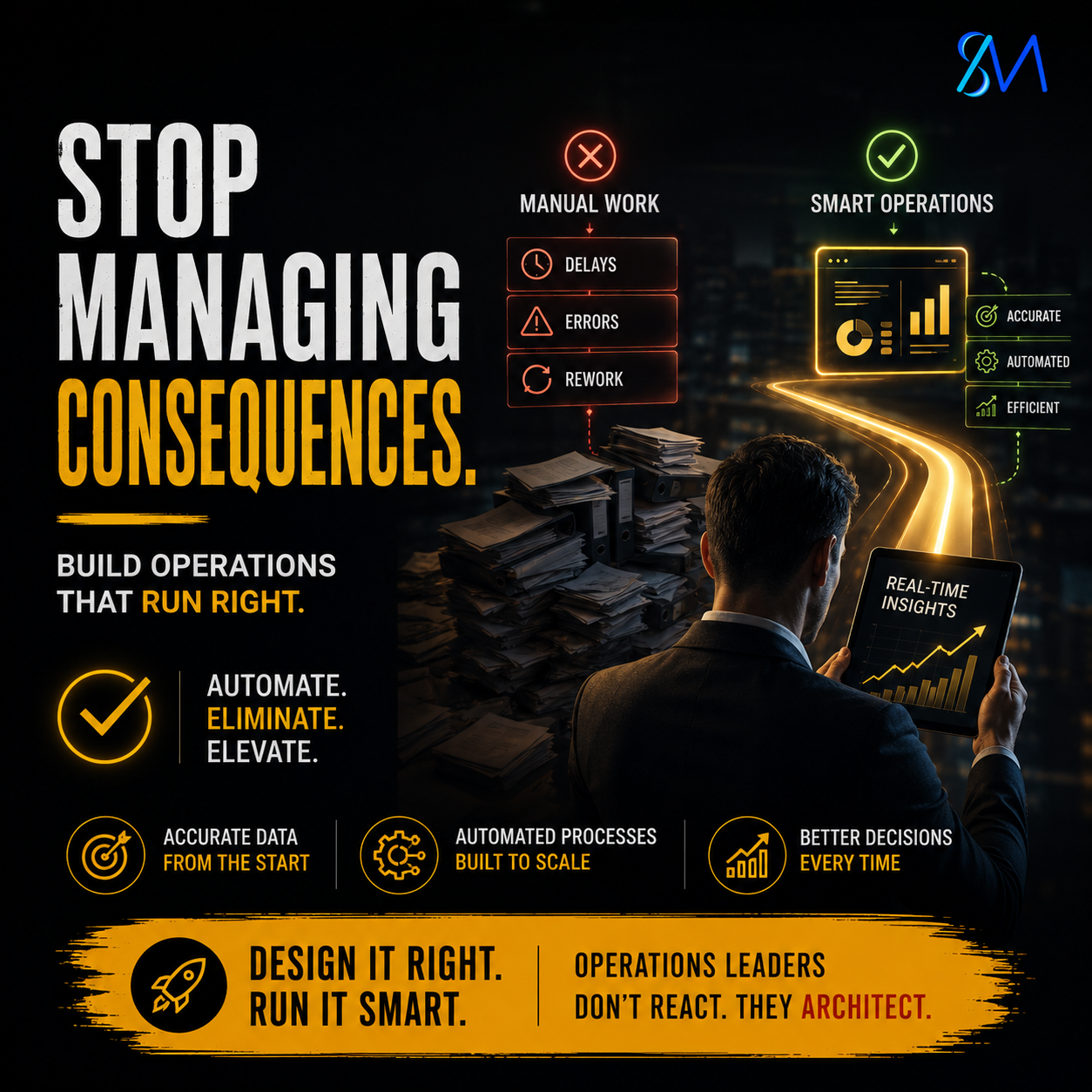


A customer emails asking where their order is. By the time that email lands in a support inbox, the actual damage to the relationship has usually already happened, and it rarely has anything to do with the product itself. It has to do with the silence that preceded the email, the fact that nobody on the operations side reached out first. Across manufacturing and retail operations of every size, we have seen this exact moment define whether a customer relationship survives a disruption or quietly starts looking for an alternative supplier.
The instinct inside most organisations is to treat this as a logistics problem. A shipment ran late. A carrier missed a window. The fix, in this framing, is a better carrier or a tighter SLA. But in our engineering reviews across supply chain and operations engagements, the shipment delay itself is almost never the root cause worth solving. It is a visibility problem wearing a logistics label. The team closest to the disruption typically knows about it hours, sometimes days, before it reaches anyone in a position to communicate with the customer.
That gap between when a disruption is known internally and when it becomes visible externally is where customer trust is actually won or lost. And it is a gap that compounds. Once a customer has experienced finding out about a delay before the business told them, every future interaction carries a small, quiet discount on trust, whether or not the next shipment arrives exactly on time.
Why This Gap Persists Across Well Run Operations
This is not a symptom of a poorly managed operation. Across our supply chain engagements, the organisations facing this pattern most acutely are frequently the ones with mature logistics functions and experienced operations teams. The gap persists because the systems tracking a shipment’s physical movement and the systems managing the customer relationship were built, purchased, and maintained by different teams, at different times, for different purposes, and were never designed to inform each other in real time.
A warehouse management system knows precisely where a pallet sits. A transportation management system knows a carrier’s estimated arrival window. A customer relationship platform knows the delivery promise a sales team made six weeks earlier. Each system is accurate within its own domain. None of them are wired to flag, automatically and immediately, the moment their three separate truths stop agreeing with each other.
The businesses protecting customer trust most consistently are not the ones with the fewest disruptions. They are the ones where a disruption reaches a customer facing decision before the customer has to ask about it.
The result is a structural lag, not a competence gap. A regional operations lead may flag an at risk shipment internally the same morning it happens. But if that signal has no defined path to a customer facing team, and no clear owner responsible for making the call to communicate proactively, it sits in an internal channel while the customer’s own tracking page quietly falls behind reality. By the time an email arrives asking where the order is, the business has already lost the ability to get ahead of the conversation.
How SuperBotics Approaches This
SuperBotics builds supply chain and operations infrastructure that treats this as a single connected problem rather than two separate systems that happen to sit near each other. Our approach begins with mapping the actual signal path inside a client’s operation, tracing exactly how long it takes for a disruption known at the warehouse or transportation layer to reach a person empowered to act on the customer relationship.
From there, our engineering teams connect the systems that track physical movement with the systems that manage customer communication, using API orchestration and custom automation rather than forcing a wholesale platform replacement. In most engagements, the existing warehouse management, transportation management, and CRM platforms remain in place. What changes is the wiring between them, and the defined ownership of who is notified, and empowered to act, the moment a shipment’s status diverges from its promised delivery window.
| Operational Layer | What SuperBotics Connects |
|---|---|
| Physical movement tracking | Warehouse and transportation management systems, in real time rather than batch updated |
| Customer relationship visibility | CRM and customer communication platforms, triggered by the same signal |
| Ownership and escalation | A named owner for proactive communication before the customer has to ask |
This structure is built around three principles that consistently separate operations that protect customer trust from those that lose it. Real time visibility into where a shipment actually stands, rather than where a system last recorded it hours earlier. Clear, single point ownership of who communicates a delay before a customer has to initiate contact. And a review cadence built around what is developing today, rather than a weekly summary of what already happened.
The Proof Behind This Approach
Across our enterprise supply chain and operations engagements, clients maintain a 98% on-time release rate, a figure that reflects not the absence of disruption, but the consistency of how disruption is surfaced and communicated when it does occur. Our engineering reviews consistently show that the shipment delay itself was rarely preventable in the moment. What was preventable, in nearly every case, was the gap between internal awareness and customer facing communication.
This pattern holds across the manufacturing and retail operations we have supported across the US, UK, France, Europe, Brazil, and Asia. The specific disruption varies by industry and by season. The structural fix does not. Connecting the systems that know a disruption is happening with the systems and people responsible for the customer relationship, before the customer has to ask, is the consistent variable behind every engagement where trust was protected rather than eroded.
What SuperBotics Specifically Delivers
For operations facing this exact pattern, SuperBotics delivers connected supply chain infrastructure that surfaces disruption signals before they reach a customer’s inbox, built through API orchestration, enterprise integration, and custom automation across the platforms already in use. This is not a recommendation to replace existing warehouse, transportation, or CRM systems. It is a structural layer that wires those systems together around a single, real time source of truth, with clear ownership assigned for the moment a signal requires customer facing action.
Every engagement is scoped around the specific systems, teams, and customer commitments already in place, and every implementation is measured against a defined outcome, a 98% on-time release rate benchmark, rather than a generic uptime or integration completion metric. This is the difference between technology that exists in the stack and technology that actively protects a customer relationship the moment something goes wrong.
The Path Forward
Customer trust in an operations relationship is never rebuilt with a well written apology email. It is protected by a structure that makes the apology unnecessary, because the customer heard about the disruption from the business, not from their own tracking page falling silent. This is a solvable structural problem, not a permanent cost of scale.
SuperBotics has built this connected visibility layer across manufacturing and retail operations for more than a decade, anchored in delivery data from 500+ successful engagements and a consistent 98% on-time release rate across enterprise clients. The organisations that protect customer trust most reliably are not the ones who never face a disruption. They are the ones who never let their customer find out about one first.