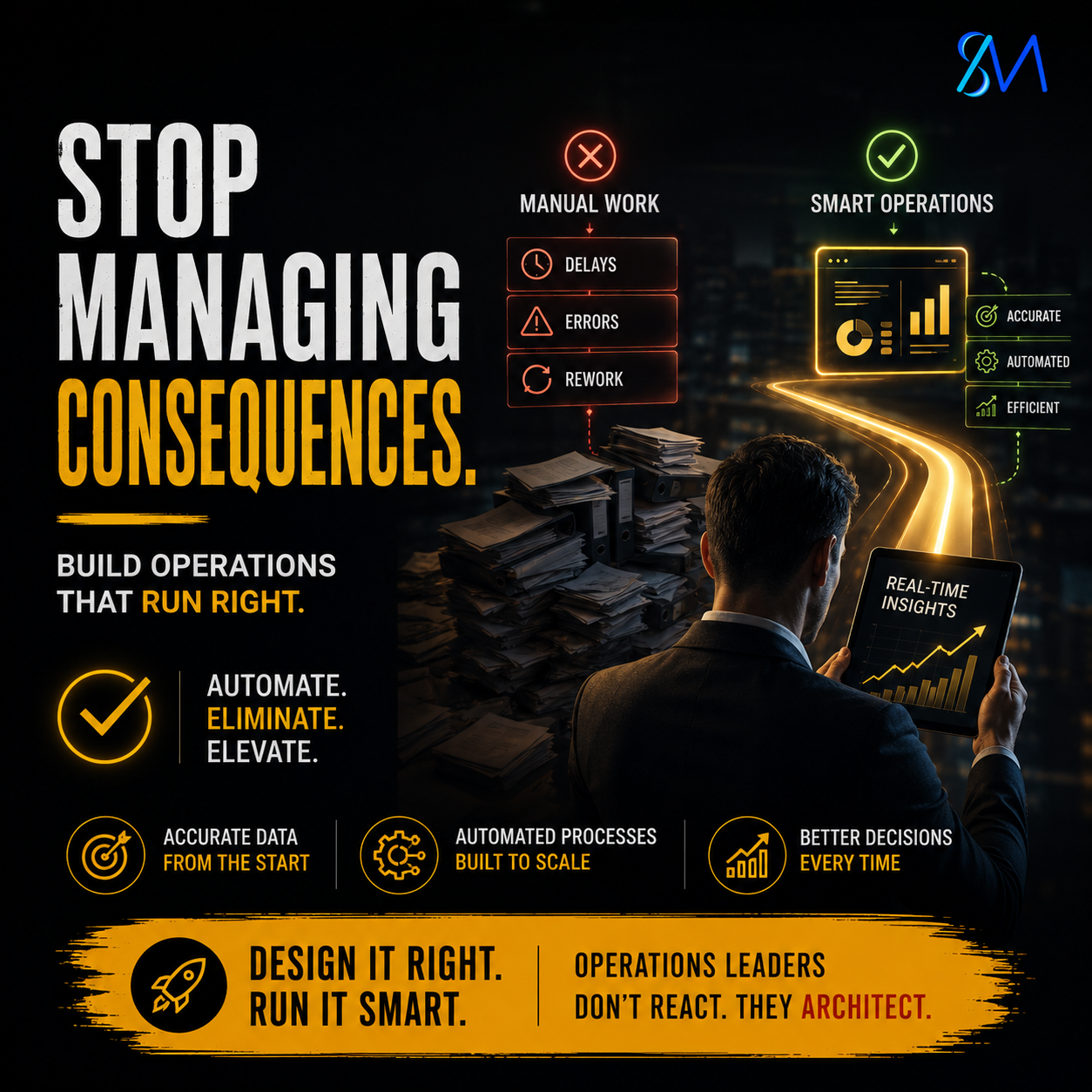
The 5 Real-Time Visibility Myths Causing Your Daily Operational Stress (and the Pragmatic Truths Every Enterprise Leader Needs to Hear)

abitha
May 13, 2026 · 19 min read

Your Organisation Has Data. What It Does Not Yet Have Is Clarity.
There is a particular kind of operational stress that only experienced enterprise leaders understand. It is not the stress of not having enough information. It is the stress of having an abundance of information and still not being able to make a confident, fast, well-grounded decision when the business needs one. You have invested in platforms. You have approved dashboards. You have teams producing reports on a rhythm that was designed to keep leadership informed. And yet, on any given Monday morning, someone is still chasing a number, a decision is still waiting on a call that has not happened yet, and an escalation that should have been visible two weeks ago is arriving on your desk fully formed, urgent, and demanding immediate attention. This pattern is not a failure of investment. It is not a failure of your people. It is the natural output of a visibility architecture that was built around the wrong set of beliefs, and those beliefs have never been named directly until now.
Across more than 500 enterprise engagements and 150 enterprise launches spanning 14 countries, SuperBotics has worked alongside CTOs, COOs, and senior operations leaders who share one consistent characteristic: they are not short on data. Their organisations are, in many cases, producing more operational data than any previous generation of leadership has ever had access to. The problem is structural, not informational. The assumptions layered underneath every dashboard, every reporting cycle, and every visibility investment are quietly ensuring that clarity remains one step out of reach. The technology is doing what it was configured to do. The configuration was built on beliefs that have never been tested against what real operational clarity actually requires. That is the gap this blog addresses, and it is the gap that, once closed, changes how an entire organisation leads.
The five myths below are drawn from direct enterprise delivery experience across financial services, healthcare, retail, and technology organisations. Each one is held sincerely by smart, well-resourced leadership teams. Each one is producing a specific, identifiable cost at the leadership level. And each one has a pragmatic truth attached to it that does not require a platform replacement, a multi-year transformation programme, or a budget conversation that needs to wait until next quarter. The organisations that resolved their daily operational stress did not do so by adding more technology. They did so by changing the beliefs that were shaping how their technology was configured and used. This is what that shift looks like in practice.
The gap is rarely where it first appears. Most operations leaders who take the ERP Fit Quiz find the real friction point is one layer deeper than where they have been looking.
→ See Where Your Operations Actually Stand — 2 Minutes→ Speak with Our Team
Why Smart, Well-Resourced Organisations Still Operate One Step Behind Reality
The most disorienting aspect of operational stress for experienced leaders is that it persists despite significant investment and genuine organisational effort. Boards have approved the infrastructure. Capable implementation teams have delivered the platforms. Reporting cadences have been established and followed. And yet the reactive pattern continues, week after week, quarter after quarter, with enough regularity that many leadership teams have quietly stopped expecting it to change. Understanding why this happens requires looking beneath the technology layer to the architectural assumptions that shaped how the visibility infrastructure was designed in the first place.
Almost every enterprise visibility system is built to answer one question: what happened? The architecture is designed around aggregation, formatting, and distribution of historical data. Reports are generated. Dashboards display what the last data pull captured. Summary views consolidate what multiple systems recorded after the fact. This is a powerful capability for historical analysis and governance reporting. It is a deeply limited capability for real-time operational leadership. The fundamental challenge is that the interval between when a consequential operational event occurs and when that event appears in a scheduled report is precisely the interval in which a leadership decision could have changed the outcome. By the time the report lands, the window has narrowed. By the time the escalation is formatted, the downstream impact is already compounding. The firefighting that follows is not a sign of poor management. It is the natural and entirely predictable output of a visibility system that was designed to look backward and is being asked to support decisions that are inherently forward-looking.
The five myths below are the specific beliefs that sustain this architecture. They feel reasonable because they contain partial truths. They persist because they are rarely challenged directly at the executive level. And they are costing enterprise organisations a measurable and significant amount of leadership capacity, decision quality, and operational velocity every single day.
Myth One: More Dashboards Produce More Clarity
This is the most consistently reinforced belief in enterprise technology investment, and it produces the most consistently disappointing return. The reasoning behind it is straightforward: if we can see more of our operational data, formatted and accessible, we will be better positioned to make informed decisions. The belief is not wrong in principle. The problem is in how it translates into practice. More dashboards do not produce more clarity. They produce a navigation problem layered on top of an interpretation problem, placed on top of a prioritisation problem, all of which sits in front of a leader who already has more demands on their attention than the day allows for.
The organisations SuperBotics has worked with that achieved genuine operational clarity made one consistent structural decision early in their programmes: they reduced the number of views their leadership team was expected to monitor and rebuilt those views from the decision backward. A COO does not need a comprehensive overview of every operational metric the business produces. A COO needs the five signals that tell them whether the organisation is on track, where risk is accumulating before it becomes a problem, and what specifically requires their attention today rather than next week. A CTO does not need seventeen infrastructure panels open across three screens. A CTO needs the architecture health signals, the delivery pipeline status, and the security posture indicator, all in a single governed view, all updated as close to real time as the data sources allow. The shift from dashboard proliferation to decision-centred visibility design is not a technology change. It is a design philosophy change, and it produces a clarity improvement that no additional dashboard has ever matched.
The pragmatic truth is that the number of dashboards an organisation runs is inversely related to the speed and confidence of its decisions beyond a certain threshold. Every new view requires attention, interpretation, and reconciliation with other views. Reducing the surface area of operational visibility and increasing the relevance of what remains is the discipline that produces clarity. SuperBotics begins every operational intelligence engagement by auditing not what data is available, but what decisions are being made, how frequently they are made, and what signals each decision genuinely requires. That decision audit produces a visibility architecture that is smaller, more connected, and dramatically more useful than any accumulation of dashboards has ever been.
Myth Two: Scheduled Reports Accurately Reflect Operational Reality
Scheduled reporting was designed for an era of business where the pace of operational change was slower than the pace of reporting cycles. In that environment, a weekly summary or a monthly board pack captured the state of the business accurately enough for leadership decisions to be grounded and well-informed. That operating environment no longer exists for most enterprise organisations. The pace of operational change, particularly for organisations scaling across multiple markets, managing complex supply chains, or running integrated digital and physical operations, is now faster than any fixed reporting interval can reliably capture. A scheduled report reflects what was true when the data was last extracted. In fast-moving operations, the gap between that moment and the moment the report is read is where the majority of consequential operational events occur.
The specific cost of this myth at the leadership level is the confidence gap it creates. Senior leaders who are operating on scheduled reports frequently find themselves in two distinct and equally uncomfortable positions. The first is the position of receiving information they cannot act on because the window for intervention has already closed. The second is the position of making decisions based on data they know is stale, accepting the risk that operational reality has moved since the report was generated, and absorbing the consequences when it has. Neither position reflects what leadership at this level is capable of when it is supported by the right architecture. Both positions are the entirely predictable output of a visibility system that delivers information on a fixed schedule to an operational environment that moves continuously.
The pragmatic truth is that operational reality is not a document. It is a continuous state. The visibility architecture that enables confident, fast, well-grounded leadership decisions is one that surfaces signals as they emerge from the operational environment, not as they are formatted, approved, and distributed. This does not require rebuilding data infrastructure from scratch. It requires connecting the data sources that already exist within the enterprise environment and designing the flow of information around when decisions are actually made, not when reports are traditionally generated. SuperBotics has delivered this architectural shift for enterprise clients without a single infrastructure replacement programme. The data was already there. The connection was the work.
Myth Three: Operational Firefighting Is Simply What Growth Looks Like at Scale
Of all five myths, this one carries the greatest long-term organisational cost. It does so not because it is the most technically damaging, but because it is the most psychologically embedded. When firefighting is normalised as a feature of scaling, as a sign that the business is moving fast and the team is capable enough to handle the pace, organisations stop looking for the structural resolution. Leaders adapt their working patterns around the firefighting. Teams build informal workarounds that compensate for the visibility gap. The reactive culture becomes the operating culture, and the assumption that this is simply how enterprise growth feels at scale becomes fixed and largely unexamined.
The organisations that resolved their daily operational stress without slowing their growth rate share one consistent structural characteristic: they invested in surfacing signals earlier. Not more signals. Not faster reports. Earlier signals. The specific value of an operational intelligence layer designed to detect and flag before escalation is not that it reduces the amount of information a leadership team has to process. It is that it changes when in the operational cycle that information arrives. When the signal arrives before the problem has compounded, a leadership team has the full range of options available to it: address the root cause, redirect resources, adjust the plan, or deliberately accept the risk. When the signal arrives as an escalation, the option set has already narrowed to reactive management. The output looks like firefighting. The input was a visibility architecture that did not surface the signal early enough.
The pragmatic truth is that growth at scale does not require more firefighting. It requires earlier signals and a visibility layer designed to deliver them. SuperBotics clients who implemented operational intelligence architectures with AI-assisted signal detection have achieved fourfold faster insight cycles. That result reflects not just a technology deployment, but a fundamental shift in when consequential operational information reaches the people positioned to act on it. The firefighting did not stop because the business slowed down. It stopped because the architecture started working in service of decisions rather than in service of reporting.
Myth Four: Real-Time Visibility Requires a Major Infrastructure Overhaul
The investment required to achieve real-time operational visibility is almost always overestimated at the outset, and this overestimation is itself one of the most consequential barriers to achieving it. When the resolution to a persistent operational problem is perceived as requiring a multi-year infrastructure programme, a significant capital commitment, and an organisational change effort that competes with active delivery priorities, the decision to proceed gets deferred. The problem continues. The cost of the problem accumulates. And the belief that the resolution requires a major overhaul becomes self-reinforcing because the organisation never reaches the point of finding out whether that belief is accurate.
In practice, across SuperBotics engagements with enterprise clients spanning financial services, healthcare, and global retail, the data sources required to build meaningful real-time operational intelligence are already present in almost every enterprise environment. ERP systems, CRM platforms, project management tooling, cloud infrastructure monitoring, financial reporting systems, and customer experience platforms are all producing operational data continuously. The gap is not in the production of that data. The gap is in the integration architecture that connects those sources into a unified, governed, decision-ready intelligence layer. That integration and design work is a fraction of the effort and cost associated with infrastructure replacement, and it produces a visibility capability that a new infrastructure would not automatically deliver without the same integration and design discipline applied on top of it.
The pragmatic truth is that the architecture for real-time operational clarity is available in almost every enterprise environment right now. SuperBotics approaches every operational intelligence engagement with a connectivity-first principle: understand what data already exists, map the integration points that connect it, design the governance layer that ensures its reliability and security, and build the intelligence surface that delivers it in a decision-ready format. This approach has produced operational intelligence capabilities for enterprise clients across 14 countries without a single rip-and-replace infrastructure programme. The investment is real. The scale of that investment is a fraction of what most executives expect before they have seen the methodology.
Myth Five: Adding AI Tools to Existing Visibility Architecture Resolves the Clarity Problem
The rapid growth of the enterprise AI market has produced a new version of an old visibility myth. The belief that deploying an AI layer on top of an existing reporting architecture will resolve the clarity gap is now among the most common drivers of AI investment decisions at the enterprise level. It contains a genuine truth: AI applied to operational data is capable of detecting patterns, surfacing anomalies, and generating insights at a speed and scale that no human analyst team can match. The myth is not in the capability of the technology. The myth is in the assumption that the technology alone resolves the underlying architectural problem.
An AI tool applied to a reporting architecture still produces reports, at higher speed and at greater volume, but reports nonetheless. Intelligence without a decision framework still produces data without direction. An AI model trained on historical operational data will surface patterns and predictions with impressive technical sophistication, but if the architecture it sits on top of is designed around reporting rather than around decisions, the output of that sophistication will arrive in the same formatted, distributed, interval-based way that the reports it is augmenting arrived before it. The speed of the insight will have improved. The relevance of the insight to the decision being made at the moment it needs to be made will not have changed.
The pragmatic truth is that AI produces its highest and most sustainable value when it is embedded into a visibility architecture that has already been designed around decisions. When the signals have been defined, when the data sources are connected, when the governance model ensures that AI outputs are reliable and auditable, and when the delivery layer is designed around how leadership teams actually decide rather than how they theoretically should, the AI layer accelerates the entire cycle from signal to decision with measurable and repeatable results. SuperBotics enterprise AI clients have achieved 82 percent automation coverage and 4x faster insight cycles. Those results did not come from the AI capability in isolation. They came from the combination of AI capability and a well-designed, well-governed operational intelligence architecture that was built to receive and act on what the AI was producing.
The SuperBotics Approach to Operational Intelligence: Built for How Leadership Teams Actually Decide
SuperBotics approaches real-time operational visibility as a combined strategy and engineering programme, and the starting point is always a decision audit rather than a technology audit. The first question in every engagement is not which systems the client is running or which data sources are available. The first question is: what decisions does each member of the leadership team need to make, at what frequency, with what level of confidence, and what signals does each of those decisions require to be made well? That decision map becomes the architecture blueprint. Every integration, every data connection, every governance rule, and every intelligence surface in the programme is designed to serve that blueprint rather than to maximise data volume or platform capability.
The delivery is structured, fast, and governed from day one. Cross-functional pods, drawn from SuperBotics’ network of more than 120 specialists with an average of seven years of enterprise delivery experience, are onboarded and delivering within 10 business days. The team structure combines data engineers, AI model specialists, integration architects, and governance leads, all working within a delivery model that includes shared velocity dashboards, outcome-linked accountability, and quarterly value reviews that connect technical delivery to business outcomes. Every engagement is fully aligned to the client’s existing compliance environment, including GDPR, CCPA, HIPAA, SOC 2, and ISO 27001 standards, and intellectual property is assigned to the client as standard in every agreement. The programme is designed to produce visible, measurable improvements to operational clarity within weeks, with a governance framework that ensures those improvements compound over time rather than degrading as the organisation grows.
The outcomes this approach has delivered have been validated across more than 500 projects and a 12-year enterprise technology track record. A financial services client achieved 45 percent reduction in manual review time through AI-assisted operational processes. Enterprise clients across industries have achieved 82 percent automation coverage. Insight cycles have accelerated fourfold. Teams operating on the operational intelligence layer SuperBotics builds have consistently shifted from reactive management patterns to proactive, signal-based decision-making, not because they became better managers, but because the architecture they were working with finally gave them what they needed at the moment they needed it.
What SuperBotics Specifically Delivers for Enterprise Leaders Ready to Close the Clarity Gap
For executive teams navigating daily operational stress, SuperBotics delivers the operational intelligence layer that converts the data already present in the enterprise environment into decision-ready signals, governed, connected, and designed around how the leadership team actually operates. The engagement begins with a structured discovery process that maps existing data sources, current decision workflows, and the specific visibility gaps that are producing operational friction at the leadership level. From that foundation, an integration architecture is designed to connect existing systems without requiring infrastructure replacement, applying data quality and governance standards at every connection point to ensure that the intelligence layer produces reliable, auditable, and actionable output.
The AI and analytics layer is then engineered to surface signals before escalation, with predictive and pattern-recognition capabilities embedded into the operational intelligence architecture rather than added as a separate tool. Platform coverage spans OpenAI, Google Gemini, Azure AI, Anthropic Claude, Amazon Bedrock, LangChain, and LlamaIndex, with the selection driven by what best serves the decision architecture rather than by platform preference. Cloud architecture across AWS, GCP, Azure, and DigitalOcean supports the infrastructure layer, with FinOps governance, autoscaling, and zero-trust security frameworks applied as standard. CRM and ERP integration capabilities, including Salesforce, Zoho, SAP, Microsoft Dynamics, and Odoo, extend the operational intelligence layer into the customer and financial data domains where some of the highest-value decision signals are generated. The result is not a set of tools. It is a unified operational intelligence capability, connected across the enterprise technology estate, governed to the standards the client’s compliance environment requires, and designed around the decisions that matter most to the leadership team.
Clarity Has Always Been Available. The Architecture Is the Work.
The organisations that resolved their daily operational stress did not find a more powerful dashboard. They did not replace their infrastructure or wait for a platform vendor to solve the problem on their behalf. They changed what they believed visibility actually required, and then they built to that standard. The five myths examined in this blog are not obscure technical misunderstandings. They are the architectural assumptions of most large enterprises operating today, held sincerely by capable and experienced leadership teams, sustained by the reasonable-sounding logic that more data, more dashboards, and more tools will eventually produce the clarity that fewer, better-connected, decision-centred intelligence systems already deliver.
The pragmatic truth, drawn from 14 countries, 500 plus enterprise engagements, and a 12-year track record of operational intelligence programmes, is that real-time visibility does not require rebuilding what already exists. It requires connecting what already exists, designing it around decisions rather than reports, surfacing signals earlier in the operational cycle, and applying intelligence that converts volume into direction. That is a design and engineering challenge. It is not an infrastructure replacement. It is not a multi-year transformation. It is a focused, governed, outcome-linked programme that produces visible clarity improvements within weeks and compounds those improvements as the organisation grows.
The executives who stopped firefighting and started leading from a position of real operational clarity share one foundational insight: the data was always there. The architecture was the work. SuperBotics builds that architecture, and has done so for 150 enterprise launches across the industries and geographies where the pressure on operational clarity is highest. The clarity that leadership teams across those organisations were seeking was available the entire time. The beliefs standing between them and it simply needed to be named, examined, and replaced with something more accurate, more useful, and more aligned with what confident enterprise decision-making actually requires.
The decision to close the visibility gap is the decision that changes how the organisation leads. Every week that gap remains open is a week of leadership capacity directed at firefighting rather than strategy. For enterprises ready to build the operational intelligence layer that resolves this, the path forward starts at superbotics.com.
Visit SuperBotics MultiTech: superbotics.com
The clearest starting point we have seen: know what your operations are actually ready for before deciding what to change.
The ERP Fit Quiz surfaces that picture honestly — no interpretation required.