The Executive’s 7-Step Guide to Maintaining Ironclad Operational Control During System Migrations

Abitha Jeyaraj, Marketing Executive
July 16, 2026 · 5 min read
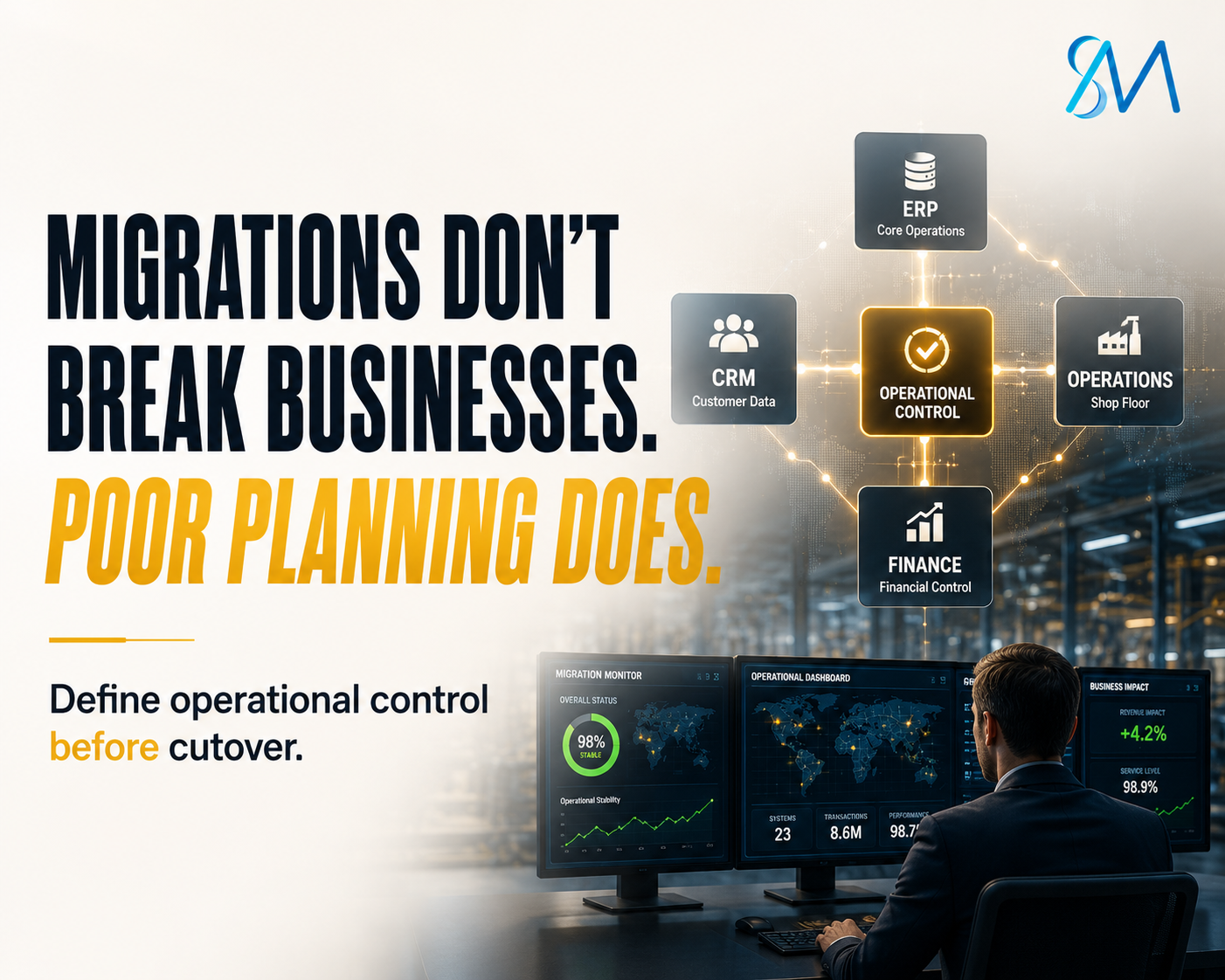
Most executives discover the operational cost of a migration after it has already been absorbed.
The escalations arrive. The reconciliation gaps appear. A quarter underperforms without a clear explanation. By the time the connection is made to the transition, the project has been closed and the team has moved on. The operational disruption has become a sunk cost with no owner and no post-mortem that identifies the structural gap that produced it.
In our work across 150+ enterprise launches, the operational cost of migration is almost never caused by technical failure. It is caused by the absence of a governance framework that treats operational continuity as a primary delivery commitment — before the first cutover window opens.
The gap is rarely where it first appears. Most operations leaders who take the ERP Fit Quiz find the real friction point is one layer deeper than where they have been looking.
→ See Where Your Operations Actually Stand — 2 Minutes→ Speak with Our Team
The 7-Step Framework for Ironclad Operational Control During Migration
The organisations that navigate major system transitions without operational disruption apply a consistent governance sequence. Each step addresses a specific failure mode that we observe in migrations that produce post-go-live recovery periods.
Step 1: Define operational stability before technical delivery begins. Stability is not a technical metric. It is an operational one — measured in decision cycle time, escalation volume, data reconciliation accuracy, and customer-facing performance. Organisations that define this before the project kick-off have a target. Those that define it after go-live are measuring damage.
Step 2: Map every business decision that depends on system data, and rank by time-sensitivity. Supply chain calls, financial reconciliation, customer service escalations, pricing reviews — each has a data dependency and a decision window. Knowing which ones cannot tolerate a 24-hour data lag before the transition begins is what allows the continuity layer to be designed specifically enough to be effective.
The organisations that navigate migration without disruption design their continuity layer before go-live — not in response to the first incident after it.
Step 3: Build a reporting layer that functions independently of the new system’s go-live status. This is the single highest-impact governance decision in any migration. Leadership should have a guaranteed data source for time-sensitive decisions throughout the transition window — one that does not depend on the new system having proven stable.
Step 4: Assign a named owner for operational continuity who is separate from the technical project lead. Across our 500+ successful project engagements, this separation consistently distinguishes transitions that absorb business disruption from those that do not. When one person carries both accountabilities, technical complexity reliably crowds out business continuity oversight.
Step 5: Assess change absorption capacity before the cutover window opens. The operational teams who will be running the new system are not a neutral delivery surface. They have existing workload, existing cognitive load from the change process, and defined limits on what they can absorb simultaneously. A change absorption assessment before cutover is not a people management exercise. It is a risk quantification exercise with direct implications for go-live timing.
Step 6: Define the difference between a technical incident and an operational one — and create separate response paths for each. A system alert and a business escalation require different owners, different resolution timelines, and different communication paths. Organisations that merge these create a response bottleneck precisely when speed matters most.
Step 7: Set operational stability criteria with a defined review point at 30, 60, and 90 days post-go-live. Migration risk does not end at cutover. It extends through the period when teams are building confidence in the new system, workarounds are being identified and resolved, and the reporting layer is being transitioned to the primary system. Structured operational reviews at 30, 60, and 90 days are what transform a successful go-live into a confirmed operational outcome.
What SuperBotics Builds Into Every Migration Engagement
SuperBotics engineers the governance layer that most migration projects treat as a project management afterthought. Our cross-functional pods — combining engineering, QA, DevOps, and operational design — are onboarded within 10 business days and build the continuity framework alongside the technical delivery plan from week one.
| Migration Phase | SuperBotics Governance Output | Business Outcome |
|---|---|---|
| Pre-transition | Decision data mapping and continuity layer design | Leadership has guaranteed data sources before cutover |
| Cutover window | Independent reporting layer, named continuity owner | Business decisions not dependent on new system stability |
| Post-go-live | 30/60/90-day operational review cadence | Stability confirmed in operational terms, not technical |
Our 98% on-time release rate across 500+ projects reflects delivery discipline. Our 6.8-year average client partnership tenure reflects what happens to the business after the release — the operational outcomes that make organisations return for the next transition rather than approach it with caution.
The Migration Your Business Needs Is One That Ends With Better Operations, Not Recovered Ones
Risk-averse leadership is not a barrier to major system transitions. It is the quality that makes transitions successful, when the governance framework matches the level of care that leadership brings to the decision. The seven steps above are not theoretical — they are the sequence we have refined across enterprise manufacturing, retail, financial services, and technology clients who approached their migrations the same way: with the expectation that the business should run better afterward, not merely survive the transition.
The organisations that achieve that outcome are the ones who defined what “better” looks like before the project began.
Preparing for a major system migration and want a governance framework built around your operational outcomes?
SuperBotics works with enterprise technology and operations leadership to design migrations that deliver confirmed operational stability — not just technical go-lives.
Start the conversation with SuperBotics →
Ready to solve this for your organization? Visit SuperBotics MultiTech to see how our team can help.
The clearest starting point we have seen: know what your operations are actually ready for before deciding what to change.
The ERP Fit Quiz surfaces that picture honestly — no interpretation required.