The Three Hidden Causes Keeping Operations Teams Stuck In Firefighting Mode

Abitha Jeyaraj, Marketing Executive
July 20, 2026 · 8 min read
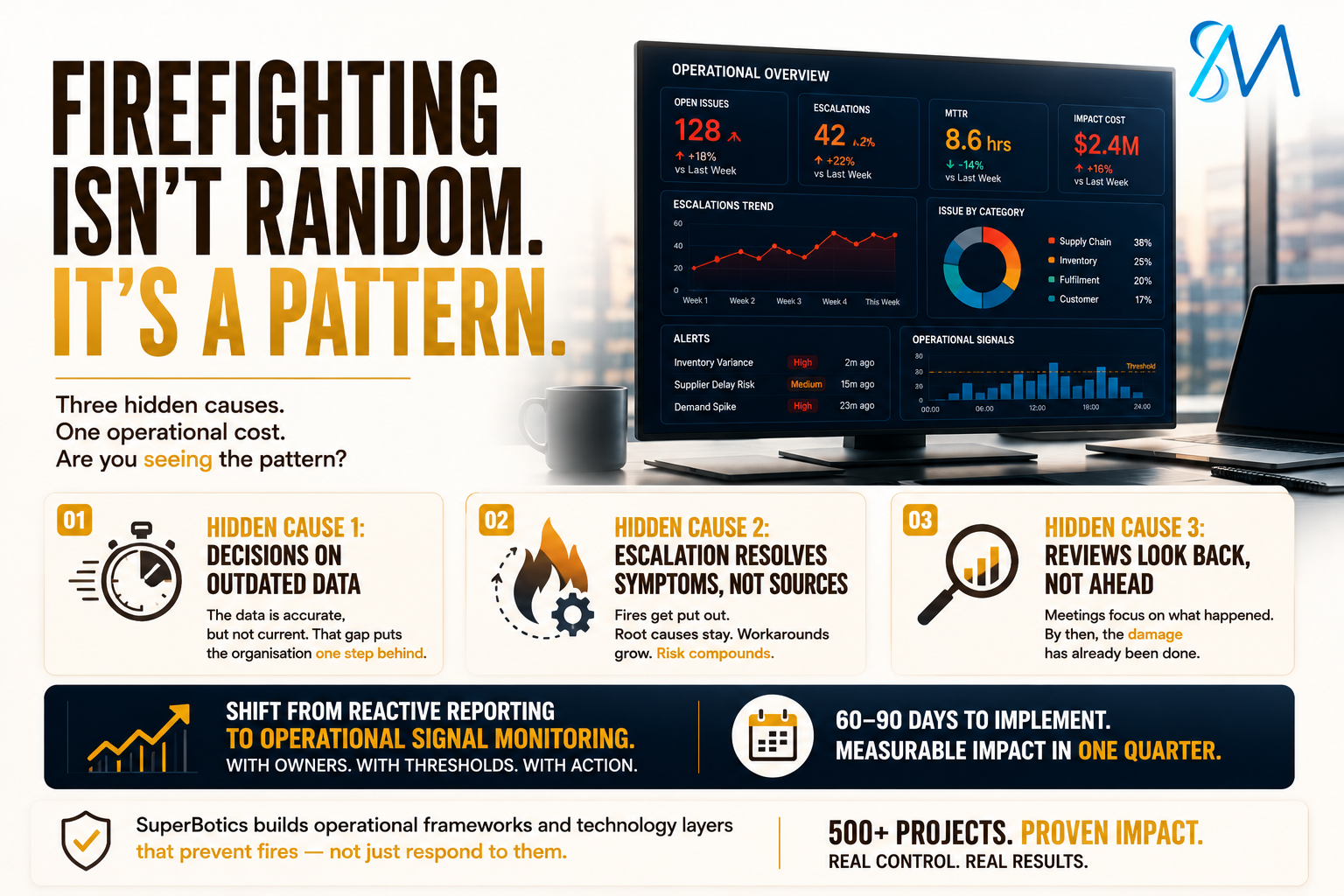
Operational firefighting rarely starts with a single dramatic failure. For most manufacturing, retail, and logistics leaders managing operational efficiency, it starts with three conditions that build quietly for months before anyone in leadership recognises the pattern for what it is. By the time it is visible on a leadership dashboard, the organisation has usually been absorbing the cost of it for a full quarter or more.
This matters because the instinct inside most operations teams is to treat firefighting as a resourcing problem. Add headcount, add tooling, add another layer of review. Across our enterprise engagements, that instinct is almost always misdirected. Firefighting is not a symptom of an understaffed team. It is a symptom of a system that was designed to react rather than anticipate, and no amount of additional staffing changes that underlying design.
The Three Conditions That Precede Every Firefighting Cycle
The first hidden cause is decision making built on data that is accurate but not current. This distinction matters more than it sounds. Teams operating in this condition are not working from bad information. They are working from information that was correct forty eight hours ago, and in fast moving operations, that gap is enough to put the organisation permanently one step behind whatever is actually happening on the floor.
The gap is rarely where it first appears. Most operations leaders who take the ERP Fit Quiz find the real friction point is one layer deeper than where they have been looking.
→ See Where Your Operations Actually Stand — 2 Minutes→ Speak with Our Team
The second hidden cause is escalation paths built to resolve symptoms rather than sources. Every fire that gets raised does get put out, which is precisely why the underlying condition survives. Operations teams build informal workarounds to compensate, and those workarounds become invisible to leadership right up until the moment they fail under load, usually during the exact peak period when failure is most expensive.
The third hidden cause is a review cadence structured around what already happened rather than what is currently developing. A weekly operations review built entirely on last week’s data is not designed to prevent this week’s escalation. It is designed for accountability after the fact, which has its place, but it cannot substitute for early detection.
By the time an issue appears in a scheduled review, it has already cost the business something. The meeting cadence was never built to catch it earlier.
Why These Three Conditions Compound Instead of Staying Isolated
None of these three conditions operate independently inside a real operation. Lagging data delays detection. Delayed detection forces teams to resolve symptoms because the source is no longer visible by the time anyone notices. And symptom driven resolution generates informal workarounds that get folded into review cadences built for accountability, not early signal detection. Each condition reinforces the next, which is why firefighting operations tend to stay firefighting operations without a structural intervention.
How the Pattern Typically Shows Up Across Operating Functions
| Operational Function | Typical Symptom | Underlying Hidden Cause |
|---|---|---|
| Inventory and supply | Repeated stockouts despite forecasting tools | Data accurate at capture, stale by decision time |
| Customer escalations | Same complaint categories recurring monthly | Escalation paths resolve symptoms, not sources |
| Production scheduling | Weekly reviews show issues after cost is incurred | Review cadence built on lagging, not developing, data |
How SuperBotics Approaches the Shift From Firefighting to Signal Monitoring
In our engineering reviews across five hundred plus delivered projects, the organisations that move from constant firefighting to proactive operational control make one specific structural change. They shift from reactive reporting to operational signal monitoring, with defined owners assigned to each signal category and clear response thresholds set before an incident occurs, not during one.
This shift begins with an audit that separates incident resolution from pattern elimination, treating them as two distinct operational processes rather than one blended function. Incidents get resolved through the existing escalation path. Patterns get redesigned through a separate process with its own ownership, timeline, and success measure. Most organisations we assess only have infrastructure for the first of these two processes, which is precisely why the same categories of fire keep recurring quarter after quarter.
Moving Data Closer to the Decision Point
The second structural element is moving operational data closer to the point of decision, rather than routing it through layers of analyst interpretation before a leader can act. Visibility tools that require translation before action create a response lag that keeps operations reactive by design, regardless of how sophisticated the underlying data collection is. The objective is signals reaching the right person with enough time remaining to act, not simply signals reaching a dashboard.
The review cadence itself also has to be redesigned around what is currently developing rather than what has already occurred. This does not mean discarding weekly leadership reviews. It means supplementing them with a signal layer that surfaces developing conditions in real time, so the weekly review becomes a forum for structural decisions rather than the first place an emerging problem gets noticed.
The Proof Behind This Structural Shift
Across our enterprise operations engagements, organisations that move through this reactive to proactive framework see a measurable reduction in operational escalations within ninety days, with the full shift typically taking sixty to ninety days to implement from audit through to a functioning signal monitoring layer. This is consistent with what we have seen across five hundred plus delivered projects spanning manufacturing, retail, and logistics operations across multiple markets.
The technology underpinning this shift is rarely the constraint. The constraint is almost always the operational design surrounding it, specifically whether incident resolution and pattern elimination are treated as one process or two, and whether review cadences are built around historical accountability or developing signals.
Quantifying the Cost Before Proposing the Fix
Operations leaders often sense that firefighting is expensive without being able to name a specific number, and that absence of a quantified cost is usually what stalls the internal case for structural change. Before proposing a signal monitoring layer, it is worth building a simple accounting of what the current pattern actually costs, broken down by the hours senior staff spend resolving recurring incidents each month, the overtime or expedited shipping costs triggered by late detection, and the customer facing consequences of the same complaint categories resurfacing quarter after quarter.
This exercise typically surfaces a number large enough to justify structural investment on its own, without needing to reference industry benchmarks or comparable case studies. It also gives the operations team a baseline against which the ninety day reduction in escalation volume can be measured concretely, rather than assessed on a general sense that things feel calmer. Leadership teams that skip this quantification step tend to under invest in the redesign, because the informal workarounds absorbing the cost of firefighting are, by their nature, invisible on a standard financial report.
Building Internal Alignment Before the Redesign Begins
The audit phase that separates incident resolution from pattern elimination also serves a second purpose beyond diagnosis. It becomes the forum where operations, IT, and finance align on what success actually looks like before implementation begins, which prevents the common failure mode where a signal monitoring layer gets built to specifications that satisfy IT governance but never actually reach the operational leaders who need to act on the signals. Involving the people who currently run the manual workarounds in this audit is essential, since they are usually the first to know exactly where the informal bridges have formed and why.
What SuperBotics Specifically Delivers
SuperBotics builds the operational frameworks and technology infrastructure required to complete this transition, starting with a structured audit of where decisions currently slow down inside your operation, followed by the design of a dual track process separating incident resolution from pattern elimination. We then implement the signal monitoring layer itself, with defined thresholds, named ownership, and outcomes tracked in measurable operational terms from day one, including reduction in escalation volume, improvement in forecast accuracy, and decision cycle time.
This is not a reporting upgrade. It is a redesign of how information reaches the people responsible for acting on it, built specifically around the operating rhythm of your business rather than a generic monitoring template.
Moving From Reactive to Self-Managing Operations
The organisations that eventually eliminate chronic firefighting do not describe the shift as a culture change. They describe it as a design change, one where signal ownership is clearly assigned, real-time data reaches the decision point without translation delay, and review cadences are built around what is developing rather than what has already happened. That design change is deliberate, sequenced, and measurable, which is precisely why it succeeds where broader culture initiatives around accountability and ownership tend to fade after the first two quarters.
SuperBotics partners with operations and technology leadership to build exactly this transition, with outcomes tracked from the first week of engagement rather than assumed at go live. The question worth asking inside your own organisation is which of these three hidden causes is currently the most visible, because that is usually where the redesign needs to begin.
Learn more about how our teams approach operational signal design at superbotics.com.
The clearest starting point we have seen: know what your operations are actually ready for before deciding what to change.
The ERP Fit Quiz surfaces that picture honestly — no interpretation required.